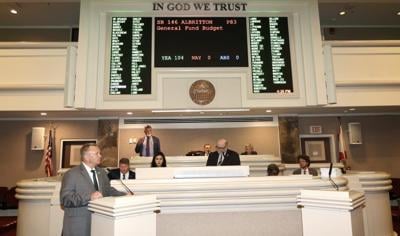
MONTGOMERY, Ala. – The House approved its $3.74 billion version of the General Fund budget on Wednesday with little discussion.
The floor vote came one day after the House Ways and Means General Fund committee approved minor changes from the Senate-passed version. The House version of the budget is $12.6 million higher than the Senate’s $3.72 billion spending bill.
The Senate’s version was $37.1 million higher than what Gov. Kay Ivey sent to lawmakers two months ago.
House General Fund committee Chairman Rep. Rex Reynolds, R-Hazel Green, said the budget is responsible and shows the government is a good steward of taxpayer dollars.
“I am especially proud that even with costs growing across the board, this year’s budget is only growing by 1% compared to fiscal year 2026,” Reynolds said in a statement. “Make no mistake about it—this budget was challenging, and with interest rates dropping and COVID-era funding coming to an end, I expect the next several budgets to present even greater challenges. Now more than ever, we must lean into the same fiscally conservative approach to government that has delivered stability and success, ensuring we continue to meet our obligations while safeguarding taxpayer dollars in the years ahead.”
Lawmakers only made one significant change to the budget on the House floor.
Rep. Donna Givens, R-Loxley, introduced an amendment to give state retirees a one-time, lump sum bonus.
The “longevity bonus” consists of $1 per month of service. That amounts to $300 for someone who worked for the state for 25 years. Lawmakers approved the bonus by a vote of 101-0. The proposed education budget now has a similar bonus for retired teachers.
Some of the largest House changes included $2 million increases for airport development and the District Attorneys Administrative Fund as well as a $1.84 million reduction from the proposed appropriation for the Correctional Facilities Maintenance Fund.
The budget already included $16 million for a cost of living raise for state employees and fully funded the expected increase in their health insurance costs when it arrived in the House.
Lawmakers also had to find $10 million for the first payment due this fall for the Legislature’s new about $400 million State House.





Several state agencies are experiencing slight funding increases in 2027, although some will see small decreases, including the Alabama Department of Mental Health, which will receive approximately $4 million less next year. The House version includes $325,000 more for the Department of Mental Health than the Senate’s version.
Alabama Daily News previously reported the budget also includes conditional appropriations for several agencies, assigning the departments of corrections, human resources and mental health tasks before they receive all of their 2027 funding.
The General Fund’s supplemental budget also includes $387.5 million for the Public Road and Bridge Fund and $200 million for the Rebuild Alabama Fund, both part of the Alabama Department of Transportation. It also increases funds for highway project bond repayment by $59.8 million for a total of $193.5 million. Reynolds said the money would help pay for the West Alabama Corridor.
Along with the budget, the House passed several other funding bills on Wednesday, including ones concerning rural health and domestic violence.
“My number one priority for our state’s budgetary process is ensuring that every dollar of taxpayer money is spent in a manner that positions Alabama for success, and I am proud of our conservative record in doing so,” Speaker of the House Nathaniel Ledbetter, R-Rainsville, said in a statement. “The 2027 General Fund Budget represents the 17th consecutive year that House republicans have funded government responsibly, and I commend Chairman Reynolds and our members for working to place Alabama on a firm financial footing.”
State financial leaders have this session expressed concerns about revenue to support the General Fund budget going forward.
Finance Director Bill Poole previously estimated a 4.2% decline in revenue for FY27, which begins Oct. 1, 2026. The drop isn’t in core revenue streams, Poole said, but instead comes from a sharp decline in interest earned on the state’s deposits.
Interest was not historically a large part of the General Fund’s revenue, between $10 million and $60 million from 2016 to 2022. But since 2023 – when federal pandemic relief funds were distributed to states and sat waiting to be spent – interest earnings have brought in between $400 million and $560 million each year. The current year’s interest revenue is expected to be $374 million. The estimate for 2027 is $124 million, officials said.
The budget now heads back to the Senate where it originated. The upper chamber either has to consider the amendments the House made. If they concur, the budget heads to the governor’s desk. If they do not concur, lawmakers will discuss it in a budget conference committee.
There are four days remaining in the 2026 session.
(0) comments
Welcome to the discussion.
Log In
Keep it Clean. Please avoid obscene, vulgar, lewd, racist or sexually-oriented language.
PLEASE TURN OFF YOUR CAPS LOCK.
Don't Threaten. Threats of harming another person will not be tolerated.
Be Truthful. Don't knowingly lie about anyone or anything.
Be Nice. No racism, sexism or any sort of -ism that is degrading to another person.
Be Proactive. Use the 'Report' link on each comment to let us know of abusive posts.
Share with Us. We'd love to hear eyewitness accounts, the history behind an article.