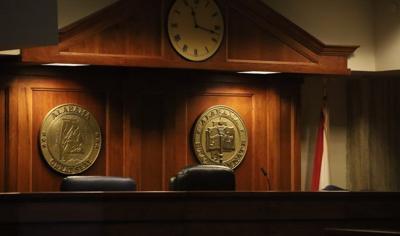
MONTGOMERY, Ala. – After a grinding four months, the Alabama Legislature wrapped up its 2026 Regular Session Thursday with smiles, hugs and shouts of “Sine Die!”
This session – the last one to be held in the current State House – was predicted to be a quiet, election-year affair where lawmakers would do the basics and finish early in order to go back home and campaign. But after unexpected House GOP caucus drama and a surge in conversation about energy prices, the annual session was anything but quiet.
And yet many legislative leaders characterized it as productive one.
After adjournment, House Speaker Nathaniel Ledbetter, R-Rainsville, commended his colleagues for dedicating the time needed to finish the term out strong.
“We passed a lot of good stuff, but also look at the work of this body,” Ledbetter said. “It’s supposed to be a part time job. They probably spend 60 hours a week doing it, certainly when we’re in session, and a lot of folks spend more time than that… For them to stand up and do what they’ve done is to be commended. They should be proud of what they’ve accomplished.”
Thursday’s Sine Die meeting, centered on the Latin phrase meaning with no appointed date to resume, was also nostalgic for many members. These were the last meetings held in the current State House, the former highway department building that was converted into a temporary home for the Legislature more than 40 years ago as the Capitol was being renovated. A new, modern State House is under construction next door.
Some members said they’ll miss the building, while others were more eager to see it come down.
Here’s a look at what passed this session.
Public Service Commission reform
Perhaps the most consequential bill of the session is one that no one was talking about when lawmakers gathered in January. But a month in, the House was rallying support to overhaul the state’s Public Service Commission, changing it from an elected to an appointed body. Pushback quickly mounted against the idea of of appointed utility regulators and that proposal was shelved, but state leaders still wanted to pass something to help rein in energy prices.
While some House members were supportive of legislation requiring formal rate hearings every three years and curtailing utilities’ profits, the end product was a Senate proposal to expand the elected board to seven, create a new cabinet-level secretary of energy and pause rate increases until Jan. 1, 2029.
The legislation allows for formal rate hearings, if the secretary or most commission members call for them. It also mandates less formal annual informational public meetings.
Ivey signed the bill the day after lawmakers passed it this month.
Tax deduction on overtime income
The Legislature again took up a proposal to reduce working Alabamians’ taxes on overtime income.
House Bill 527, sponsored by House Majority Whip Rep. James Lomax, R-Huntsville, will establish an individual income tax deduction of up to $1,000 on Alabamians’ overtime pay per year. Assuming an income tax rate of 5%, the deduction could save Alabamians a maximum of $50 annually.
A House floor amendment from Rep. Mike Shaw, R-Hoover, also added a one time sales tax holiday on groceries to the bill. That holiday will run from May 1 to June 30.
The state first adopted an overtime tax cut, carried by House Minority Leader Anthony Daniels, D-Huntsville, in 2023. That law expired in June of 2025 after its impact on the education budget far exceeded expectations and the House never put Daniels’ proposed permanent extension to a vote.
People can claim the deduction on overtime pay between Jan. 1, 2026 and Dec. 31, 2028.
Environmental rules
State agencies can’t adopt or amend environmental protection regulations more stringent than federal rules according to a new law approved by the Legislature in February and signed by Ivey.
Senate Bill 71 by Sen. Donnie Chesteen, R-Geneva, says that if there is no federal regulation, a new state rule must “be based on the best available science and the weight of scientific evidence.”
Chesteen described the bill as balancing environmental protection and economic development and said the bill doesn’t take away any of the Alabama Department of Environmental Management’s authority to set regulations.
The bill was approved by the Republican supermajority over Democrats’ objections.
“It’s going to help economic development because it’s going to let them do what they want to do,” Senate Minority Leader Bobby Singleton, D-Greensboro, said.
Ambulance reimbursements
The Legislature gave final passage late last month to a bill ambulance providers said was critical to their survival, especially in rural parts of the state. Ivey signed it into law earlier this month.
Senate Bill 269, sponsored by Sen. Bobby Singleton, D-Greensboro, would require health insurers to reimburse ambulance providers a set percentage of the federal Medicare rate and establish coverage when EMS provides care without transporting a patient to a hospital. This is known as “treat in place” coverage that allows EMS to address the medical issue on site and avoid what can be lengthy transport times to hospitals, freeing up the EMS staff for the next emergency.
The law would sunset, unless extended by the Legislature, June 1, 2029.
Budgets
Passing the state’s two operating budgets is the only thing lawmakers are constitutionally required to do each year.
The General Fund budget started in the Senate, and the Education Trust Fund budget started in the House this session. Both chambers concurred on the changes made by the other, making for a smooth budgetary process.
Ivey signed the $3.74 billion General Fund and $10.5 billion Education Trust Fund budgets earlier this week.
The budgets include a 2% cost of living pay raise for teachers and a lump-sum bonus for state retirees.





In addition to typical considerations for funding, both budget chairs had to come up with $10 million for the first payment due this fall for the Legislature’s new about $400 million State House.
Data centers
With the rise of artificial intelligence, an increasing number of data centers are popping up across the country, including in Alabama. The Legislature passed two bills concerning these facilities.
House Bill 399, sponsored by Rep. Leigh Hulsey, R-Helena, reduces tax abatements for large data centers. Starting on Jan. 1, 2027, the exemption period for abatements will be 20 years.
Data centers can earn another 10 years of abatement if they “provide qualified local investments for the benefit of the benefited community.” This includes supporting infrastructure, broadband and education in the affected community.
While lawmakers say they welcome the massive facilities that store electronic data critical to online consumption, they say they do consume a large amount of water and energy and should be treated differently than other industries the state is targeting with its incentives.
Senate Bill 270, by Sen. Lance Bell, R-Riverside, requires data centers, not their neighbors, to pay for the additional electricity they’ll require.
Parole reforms
The Legislature also took up two measures to tweak Alabama’s parole process.
The first expands the criteria the Alabama Board of Pardons and Paroles must review when making parole decisions.
House Bill 86, sponsored by Rep. Chris England, D-Tuscaloosa, mandates that the ABPP consider an inmate’s employment and education while incarcerated. It also requires board members to recognize if an incarcerated person is at low risk to reoffend upon release in their decision.
The second, Senate Bill 254 by Sen. Sam Givhan, R-Huntsville, would give the board more decision-making authority over parole revocations and modify the current law that doesn’t require a conviction to send people back to prison after arrests.
Givhan previously told the Senate Judiciary Committee the measure is needed to give the board more discretion over the revocation of paroles based on the totality of facts. Currently, an arrest is enough for an automatic revocation.
Camp safety
After 8-year-old Sarah Marsh from Birmingham and 26 other campers and counselors were killed in a flood on July 4, 2025, at Camp Mystic in Texas, lawmakers passed a camp safety reform bill.
House Bill 381, known as Sarah Marsh Heaven’s 27 Camp Safety Act, requires overnight camps in Alabama to meet higher safety standards, including creating plans for emergencies and evacuations and procuring emergency preparedness licenses from the Alabama Emergency Management Agency. It also prohibits camps from building cabins in floodplains.
Death penalty for child predators
After law enforcement discovered a child sex trafficking ring involving multiple victims and adult predators in Bibb County last year, the Legislature passed a bill to expand the death penalty for similar situations.
House Bill 41, sponsored by Rep. Matt Simpson, R-Daphne, makes the rape, sodomy or sexual torture of children younger than 12 a capital crime punishable by death.
Gulf renaming
Mirroring an executive order from President Donald Trump, the Legislature approved a bill to rename the Gulf of Mexico to the Gulf of America.
House Bill 2, sponsored by Rep. David Standridge, R-Hayden, would require state and local entities to refer to the body of water to the south of the U.S. as the Gulf of America. It also mandates these entities to “make reasonable efforts” to update old materials to reflect the new name.
Throughout the process, Democrats dismissed the bill as a waste of time and argued the Legislature should have spent its taxpayer-funded time on something else.
App store age verification
As the nationwide conversation about the risks children face online grows, the Alabama Legislature passed a bill to require app stores to verify a user’s age and link parent accounts for minors.
House Bill 161 by Rep. Chris Sells, R-Greenville, will sort children into age categories when they make an account on app stores. If users are under age, guardians would have to set up a linked account to approve the minor to download apps and make in-app purchases. If developers make major changes to apps, parents would also have to reauthorize their children’s usage of them.
The bill also stops app stores from being able to enforce contracts or terms of service agreements against minors without their parents’ permission.
Ivey signed it into law in February.
Mud dumping
In an effort to protect Mobile Bay, lawmakers penned and pushed through early in the session a bill to limit the practice of “mud dumping.”
House Bill 181, sponsored by Rep. Rhett Marques, R-Enterprise, mirrors federal law enacted by U.S. Sen. Katie Britt, R-Alabama, in 2024 that requires the Army Corps of Engineers to use at least 70% of dredged materials for “beneficial use,” including marsh creation, shoreline protection and restoration of eroding coastal habitats.
The bill specifies that beneficial use does not include “the deposition of dredged material into public waters unless that deposition is part of a shoreline restoration or marsh creation project.”
The Army Corps of Engineers, who maintains the bay, previously considered dispersing the dredge materials in the bay a beneficial use, according to lawmakers.

(0) comments
Welcome to the discussion.
Log In
Keep it Clean. Please avoid obscene, vulgar, lewd, racist or sexually-oriented language.
PLEASE TURN OFF YOUR CAPS LOCK.
Don't Threaten. Threats of harming another person will not be tolerated.
Be Truthful. Don't knowingly lie about anyone or anything.
Be Nice. No racism, sexism or any sort of -ism that is degrading to another person.
Be Proactive. Use the 'Report' link on each comment to let us know of abusive posts.
Share with Us. We'd love to hear eyewitness accounts, the history behind an article.