
The city of Marion has secured more than $7 million in grants to start rebuilding their outdated water and sewer system.
The 60-year-old system hasn’t been well maintainedin several decades and residents complain of brown water caused by the old pipes that need replacing.
Marion Mayor Dexter Hinton says it would cost $40 million to completely rebuild the system and the city doesn’t have that kind of cash on hand.
And, until recently, the city hadn’t conducted regular audits, which made it ineligible to apply for grants, he added.
But Hinton said the city is up to date enough on audits that it was able to apply for and receive more than $7 million in grants from sources like ARPA, CDBG, EPA and Rebuild Alabama to go toward the rebuild process.
On July 28, the city of Marion received a letter of approval from the EPA for a $480,000 grant that will be used to replace all the water meters in town with electronically read meters. The project should be bid soon, Hinton said.
Recently the city of Marion became the first in the state to receive a PIN grant through the Institute of Water and Health at Georgia Southern University and the Alabama Water Institute at The University of Alabama. This partnership, funded by Alabama Power Co., pairs Marion with Eastman, Georgia, a town of similar size in Georgia’s Black Belt. Georgia Southern University is nearby in Statesboro.
“A huge benefit is to be able to travel to Eastman to see how they operate their water and sewer systems,” Hinton said. Georgia Southern has gathered data on Marion’s systems.
The idea is to study the problems and formulate a solution that may help other small rural towns across the South, many of which have similar issues with their water and sewer systems.






A problem all over is a lack of water and sewer system operators, according to Hinton. Part of the funding from the PIN grant is helping to train new water and sewer system operators.
“We have three candidates right now training to get their water and sewer license,” Hinton said. “The University of Alabama is providing tutoring, and Georgia Southern is giving them materials they need for the exam.”
So far, Marion has made early progress by repairing lift stations, reopening sludge basins and installing bypass pumps to keep the system working through storms, Hinton said. They also flushed fire hydrants, cleaned out sediment and addressed long-standing environmental hazards like illegal dumping near the city shop.
As to the quality of Marion’s water, the city has brought a second well online to increase water supply, and they’ve added chlorine treatments, according to Hinton. Unlike many cities that get their water from a river, Marion’s water comes from the Gordo Aquifer, an underground source that is already so clean that it doesn’t need as much treatment.
But once the water gets out of the ground, it moves through old iron pipes. If the flow isn’tjust right, especially in the summer, the high iron content can cause the water to be discolored, according to Hinton. The ironisn't harmful, and there are no bacteria, but folks like their water to be clear.
“The goal now is to fully address discoloration by replacing outdated valves, modernizing our filtration systems and upgrading fire hydrants across the city by 2026,” Hinton said.
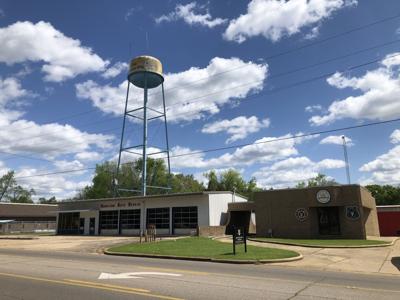
The most visible part of the water system, at least to visitors, are the water towers. And the city is cleaning and repainting the towers, starting with the Washington Street tower.
In about a month, the pump in the Marion Military Institute well will be replaced to double the volume of water it produces.

(0) comments
Welcome to the discussion.
Log In
Keep it Clean. Please avoid obscene, vulgar, lewd, racist or sexually-oriented language.
PLEASE TURN OFF YOUR CAPS LOCK.
Don't Threaten. Threats of harming another person will not be tolerated.
Be Truthful. Don't knowingly lie about anyone or anything.
Be Nice. No racism, sexism or any sort of -ism that is degrading to another person.
Be Proactive. Use the 'Report' link on each comment to let us know of abusive posts.
Share with Us. We'd love to hear eyewitness accounts, the history behind an article.