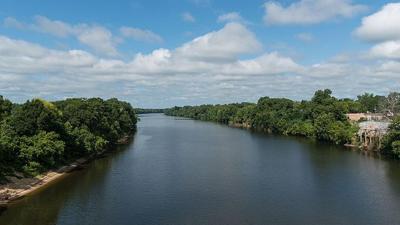
We stood unmoving at the end of the dirt road. I was sure every time that we came here, we were trespassers in some strange and wild world. The primary sound was that of the muddy river slipping over the silt and soapstone down below. The three doors of the Pontiac slamming behind us had closed off that world where we lived. Back there was work and play and – most important – humans.
My daddy, brother and I stood there, seemingly struck mute by the sounds and smell. The dampness was so palpable it could almost be touched. It might seem that we were there to fish, but I know now that it was more than that.
Daddy broke our reverie. “They’re waiting for us,” he’d say. I knew what he meant by they, but what was really waiting for us was our time together on the Alabama River.
Our father would take my brother and me fishing close to where the Alabama and the Cahaba Rivers come together. Daddy owned an outboard motor that could be bolted onto the back of a bent up, old aluminum boat. Those things and a trailer were hooked to the back of our car.
While Daddy and my brother struggled with the motor, I brought the gear down from the back of the car. With the clanging and splashing as my brother and Daddy struggled to get the motor attached, I wondered if there would be any fish within two miles of us. Surely, the noise had scared them all away
“Don't let that thing drop,” Daddy would say. I could imagine the motor slipping out of their hands and sinking, turning from side to side on the way to the bottom of the river. “By Jingo’s!” Daddy would have yelled.
“No problem,” I would think. I’d just dive to the bottom, pick it up and walk out!
They never dropped it. After seven or eight or a dozen pulls, the motor would sputter, smoke and start again.
I usually had all the gear in the boat before they decided it was time to go. I’d tie a burlap sack filled with RCs or Coca-Colas to the side of the boat, dangle my feet in the river and watch the multicolored slick twisting in the water as oil and gas spilled behind the boat.
“Get the anchor, High-Pockets,” Dad would yell to me over the noise of the puttering motor.
The mud would ooze between my toes as I followed the rope to our metal wheel anchor. As we pushed off, I would slosh each foot in the water, pull in the burlap sack, and slip into my place in the sharp bow.
I rode backwards watching Daddy as he gave directions to my brother. My brother was several years older than me. He steered the boat looking around the side of my father as we moved out into the river. But me? I would settle back and try to find a comfortable place for the metal sides of the boat to push into my back. The cold drops of water that we wanted to call spray would fall onto my arms and T-shirt.
Daddy would wave from time to time as other boats sped past us going one way or another. On weekdays, there was a good chance we would see no one.




We would go past the bend in the river where the sides hung over the water. Those rich, black banks and the tree roots exposed on them seemed about to crash into the river. Ripples sloshed against the fragile base of the bluffs as our boat puttered by.
Daddy would point up the river, looking at me. The motor was loud, but he did not yell. I knew he pointed not to show me, but because he wanted to share his pleasure. I turned to look, not because I needed to see, but because he pointed.
The sun was warm on my shoulders as I pulled the T-shirt over my head. I looked up and down the river with the modesty of a boy just entering adolescence. Satisfied, I unbuttoned the jeans and slipped them off my hips. Daddy would grab the sides to hold on as I jiggled the boat while pushing the jeans down. He spoke to my brother and, though I could not hear, I knew what he said. The boat slowed. I watched the water on the floor slosh forward and lifted my feet to slip off the pants.
The quietness of the river would fall over us when the motor stalled, and we glided toward the soapstone banks. I would slip into the water and find a place for our metal wheel anchor. Here would be our bait and our fish.
The willow fly larva lived in the holes scattered in those soapstone rocks. It was time for the larva to mature and nature knew it. Those fat, squishy larva twisted and turned as their wings unfolded. The willow flies would be everywhere. Sometimes, they would be so thick on Selma’s Edmond Pettis Bridge, that the pavement became slick. Cars would slip and slide as they tried to stop for the traffic light on Broad Street. The Selma Fire Department started hosing down the bridge every morning.
I didn’t know the word “metamorphosis” back then, but that was what we were seeing – change! I knew about change, however. I was doing my own changing. I knew it when we went skinny dipping in Johnson Mill Pond. And I knew it in the bathroom’s solitude.
I don’t remember that we caught many fish. That didn’t matter. We were together – struggling with the boat and the motor, being in the river and the woods, making cannonball jumps off the side of the boat. Sometimes, in a rare moment, there would be something to make us laugh aloud.
Before the Summer of ‘53 was over, my brother left for the University where he would begin premed studies. Before that summer was over, I would begin to wish for my year in high school to get underway.
I missed the three of us going to the river the next summer. As I would think of it later, it would be the memories of another bottoms-up in the river, of bursting through the surface and hanging there, watching my daddy and brother talking over on the soapstone bank. And I would miss lying on the that bank, feeling my skin turn brown.
I remember watching my brother. I had watched metamorphosis happening to him, and even if I did not know that word, I did know that what was happening to him would happen to me.
I now wonder why I did not look at my dad and make the same realization – about how he was changing, about what would happen to me a lifetime away and about the continuing of human metamorphosis.
Jim Herod is a Selma native and a professor emeritus in mathematics who retired from Georgia Tech and now lives and writes in Grove Hill.

(0) comments
Welcome to the discussion.
Log In
Keep it Clean. Please avoid obscene, vulgar, lewd, racist or sexually-oriented language.
PLEASE TURN OFF YOUR CAPS LOCK.
Don't Threaten. Threats of harming another person will not be tolerated.
Be Truthful. Don't knowingly lie about anyone or anything.
Be Nice. No racism, sexism or any sort of -ism that is degrading to another person.
Be Proactive. Use the 'Report' link on each comment to let us know of abusive posts.
Share with Us. We'd love to hear eyewitness accounts, the history behind an article.