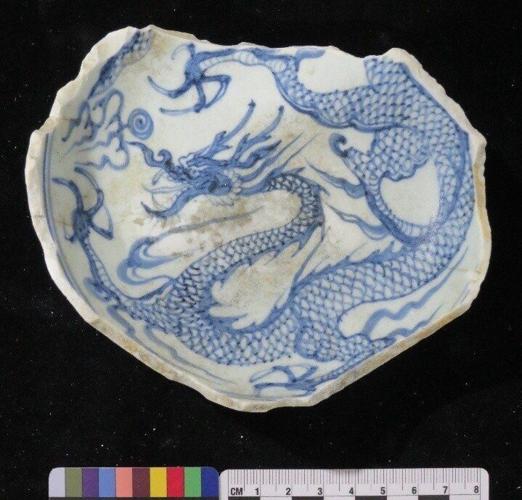



Yuan dynasty blue-and-white porcelain bowl fragment painted with a dragon inside, 14th century. (Dr. Michael Flecker via SWNS)
By Stephen Beech
An "unprecedented" cargo of Yuan dynasty porcelain dating back more than 650 years has been discovered in Singapore’s first ancient shipwreck.
A maritimearchaeological excavation in waters off the island-state uncovered the record-breaking Temasek Wreck.
Scientists say the treasure trove is both locally unprecedented and globally "significant" for the distinct Yuan dynasty blue-and-white ceramics.
The excavation has recovered about 3.5 tons of ceramic shards along with a small number of intact or nearly intact pieces.
Study author Michael Flecker says the most striking aspect of the discovery is the scale of the Yuan blue-and-white porcelain.
Flecker, of HeritageSG — a subsidiary of the Singapore National Heritage Board — said the wreck is "the first ancient shipwreck ever found in Singapore waters."






(Photo by Pok Rie via Pexels)
He added: "Its blue-and-white cargo exceeds that of any other documented shipwreck."
The recovered blue-and-white ceramics alone weigh about 136 kilograms (300 pounds) and comprise more than 2,350 shards as well as several intact or near-intact objects.
As well as the blue-and-white pieces from Jingdezhen, China — known for its history of ceramic production that peaked during the Ming and Qing dynasties — the cargo also includes Longquan celadon, Jingdezhen qingbai and shufu — or “Privy Council” wares — Dehua whiteware, greenwares probably from Fujian, and Fujian Cizao storage jars.
Flecker added: "Even with relatively few intact pieces, the overall ceramic quality is often 'superlative' — particularly for Jingdezhen blue-and-white and qingbai/shufu wares, as well as Longquan celadon."
The study, published by KeAi in the journal Archaeological Research in Asia, also looked at the ship's origin and its trade route.
Although no hull survives, Flecker said associated evidence supports its identification as a Chinese junk.
He proposed the vessel likely loaded at Quanzhou in the mid-14th century and was bound for the thriving port of Temasek that preceded modern Singapore.
(0) comments
Welcome to the discussion.
Log In
Keep it Clean. Please avoid obscene, vulgar, lewd, racist or sexually-oriented language.
PLEASE TURN OFF YOUR CAPS LOCK.
Don't Threaten. Threats of harming another person will not be tolerated.
Be Truthful. Don't knowingly lie about anyone or anything.
Be Nice. No racism, sexism or any sort of -ism that is degrading to another person.
Be Proactive. Use the 'Report' link on each comment to let us know of abusive posts.
Share with Us. We'd love to hear eyewitness accounts, the history behind an article.