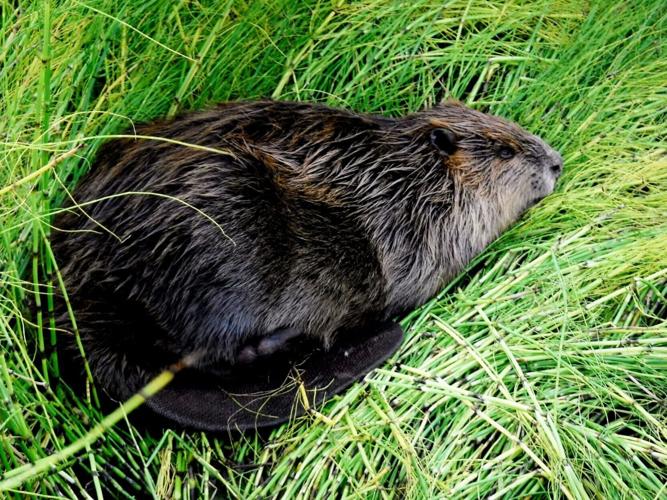

North American beaver in the Northwest Territories. (Anglia Ruskin University via SWNS)
By Stephen Beech
Beavers have left a tell-tale trail as they move into the Arctic, reveals new research.
Scientists have been able to track the mammals' colonization of territory within the Arctic Circle by dating the changes they have made to the landscape as they spread northward.
The research combines tree ring analysis — looking at beaver browsing scars — with satellite imagery of surface water, highlighting dams, to track beavers' expansion into a remote region of Canada's Northwest Territories.
The findings, published in the journal Ecosphere, provide evidence of beaver activity dating back to 2008.
Researchers from Anglia Ruskin University (ARU) explained that beavers are ecosystem engineers — capable of changing landscapes through the construction of dams.
Dam-building can alter the stability of permafrost and impact the flow of water, fish populations and local livelihoods.
The study shows that beavers leave behind a datable environmental record.

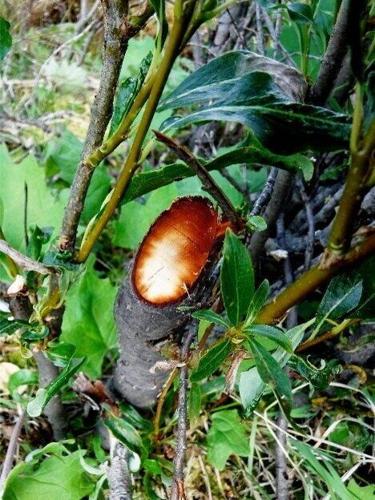
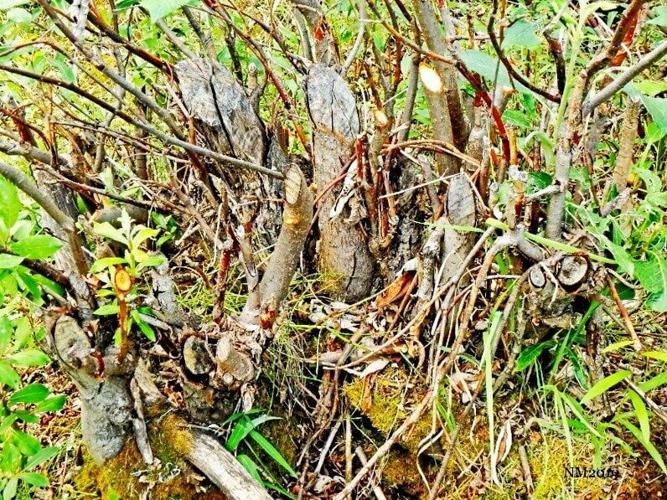
Beaver browsing scars on willow in the Northwest Territories. (Anglia Ruskin University via SWNS)
Their browsing creates scars within the growth rings of shrubs, and their dams generate hydrological changes detectable from space.
Beavers' northward expansion is thought to be driven by climate change, with the Arctic tundra experiencing increased shrubification.
Species such as Salix (willow) and Alnus (alder), which provide food and construction material for beavers, have become more abundant as temperatures rise.
Working alongside the Indigenous environmental guardian and monitoring group, the Imaryuk Monitors, the research team surveyed locations in the Inuvialuit Settlement Region from Inuvik north to Tuktoyaktuk, on the coast of the Arctic Ocean.
The team recorded 60 beaver lodges or dam sites and collecting Salix and Alnus stems containing scars from beaver browsing.
To reconstruct browsing histories and confirm past beaver occupancy, these samples were cross-dated against regional shrub-ring chronologies spanning 1973–2023 (Salix) and 1968–2023 (Alnus), providing evidence of beaver colonization in the region starting in 2008.






Satellite analysis revealed that at one large lodge-dam complex, beaver activity caused a "significant and abrupt" expansion of surface water between 2015 and 2019.

Beaver browsing scars on willow in the Northwest Territories. (Anglia Ruskin University via SWNS)
The flooding, detected through satellite data, matched a period of intense browsing recorded in shrub-ring samples at the site, providing strong agreement between two independent methods.
Study senior author Helen Wheeler, of ARU, said: "The engineering activities of beavers leave a clear trail of evidence, and our findings confirm important aspects of beaver occupancy at locations extending northwards as far as the shores of the Arctic Ocean.
"Arctic Indigenous communities are already observing rapid environmental change, and beaver range expansion is part of that shift.
"Their impacts on lakes, rivers, fish populations and traditional practices make understanding these dynamics a priority for the Inuvialuit community.
"As the Arctic continues to warm, the presence of beavers could increase further.
"The approach we've used in this research can help track these changes and support local communities and decision-makers."

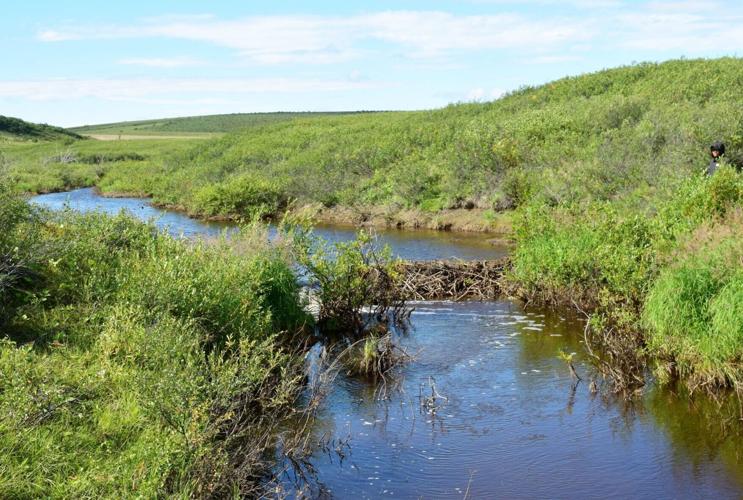
Beaver dam on a river in the Northwest Territories. (Anglia Ruskin University via SWNS)
The scientists say that the type of research they used could prove particularly useful for reconstructing wildlife activity in locations where long-term field observations are absent or incomplete.
Study lead author Georgia Hole said: "In the Arctic, we often lack the historical baselines needed to understand ecological change.
"This study shows how we've developed an approach to reconstruct that missing history.
"Beavers effectively write their history into the landscape with each shrub they cut and every pond they create by damming streams.
"By dating browsing scars in willow and alder using dendrochronological techniques, and linking these to hydrological changes detected in satellite imagery, we're able to pinpoint when and where beavers were present."
Hole, who conducted the work while at ARU and is now based at Durham University, added: "Our findings demonstrate a powerful new way to track past beaver colonization in Arctic regions that are rapidly transforming under climate change."
The study was carried out as part of the BARIN project funded by CINUK, the Canada-Inuit Nunangat-United Kingdom Arctic Research Programme.

(0) comments
Welcome to the discussion.
Log In
Keep it Clean. Please avoid obscene, vulgar, lewd, racist or sexually-oriented language.
PLEASE TURN OFF YOUR CAPS LOCK.
Don't Threaten. Threats of harming another person will not be tolerated.
Be Truthful. Don't knowingly lie about anyone or anything.
Be Nice. No racism, sexism or any sort of -ism that is degrading to another person.
Be Proactive. Use the 'Report' link on each comment to let us know of abusive posts.
Share with Us. We'd love to hear eyewitness accounts, the history behind an article.