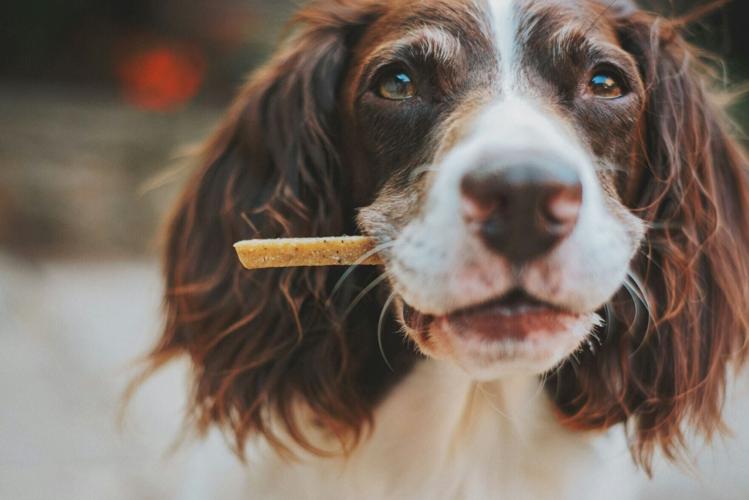


(Photo by James Lacy via Unsplash)
Would you eat your dog’s food? According to new research, four in ten dog parents would.
A survey of 2,000 dog owners found that 23% would try their dog’s food without hesitation and 16% would try it “only once, out of curiosity.” Just 25% said they’d “never try it in a million years.”
More than half of dog parents (56%) said they feed their dog straight off their own plate at least a few times a week (28%), if not daily (28%).
Commissioned by The Pets Table and conducted by Talker Research, the survey found that 52% have made a home-cooked meal specifically for their dog within the last month.
In fact, pets may be eating better than their owners: Forty-five percent rated their dog's food as higher quality than their own meals, and 49% said they pay more attention to their dog's diet and health than they do their own.
However, 60% of respondents said they could only name a maximum of one or two ingredients in their dog’s food.
Beyond sharing table scraps, 51% of respondents said they keep certain human foods in their kitchen specifically because they’re safe for their dog. Fifty-five percent keep ingredients meant for them and their dog to share, suggesting a move toward more of a blended pantry.
“We're seeing a real shift in how people think about feeding their dogs. It's less ‘pet food' and more 'what's good enough for my family.' Owners want the same quality on their dog's plate as their own, and that's exactly the dog parent we created The Pets Table for,” said Dovas Zakas, co-founder of The Pets Table.
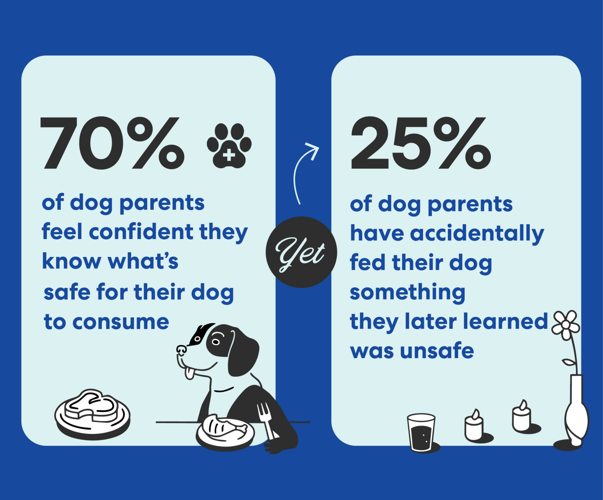
Although 70% of respondents feel “very” to “extremely” confident they know which human foods are safe for dogs, experience evidently makes all the difference.






(Talker Research)
Among dog owners with at least a decade of experience, 90% correctly identified chocolate as unsafe, 76% flagged grapes, 67% recognized onions as harmful and 59% identified garlic.
Newer dog owners were far less likely to identify these dangers, with just 53% recognizing chocolate as unsafe, 30% identifying grapes, 30% flagging onions and 34% recognizing garlic.
A quarter of all respondents (25%) said they've fed their dog something they later learned was unsafe.
Dog parents who have had their dog for less than one year were also more likely to cite convenience (47%) as a barrier to feeding their dog the way they’d truly prefer, compared to just 18% of those who have been a dog parent for 10 or more years.
Half of dog parents said they would feed their dogs exclusively human-grade fresh dog food if it were as convenient as regular kibble.
“I hear from dog parents all the time who want to do right by their dog but feel overwhelmed trying to figure out what's safe, what's healthy, and what fits into their day. That's the problem we set out to solve: convenience and health really don't have to be at odds,” said Zakas.
Research methodology:
Talker Research surveyed 2,000 American dog owners who have access to the internet; the survey was commissioned by The Pets Table and administered and conducted online by Talker Research between July 23 - July 28, 2026. A link to the questionnaire can be found here.
To view the complete methodology as part of AAPOR’s Transparency Initiative, please visit the Talker Research Process and Methodology page.

(0) comments
Welcome to the discussion.
Log In
Keep it Clean. Please avoid obscene, vulgar, lewd, racist or sexually-oriented language.
PLEASE TURN OFF YOUR CAPS LOCK.
Don't Threaten. Threats of harming another person will not be tolerated.
Be Truthful. Don't knowingly lie about anyone or anything.
Be Nice. No racism, sexism or any sort of -ism that is degrading to another person.
Be Proactive. Use the 'Report' link on each comment to let us know of abusive posts.
Share with Us. We'd love to hear eyewitness accounts, the history behind an article.