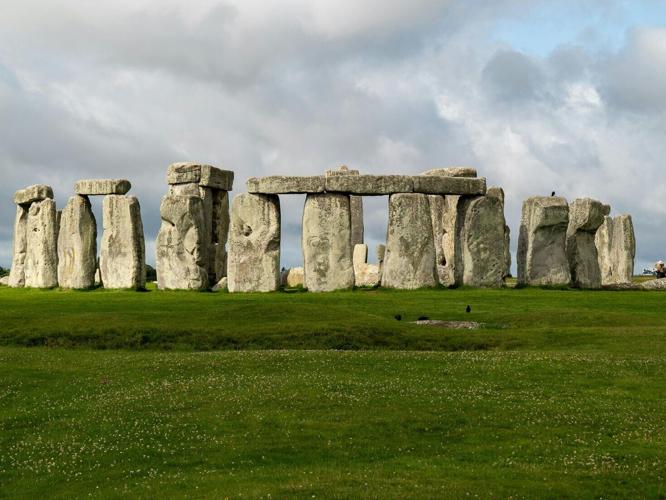
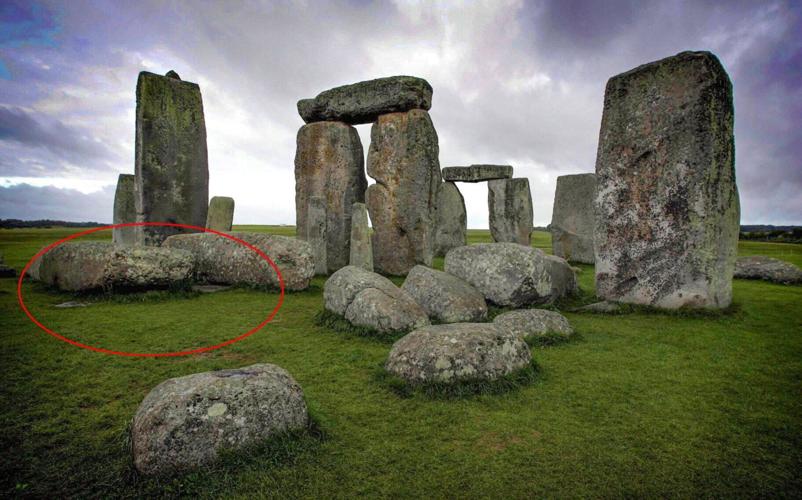
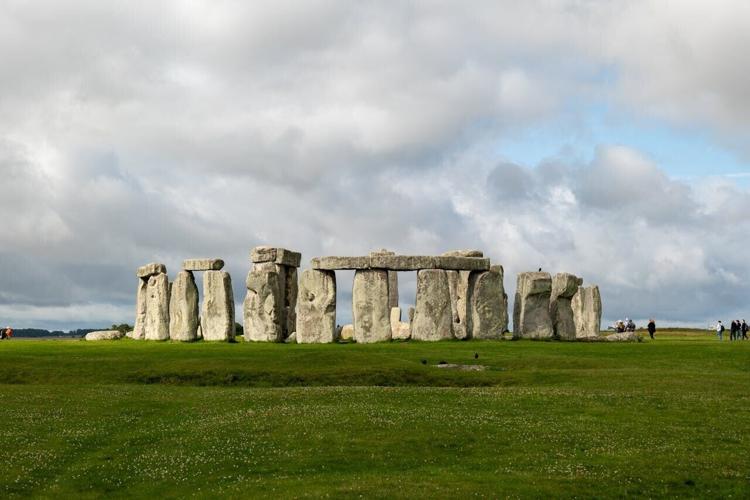

New information about Stonehenge's altar stone, circled in red, has been revealed. (Oli Scarff via SWNS)
By Dean Murray
Stonehenge's altar stone was likely transported more than 400 miles through a mix of glacial movement and human endeavor, according to new research.
The story of the stone at the heart of the megalith structure on Salisbury Plain has been widely debated.
Now, researchers say they have uncovered its "true" journey — from Scotland to Wiltshire via the North Sea.
A study led by Curtin University suggests the sandstone megalith originated in northeast Scotland — around 700km (430 miles) from Salisbury Plain — highlighting the extraordinary scale of its journey.
It is believed ice flow moved the stone from Scotland to Dogger Bank in the North Sea.
Prehistoric Britons then picked up it up and transported it to its current site in Wiltshire — a feat of "tremendous determination."

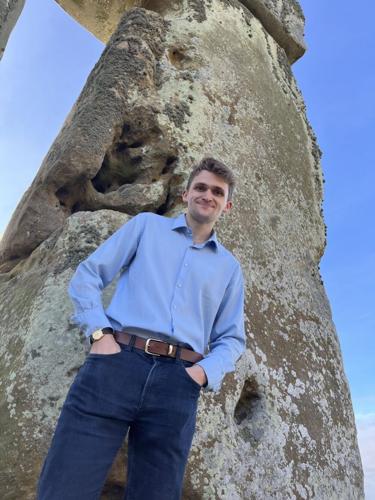
Dr. Anthony Clarke at Stonehenge. (Curtin University via SWNS)
The findings build on earlier work that ruled out glaciers as the sole mechanism for moving the stone, strengthening the conclusion that human effort, rather than natural Ice Age processes, was responsible for some of the journey.
Researchers combined mineral grain dating with ice-sheet modeling to determine the stone's origin and assess whether glaciers could have carried it south.






Co-lead author Anthony Clarke, from the Timescales of Minerals Systems Group within Curtin's School of Earth and Planetary Sciences, said the journey would have required significant planning and coordination.
"Rather than being carried naturally by ice, the evidence points to a deliberate, carefully planned movement across a challenging and varied landscape," Clarke said.
"Our modeling shows glaciers may have transported rocks part of the way during the last Ice Age — potentially as far as Dogger Bank in the North Sea — but not into southern England, meaning the stone would still have needed to be moved hundreds of kilometers by people.
"The research indicates there were no viable glacial pathways linking the source region directly to Stonehenge, reinforcing the conclusion that human transport was required.
"Instead, this suggests the stone was likely moved in stages, potentially combining overland hauling with river or coastal transport where possible."

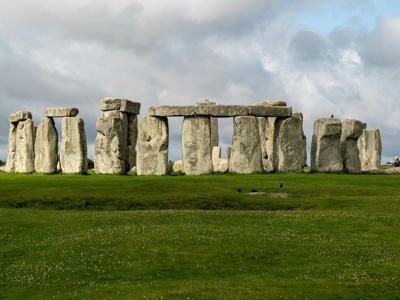
(Photo by Eren Cebeci via Pexels)
Clarke said the findings point to a previously underappreciated level of organization among Neolithic communities.
"Transporting a stone of this size over such a long distance would have required planning, coordination and a deep understanding of the landscape — not to mention tremendous determination," Clarke said.
"The study demonstrates how combining geological analysis with computer modeling can help resolve long-standing questions about how Stonehenge was built."
Further research will aim to pinpoint the altar stone's exact source in northeast Scotland and explore possible transport routes.
The study, conducted with researchers from Sheffield Hallam University, the University of Sheffield, Wessex Archaeology and the University of Bristol, was published in the Journal of Quaternary Science.

(0) comments
Welcome to the discussion.
Log In
Keep it Clean. Please avoid obscene, vulgar, lewd, racist or sexually-oriented language.
PLEASE TURN OFF YOUR CAPS LOCK.
Don't Threaten. Threats of harming another person will not be tolerated.
Be Truthful. Don't knowingly lie about anyone or anything.
Be Nice. No racism, sexism or any sort of -ism that is degrading to another person.
Be Proactive. Use the 'Report' link on each comment to let us know of abusive posts.
Share with Us. We'd love to hear eyewitness accounts, the history behind an article.