How Large of a Tax Refund Will You Get? Average Refunds by State and County
As Tax Day nears, millions of Americans are crunching numbers and hoping for a refund—a financial bright spot that, for many, offers much-needed relief to pay down debt, boost savings, or simply catch up on bills. A new report from Upgraded Points examines average tax refund amounts by county and state, analyzing the latest IRS data to show how refunds have changed in recent years, how they vary by income level and geography, and who’s most—and least—likely to get money back.
Alabama Residents See 10th Largest Tax Refunds in the U.S. on Average
Updated

Photo Credit: mdgn / Shutterstock
How Large of a Tax Refund Will You Get? Average Refunds by State and County

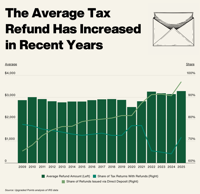
Over the past 15 years, the average federal tax refund has generally remained in the range of $2,800 to $3,000, but the COVID-19 pandemic disrupted that pattern. During the 2020 filing season, the average refund dropped to $2,549, reflecting widespread job losses and reduced earnings early in the crisis.
In the years that followed, refunds rebounded sharply. A combination of rising wages, expanded tax credits, and other stimulus measures pushed the average refund to a record $3,252 by 2022. However, as pandemic-era tax credits expired, a smaller share of taxpayers ended up receiving refunds. The proportion of returns resulting in a refund dropped from 77.1% in 2021 to just 64.1% by 2024.
At the same time, how Americans receive their refunds has also changed. In 2009, just 65% of refunds were issued via direct deposit. By the 2024 filing season, that figure had climbed to 91%, and it has risen further to 97% in early 2025. This trend aligns with a recent policy change by the Trump administration to phase out paper refund checks, citing cost savings and fraud prevention. While the move may improve efficiency, it could pose challenges for unbanked households and those without reliable access to digital financial services.
How Large of a Tax Refund Will You Get? Average Refunds by State and County

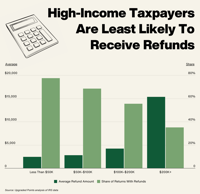
Tax refunds vary significantly by income level, with higher-income households receiving larger refunds on average — but a smaller share of these households receiving refunds at all. According to the latest IRS data, filers earning less than $50,000 received an average refund of $2,403, with over 77% of total returns in this group receiving refunds. Refund participation was nearly universal among the lowest-income group, with 99.3% of those eligible choosing to receive a refund rather than applying their overpayment to next year’s taxes.
For middle-income filers earning $50,000 to $100,000, the average refund rose to $2,789, though just 68.3% received one. Refunds increased further to $4,188 for those earning $100,000 to $200,000, but only 55.4% of these returns resulted in a refund.
At incomes above $200,000, the average refund surged to $15,350. Yet just 35% of returns received a refund, and nearly one-third of filers with overpayments opted to apply their credit to the following year’s taxes instead.
How Large of a Tax Refund Will You Get? Average Refunds by State and County

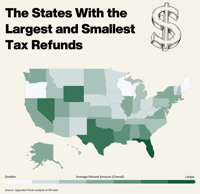
Average federal tax refunds vary widely across states, with a clear concentration of higher refunds in parts of the South and Mountain West. Below are the 5 states with the highest average refunds, based on the latest IRS data:
1. Florida
Florida reported the highest average refund in the country at $3,852. Out of more than 11.1 million federal tax returns filed, about 7.5 million (67%) resulted in a refund.
2. Texas
In Texas, the average refund stood at $3,774, slightly below Florida. The state had the second-largest overall filing volume of any state, with 13.6 million returns filed and over 9.7 million (71%) receiving a refund.
3. Wyoming
Despite its smaller population, Wyoming recorded an average refund of $3,720. Of the 280,750 returns filed, about 190,000 (68%) received a refund.
4. Nevada
Nevada had an average refund of $3,643, with 1.08 million refunds issued out of 1.6 million total returns — an overall refund rate of roughly 70%.
5. Louisiana
Rounding out the top 5, Louisiana reported an average refund of $3,577, with 1.4 million refunds issued across nearly 2 million returns, reflecting a 73% refund rate — the third-highest of all states.
How Large of a Tax Refund Will You Get? Average Refunds by State and County

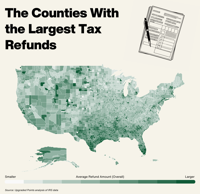
At the local level, some of the highest average tax refunds in the country are concentrated in counties with especially high incomes. Each of the 5 counties listed below falls within the top 5% of the U.S. income distribution, and all are known for their concentrations of wealth and high-value property. These counties also tend to have lower rates of refund issuance overall, reflecting more complex tax situations and a greater likelihood of filers applying overpayments to future tax years.
1. Teton County, WY
Located in northwestern Wyoming and home to the town of Jackson, Teton County had the highest average refund in the nation at $13,168. Of the 15,210 federal tax returns filed, only about 7,900 (52%) resulted in a refund — well below the national average.
2. Pitkin County, CO
Home to the resort town of Aspen, Pitkin County recorded an average refund of $7,607. Roughly 5,470 of the county’s 10,520 filers received a refund, a 52% refund rate similar to Teton County.
3. Summit County, UT
Nestled in the Wasatch Range and encompassing Park City, Summit County had an average refund of $7,368. Out of nearly 25,000 returns filed, 13,940 (56%) received a refund.
4. Collier County, FL
Located on Florida’s Gulf Coast and including the city of Naples, Collier County reported an average refund of $6,667. Of the 214,600 tax returns filed, roughly 121,400 (57%) resulted in a refund.
5. Shackelford County, TX
Though much smaller in size, Shackelford County — a rural area north of Abilene, TX — had an average refund of $6,407. Just 940 of its 1,490 returns (63%) received a refund, suggesting a smaller but relatively affluent taxpayer base.
How Large of a Tax Refund Will You Get? Average Refunds by State and County

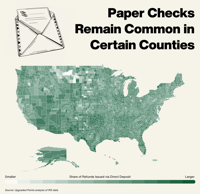
While just over 90% of Americans received their tax refunds via direct deposit in the most recent full year of IRS data, around 10% of taxpayers still opted to receive paper checks. This nationwide figure, however, masks substantial regional variation.
Across most states, direct deposit is the clear norm, with particularly high adoption rates in the South and West. However, in several New England and Midwestern states, the use of traditional paper checks remains comparatively higher. County-level data show even more pronounced disparities, especially in rural areas. In parts of Montana and the Dakotas, for example, fewer than 70% of refunds are issued via direct deposit, suggesting continued reliance on paper checks in remote and low-population areas. These counties also tend to have older average populations, a demographic more likely to use brick-and-mortar banks and less likely to adopt newer technologies.
For a full breakdown of direct deposit usage and average tax refund amounts—both overall and by income group—across every U.S. state and county, see the original post on Upgraded Points: How Large of a Tax Refund Will You Get? Average Refunds by State and County.

(0) comments
Welcome to the discussion.
Log In
Keep it Clean. Please avoid obscene, vulgar, lewd, racist or sexually-oriented language.
PLEASE TURN OFF YOUR CAPS LOCK.
Don't Threaten. Threats of harming another person will not be tolerated.
Be Truthful. Don't knowingly lie about anyone or anything.
Be Nice. No racism, sexism or any sort of -ism that is degrading to another person.
Be Proactive. Use the 'Report' link on each comment to let us know of abusive posts.
Share with Us. We'd love to hear eyewitness accounts, the history behind an article.