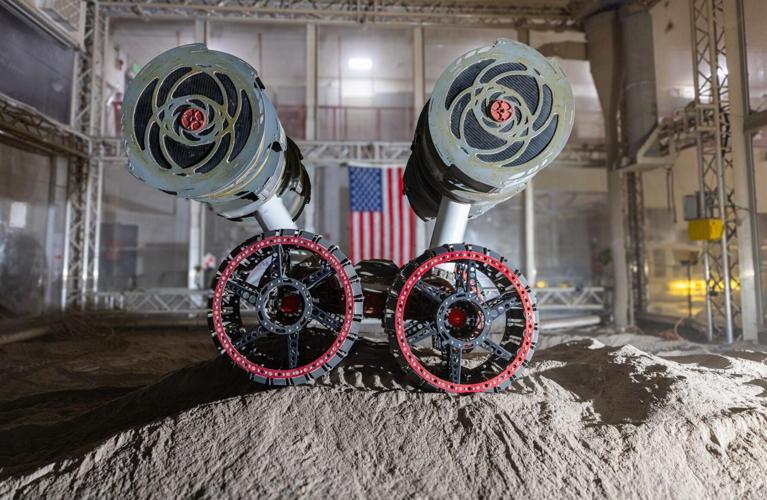
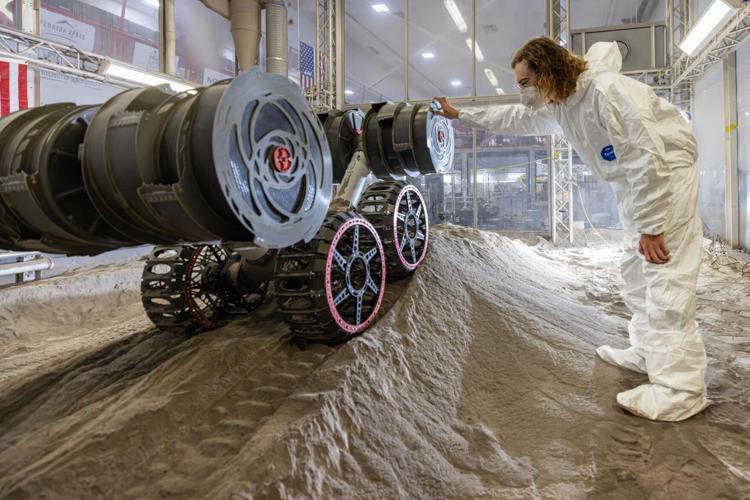
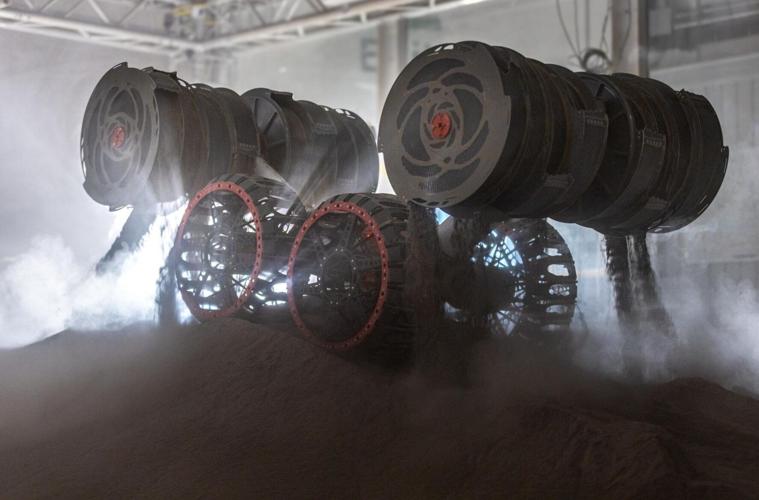
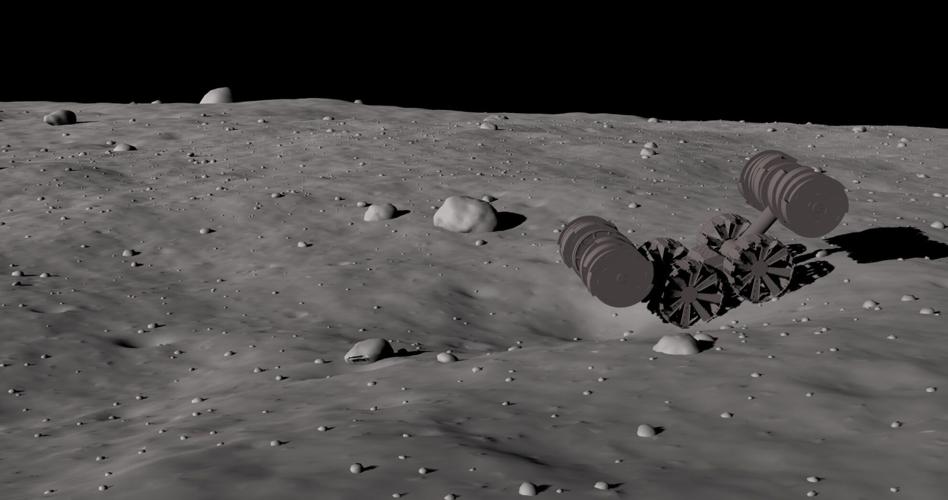
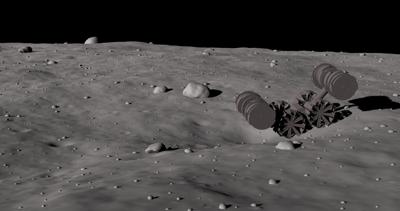
A visualisation of the In-Situ Resource Utilization (ISRU) Pilot Excavator on the Moon. This vehicle is based on RASSOR's previous development. The United States has shown off how it plans to mine the Moon. Incredible scenes show NASA testing a vehicle designed to extract vital resources that could help humans live in the lunar environment or even on Mars. Engineers at Kennedy Space Centre in Florida are experimenting with the RASSOR (Regolith Advanced Surface Systems Operations Robot) on a simulated lunar surface. RASSORÂs counter-rotating drums dig up simulated moon dust to extract regolith, the loose, fragmental material found on the MoonÂs surface. The opposing motion of the drums helps RASSOR grip the surface in low-gravity environments like the Moon or Mars. On Tuesday (3 June), NASA said: "With this unique capability, RASSOR can traverse the rough surface to dig, load, haul, and dump regolith that could later be broken down into hydrogen, oxygen, or waterÂresources critical for sustaining human presence."
A visualisation of the In-Situ Resource Utilization (ISRU) Pilot Excavator on the Moon. This vehicle is based on RASSOR's previous development. The United States has shown off how it plans to mine the Moon. Incredible scenes show NASA testing a vehicle designed to extract vital resources that could help humans live in the lunar environment or even on Mars. Engineers at Kennedy Space Centre in Florida are experimenting with the RASSOR (Regolith Advanced Surface Systems Operations Robot) on a simulated lunar surface. RASSORÂs counter-rotating drums dig up simulated moon dust to extract regolith, the loose, fragmental material found on the MoonÂs surface. The opposing motion of the drums helps RASSOR grip the surface in low-gravity environments like the Moon or Mars. On Tuesday (3 June), NASA said: "With this unique capability, RASSOR can traverse the rough surface to dig, load, haul, and dump regolith that could later be broken down into hydrogen, oxygen, or waterÂresources critical for sustaining human presence."
The United States has shown off how it plans to mine the Moon.
Incredible scenes show NASA testing a vehicle designed to extract vital resources that could help humans live in the lunar environment or even on Mars.
NASA's RASSOR conducts excavation testing. (NASA/Frank Michaux via SWNS)
The opposing motion of the drums helps RASSOR grip the surface in low-gravity environments like the Moon or Mars.
On Tuesday (June 3), NASA said: "With this unique capability, RASSOR can traverse the rough surface to dig, load, haul, and dump regolith that could later be broken down into hydrogen, oxygen, or water—resources critical for sustaining human presence."
(NASA/Frank Michaux via SWNS)
By Talker
The space agency is using the foundation of RASSOR’s development to inform IPEx (In-Situ Resource Utilisation Pilot Excavator), a newer vehicle being prepared for a potential technology demonstration mission on the Moon.
IPEx is still in the advanced development and testing phase and will improve on RASSOR with refinements in scale, modularity, and mission capability to support future lunar resource extraction missions.
Keep it Clean. Please avoid obscene, vulgar, lewd,
racist or sexually-oriented language. PLEASE TURN OFF YOUR CAPS LOCK. Don't Threaten. Threats of harming another
person will not be tolerated. Be Truthful. Don't knowingly lie about anyone
or anything. Be Nice. No racism, sexism or any sort of -ism
that is degrading to another person. Be Proactive. Use the 'Report' link on
each comment to let us know of abusive posts. Share with Us. We'd love to hear eyewitness
accounts, the history behind an article.








(0) comments
Welcome to the discussion.
Log In
Keep it Clean. Please avoid obscene, vulgar, lewd, racist or sexually-oriented language.
PLEASE TURN OFF YOUR CAPS LOCK.
Don't Threaten. Threats of harming another person will not be tolerated.
Be Truthful. Don't knowingly lie about anyone or anything.
Be Nice. No racism, sexism or any sort of -ism that is degrading to another person.
Be Proactive. Use the 'Report' link on each comment to let us know of abusive posts.
Share with Us. We'd love to hear eyewitness accounts, the history behind an article.