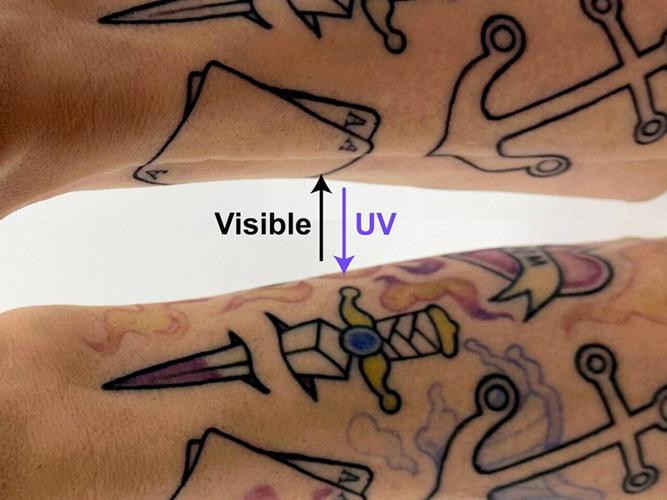
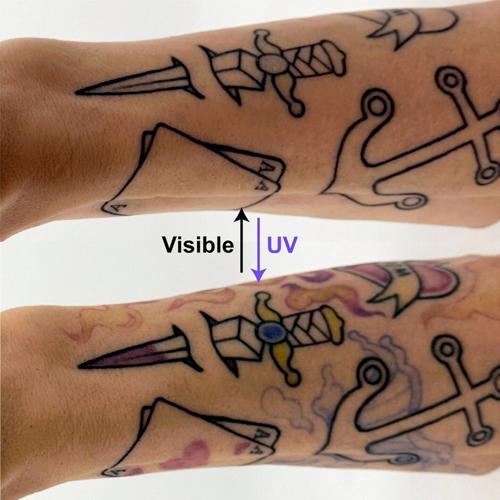
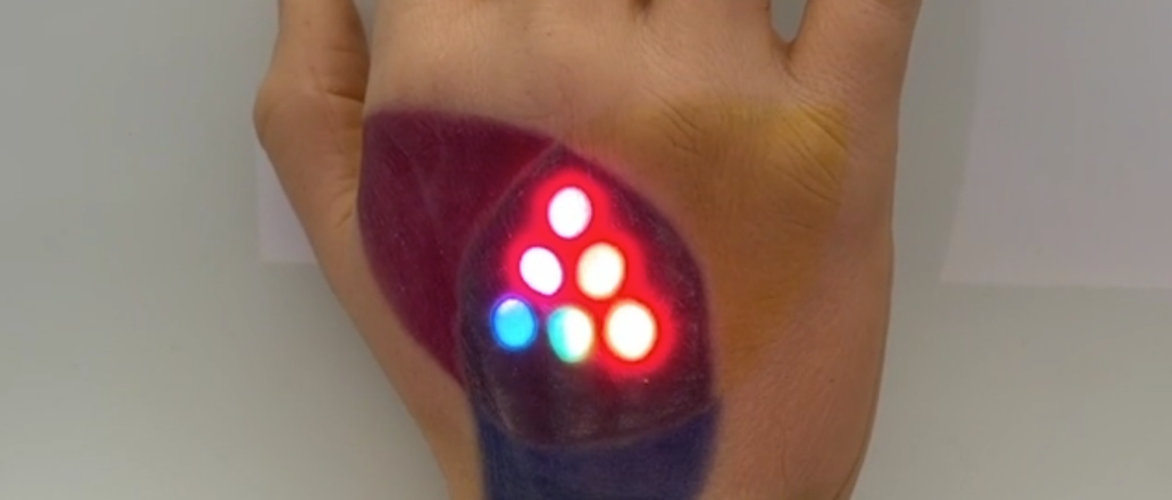
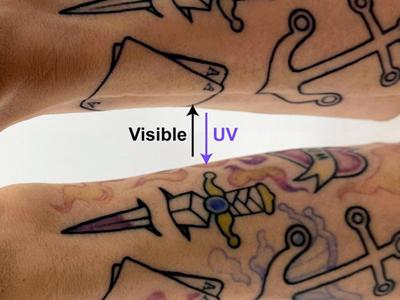

Arm tattoo before and after light activation. (Matter& Light, Bruns et al. via SWNS)
By Stephen Beech
A new generation of “invisible” tattoos switches on and off under different kinds of light.
American engineers who created the multicolored inks say they could one day help people hide their body art when they have an important business meeting.
They could even doodle on their own skin using a simple laser pointer, according to a study published in the journal Matter & Light.
Lead author Carson Bruns said: “Tattooing is a very ancient technology that remains mostly untapped as a platform for today’s technologies.”
He explained that the new inks, known as PhotoTat, are made from dyes and a plexiglass-like material common in many medical technologies on the market today, including dermal fillers.
The research is a passion project for the biomedical engineering expert, who has a lot of his own tattoos — including a green lion on his arm.
Bruns, of the University of Colorado Boulder, said: “I love body art because of how personal it is.”
To make the inks, he and his colleagues start with a material called polymethyl methacrylate, or PMMA, which forms incredibly small spheres that look like they’re made of glass.
The team then inserts a range of color-changing dyes into the spheres.
Bruns said: “By mixing these primary colors, we can generate a full color image.”
Normally, the dyes are completely invisible to the human eye.
But when an ultraviolet light is shined on them, they change color in just seconds — turning a vibrant blue, magenta or yellow.
The colors fade over several hours, but they can be switched off faster by exposing them to a bright LED light.







(Matter& Light, Bruns et al. via SWNS)
Bruns said: “PhotoTat is like a switch.
“You turn it on with UV light, but you can turn it off again when you go to grandma’s house.”
PhotoTat won’t be available at any tattoo parlors just yet, but Bruns and his colleagues hope to continue improving their designs in the coming years so that the inks become widely available for fans of body art.
Beyond cosmetics, Bruns also foresees practical applications for the technology.
For example, he said many people undergoing radiation therapy for cancer have to get small tattoos on their body to help doctors guide the radiation beams.
Those markers can be scarring, both mentally and physically.

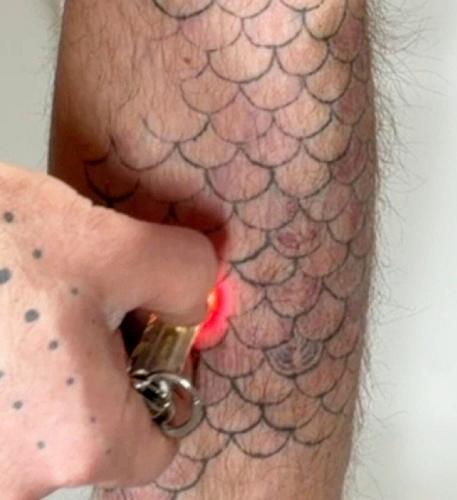
Author Carson Bruns shines light on his Phototat leg tattoo. Arm tattoo before and after light activation. (Matter& Light, Bruns et al. via SWNS)
Bruns said: “They’re not beautiful, and they become a permanent reminder of a traumatic experience.
“With PhotoTat, we could turn an involuntary medical tattoo into something that’s only visible to the doctor when you go in the clinic, and then it can be invisible the rest of the time.”
He hasn’t yet determined whether the inks are safe for people.
But he has tried the inks on himself.
Bruns has a black outline of fish scales on his leg, which he’s filled in with PhotoTat inks.
With a little light, he can turn the scales red, orange, blue and more — which he describes as almost like “magical mermaid scales.”
Bruns added: “There’s a stigma, in science and in many cultures, around body art.
“I’m proud to be pushing against that.”
(0) comments
Welcome to the discussion.
Log In
Keep it Clean. Please avoid obscene, vulgar, lewd, racist or sexually-oriented language.
PLEASE TURN OFF YOUR CAPS LOCK.
Don't Threaten. Threats of harming another person will not be tolerated.
Be Truthful. Don't knowingly lie about anyone or anything.
Be Nice. No racism, sexism or any sort of -ism that is degrading to another person.
Be Proactive. Use the 'Report' link on each comment to let us know of abusive posts.
Share with Us. We'd love to hear eyewitness accounts, the history behind an article.