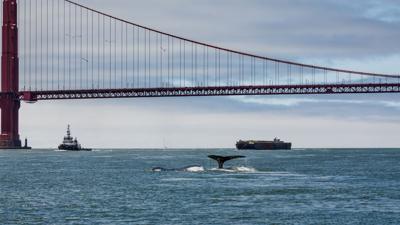

Rare sighting of mother humpback whale fluke, Megaptera novaeangliae, swimming in San Francisco Bay with Golden Gate Bridge in background
More than fifty whales have died on the West Coast of North America as of May 31st, already making it the second deadliest year for the aquatic mammals. Eleven of the fatalities were in the San Francisco Bay area, two as a result of ship strikes. Historically, 40% of grey whale deaths have been caused by collisions with ship propellers, but a new technology rolled out earlier this year hopes to reduce those numbers.
Grey whales are federally protected under the Marine Mammal Protection Act after their numbers dropped by more than half in the last 10 years. They pass the West Coast on their normal migratory pattern from Alaska to Mexico, but increasingly have wandered into the San Francisco Bay to feed as climate changes reduce their food supply.
Earlier this year, a coalition of oceanic scientists and the United States Coast Guard, along with ferry companies and whale tracking experts joined forces in an attempt to mitigate some of the deaths. The group managed to rapidly develop and deploy a system utilizing AI and the FLIR thermal imaging technology law enforcement and the military already use.
Conservation Success to Disaster
When whale hunting was banned in most of the modern world in the 1960’s, nearly every species of whale qualified for the endangered list. Humpback whales in particular were down to fewer than 5000 across the globe. In the mid-80s, conservation efforts, including the wildly popular “Save The Whales” campaign, and Star Trek IV: The Voyage Home helped build awareness. Whale numbers slowly built until they hit exponential momentum.
By 2016, Grey Whales in particular had reached a population of 27,000. Not as successful as the better known Humpback Whales, but one of the many species victories brought about from conservation and sustainability efforts. In the last 10 years, though, despite reductions in whale hunting from Japan, Norway and Iceland, numbers have again dwindled.
As of 2026, only about 13,000 Grey Whales remain, and more than a hundred die every year due to malnutrition, interactions with fishing gear, and boat collisions. Radical climate change in the Arctic causes melting sea ice, which reduces the bottom-dwelling crustaceans the whales rely on for food. That’s led to significant drops in caloric intake, failed pregnancies, and starvation.
Fishing gear entanglements are more an issue for Right Whales; it’s estimated 86% of them have been caught in and dragged fishing gear with them at least once, sometimes for years. But Grey Whales are also seeing more accidental entanglements as they roam closer to shore.
Efforts in Alaska and the Arctic are ongoing to increase the food supply. But it’s hard to avoid accidents like fishing gear entanglement and deep water boat collisions. Until now.
Sight Beyond Sight





On May 19, 2026, the Benioff Ocean Science Laboratory at UC Santa Barbara, the Marine Mammal Center and WhaleSpotter unveiled their new near real-time, thermal camera monitoring system. The series of cameras and alert mechanisms detect whales' heat signatures and exhaled breaths in the San Francisco Bay, giving nearby mariners a chance to re-route or reduce their speed to avoid hitting them.
The system was designed by researchers at the Benioff Ocean Science Lab, in collaboration with the U.S. Coast Guard's Vessel Traffic Service and whale experts at The Marine Mammal Center. FLIR thermal cameras work with AI-powered detection technology developed by WhaleSpotter to identify marine mammals, 24/7.
The cameras detect the heat signature of a warm-blooded whale or their exhales up to 4 nautical miles away. One of WhaleSpotter's credentialed marine mammal specialists reviews each detection instantly. Once verified, UCSB scientists map out the whale detections on the Whale Safe website and share them with Bay mariners and the U.S. Coast Guard's Vessel Traffic Service, which then can radio vessels when there are whales in the area under imminent threat.
Make It So
The U.S. Coast Guard communication station on Angel Island hosts the first node of the whale detection system. The cameras point across the Bay towards Treasure Island and the Bay Bridge to cover a literal hotspot of overlap between gray whales and vessels.
It will be followed by an installation on the MV Lyra passenger ferry operated by San Francisco Bay Ferry. The Lyra does a daily route connecting Vallejo to Downtown San Francisco. As the system expands, organizers hope to add nodes to the Golden Gate Bridge and Alcatraz, to make the Bay safer for whales and humans.
“This kind of real-time whale monitoring is a major step forward for reducing vessel strike risk and protecting gray whales navigating one of the nation's busiest waterways,” explains Kathi George, the Director of Cetacean Conservation Biology at The Marine Mammal Center. “Having 24/7 visibility into when whales are present will strengthen awareness and communication across the maritime sector and support action to help keep both whales and vessels safe."
"For too long, mariners have been asked to protect whales they simply couldn't see. We're changing that,” adds Shawn Henry, the CEO of WhaleSpotter. “This deployment means ships in San Francisco Bay now have eyes on the water, day and night, miles ahead. The whales have been here for thousands of years. We intend to keep it that way."
Conservation groups are pushing for additional measures, like mandatory speed reductions in areas of high whale activity and reevaluating existing and to-be-approved shipping lanes. But all agree that the detection system is a good step in the right direction.
Paul Rose Jr is a freelance journalist and editor. His articles have appeared on the Associated Press newswire, CNN NewsBreak, MSN and have been syndicated to hundreds of newspapers across the country. He has worked as TV News Producer, Forensic Analyst, and Train Conductor. When he’s not writing articles, he exercises his creative muscle writing screenplays and acting in film and television in Los Angeles, CA.

(0) comments
Welcome to the discussion.
Log In
Keep it Clean. Please avoid obscene, vulgar, lewd, racist or sexually-oriented language.
PLEASE TURN OFF YOUR CAPS LOCK.
Don't Threaten. Threats of harming another person will not be tolerated.
Be Truthful. Don't knowingly lie about anyone or anything.
Be Nice. No racism, sexism or any sort of -ism that is degrading to another person.
Be Proactive. Use the 'Report' link on each comment to let us know of abusive posts.
Share with Us. We'd love to hear eyewitness accounts, the history behind an article.