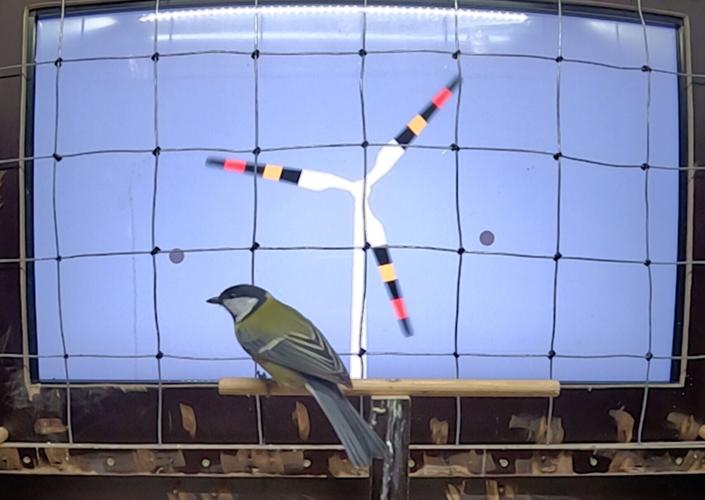
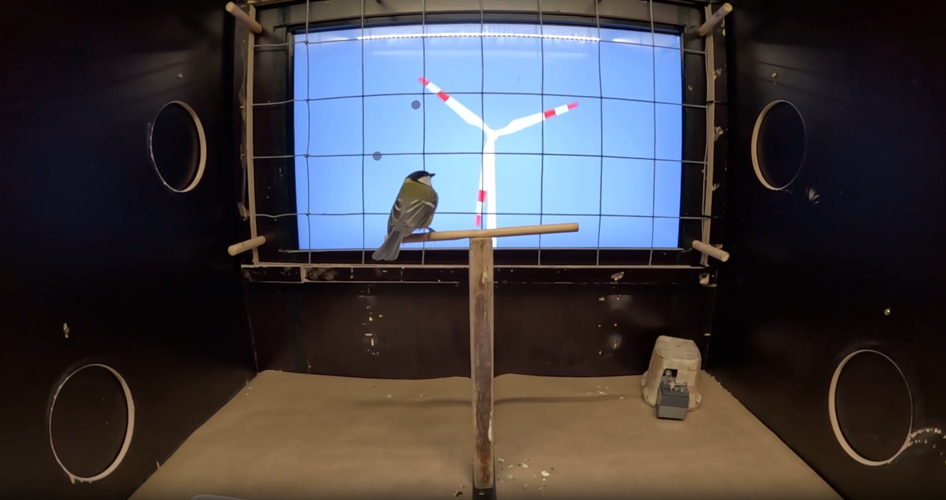

Still image from a video showing a great tit (Parus major) preparing to flee from a digital wind turbine displaying biologically inspired warning patterns. (George R. A. Hancock via SWNS)
By Dean Murray
Painting wind turbines like venomous snakes or poisonous frogs could stop birds flying into them, according to new research.
The study saw birds presented with a touchscreen "game" to test how they respond to wind turbine blades.
If they pecked the screen and avoided the onscreen blades, they would access a bird feeder for a treat.
Researchers found that warning colors – yellow, red, and black – combined with the rotating motion of the blades were clearly more frightening to birds than other patterns already used for wind turbines, such as a single black blade and red stripes.

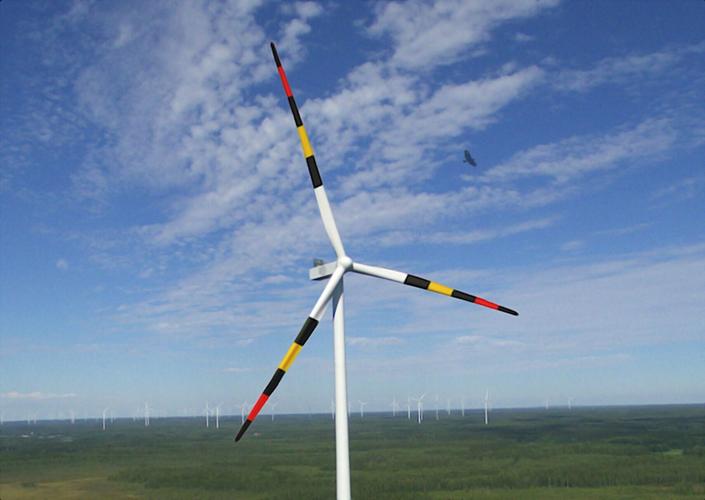
A drone photograph of a wind turbine in southern Finland, digitally modified with a biologically inspired warning pattern under natural light conditions. (Eric Lehtonen via SWNS)
"White blades, which are the most frequently used pattern around the world, turned out to be the worst option for birds. This suggests that a relatively simple visual change could reduce bird mortality in connection with wind power," says Johanna Mappes, of the University of Helsinki.






"By using a touchscreen especially designed for birds, we can use games to explore their behavior and ecology by simulating real-world scenarios, without putting the birds at risk," said George Hancock, from the University of Exeter.
"The starting point for this idea was that in nature, many animals use colors to warn predators of danger. Often, the tendency to avoid certain color combinations is genetic – colors are avoided even if there is no previous experience with them," says Mappes.
Examples include adders, coral snakes, poison dart frogs, and butterflies.

(George R. A. Hancock via SWNS)
"Painting turbines presents just one example in a suite of strategies that can be used to help birds, such as positioning turbines away from key migration routes or using computer-operated cameras to instruct turbines to turn off when a bird approaches," says Hancock.
"We've known for a long time that birds change how they respond to objects with warning colors, but to see such a large effect was remarkable!" Hancock continued.
"What is particularly new is that the solution is based on behavior shaped by evolution and warning signals optimized by nature," Mappes added.
In the longer term, the researchers say the study could lead to new standards in wind turbine design. In the future, blades could be designed to be not only aerodynamically efficient but also more easily visible or frightening to birds. The same thinking could also be applied to, for example, power lines, windows, and other structures that birds encounter.

(0) comments
Welcome to the discussion.
Log In
Keep it Clean. Please avoid obscene, vulgar, lewd, racist or sexually-oriented language.
PLEASE TURN OFF YOUR CAPS LOCK.
Don't Threaten. Threats of harming another person will not be tolerated.
Be Truthful. Don't knowingly lie about anyone or anything.
Be Nice. No racism, sexism or any sort of -ism that is degrading to another person.
Be Proactive. Use the 'Report' link on each comment to let us know of abusive posts.
Share with Us. We'd love to hear eyewitness accounts, the history behind an article.