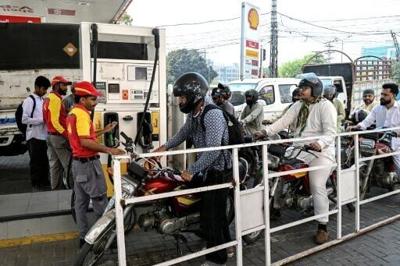
Pakistan's government on Thursday drastically raised fuel prices in response to spiking global energy prices caused by the Iran war, the country's petroleum minister said in a press conference.
The new prices mark an increase of 42.7 percent in petrol prices and 54.9 percent in the price of diesel.
"The decision made today is that as per international markets, after the increase in the petrol prices the new price will be 458.40 rupees ($1.64 per litre) which will be effective from tomorrow (Friday)," said the minister, Ali Pervaiz Malik.
As for diesel, "which has great importance for our workers and public transport," the price was set at 520.35 Pakistani rupees ($1.86) per litre, he said.
"The government has done its best, looking at its budget, to give people blanket protection" but was "forced" to pass along the price increase "because resources are limited and we do not currently see indications of the end of this war", Pervaiz said.
The US-Israel war on Iran, launched on February 28, has plunged the Middle East into conflict, with Iranian retaliatory strikes hitting targets across the Gulf and virtually freezing shipping in the Strait of Hormuz.
The key waterway normally sees a fifth of the world's energy supplies pass through it, much of it bound for Asia.
Pakistan is heavily reliant on such oil and gas, and had earlier raised prices by 20 percent on March 6, about a week into the war.
The government has unveiled a raft of austerity measures designed to save fuel, including moving many government offices to a four-day work week, extending school holidays and moving some classes online.
Pakistan is classified as a lower-middle-income country, with roughly 25 percent of its 240 million population living in poverty, as per World Bank data.
Several Asian countries have hiked fuel prices or implemented other measures to address the crisis sparked by the war on Iran.
On Thursday, Bangladesh hiked prices of liquefied petroleum gas used for cooking and compressed natural gas used in some cars by 29 percent.
Earlier this week, the International Monetary Fund warned that vulnerable economies, such as Pakistan, did not just face pressure from higher energy prices, but from supply chain snarls as well.
"Parts of the Middle East, Africa, Asia-Pacific, and Latin America face the added strain of higher food and fertilizer prices and tighter financial conditions," the IMF said in a post on its website.
Keep it Clean. Please avoid obscene, vulgar, lewd,
racist or sexually-oriented language. PLEASE TURN OFF YOUR CAPS LOCK. Don't Threaten. Threats of harming another
person will not be tolerated. Be Truthful. Don't knowingly lie about anyone
or anything. Be Nice. No racism, sexism or any sort of -ism
that is degrading to another person. Be Proactive. Use the 'Report' link on
each comment to let us know of abusive posts. Share with Us. We'd love to hear eyewitness
accounts, the history behind an article.







(0) comments
Welcome to the discussion.
Log In
Keep it Clean. Please avoid obscene, vulgar, lewd, racist or sexually-oriented language.
PLEASE TURN OFF YOUR CAPS LOCK.
Don't Threaten. Threats of harming another person will not be tolerated.
Be Truthful. Don't knowingly lie about anyone or anything.
Be Nice. No racism, sexism or any sort of -ism that is degrading to another person.
Be Proactive. Use the 'Report' link on each comment to let us know of abusive posts.
Share with Us. We'd love to hear eyewitness accounts, the history behind an article.