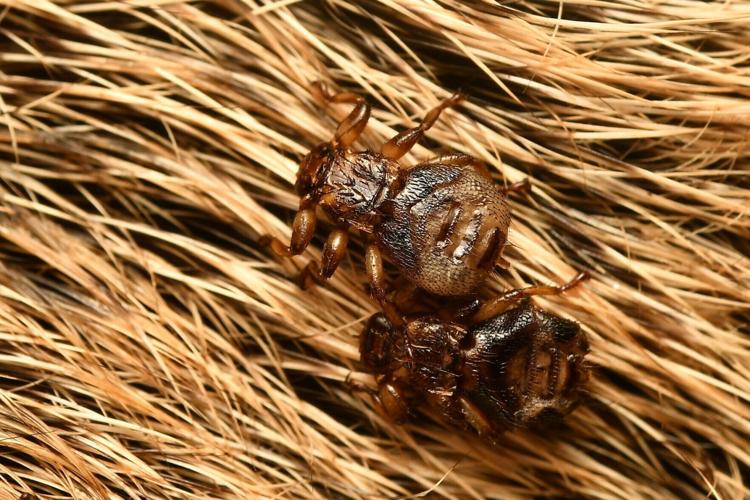

Deer keds on a host. (François-Xavier Taxil via SWNS)
By Stephen Beech
A species of fly "sacrifices" its sight after finding a host to live on, reveals new research.
The blood-feeding parasitic insect loses visual sensitivity after finding a host and permanently giving up flight, say scientists.
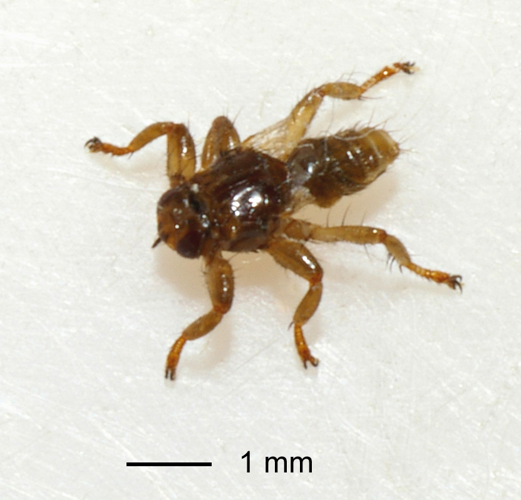
Deer keds — biting flies found across Europe, Asia, Africa and the Americas — use their eyes and flight to locate a host — usually deer, but sometimes humans or other mammals.
However, once they land they shed their wings permanently and spend the rest of their lives crawling through fur and feeding on blood.
Now researchers at Aberystwyth University in Wales and the University of Florence, Italy, have shown that their radical lifestyle shift is accompanied by a major change in the insect's sensory priorities.
After securing a host, deer keds direct resources away from vision, potentially conserving energy for functions better suited to life as a permanent parasite.
Study leader Roger Santer, from the Department of Life Sciences at Aberystwyth University, said: "Vision plays a vital role in animal behavior, but it is also energetically expensive.

Christian Fischer via Wikimedia Commons
"Evolution favors sensory systems that are efficiently matched to an animal's way of life.






"Some blood-feeding flies rely heavily on vision, while others live permanently on hosts and have little need for it.
"Deer keds are especially interesting because they switch between these two lifestyles."
The research team analyzed deer keds at different stages of their life cycle, including winged adults caught in flight while searching for a host, and wingless adults collected from deer after they had adopted their parasitic lifestyle.
Scientists examined genes underlying visual sensitivity, or "opsins" — comparing their activity before and after the insects shed their wings to understand how the flies' sensory systems respond to the abrupt lifestyle transition.
Santer said: "We found that a flying deer ked's visual system is much like that of a tsetse fly, which famously hunt out mammal hosts in Africa.
"However, after a deer ked loses its wings and becomes an ectoparasite, activity of its opsin genes reduces to around half the previous level.
"This suggests that the flies do not lose vision entirely, but that their visual sensitivity is reduced."
He added: "We think the fly might be sacrificing sight to conserve energy for functions such as digestion and reproduction."
The findings, published in the Journal of Experimental Biology, provide new insight into how parasites "fine-tune" their sensory systems during major lifestyle changes.
The researchers say improved understanding of how deer keds and other biting flies use their senses could help improve future control methods.

(0) comments
Welcome to the discussion.
Log In
Keep it Clean. Please avoid obscene, vulgar, lewd, racist or sexually-oriented language.
PLEASE TURN OFF YOUR CAPS LOCK.
Don't Threaten. Threats of harming another person will not be tolerated.
Be Truthful. Don't knowingly lie about anyone or anything.
Be Nice. No racism, sexism or any sort of -ism that is degrading to another person.
Be Proactive. Use the 'Report' link on each comment to let us know of abusive posts.
Share with Us. We'd love to hear eyewitness accounts, the history behind an article.