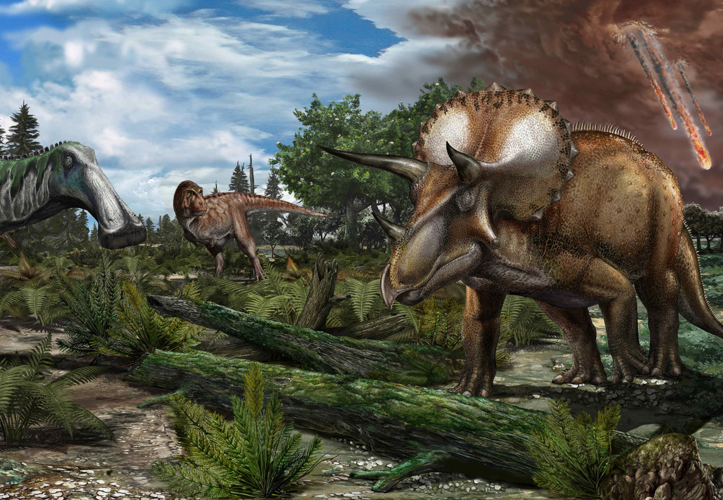
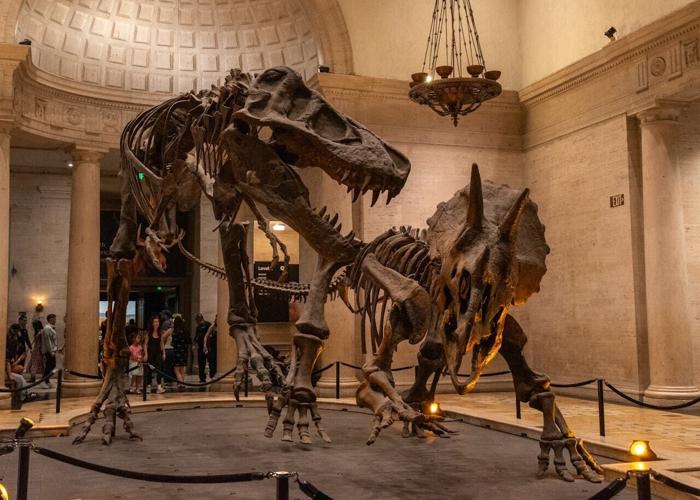

Reconstruction of a late Maastrichtian (~66 million years ago) palaeoenvironment in North America, where a floodplain is roamed by dinosaurs like Tyrannosaurus rex, Edmontosaurus annectens and Triceratops prorsus. (Davide Bonadonna via SWNS)
By Stephen Beech
Dinosaurs weren't in decline before an asteroid wiped most of them out 66 million years ago, suggests new research.
The idea that they were already dwindling in number before the devastating asteroid strike may be explained by a worsening fossil record from that time, suggests the study.
The research, led by scientists at University College London (UCL), analyzed the fossil record of North America in the 18 million years up to the asteroid impact at the end of the Cretaceous period, between 66 and 84 million years ago.
Taken at face value, those fossils - totalling more than 8,000 - suggest the number of dinosaur species peaked about 75 million years ago, and then declined in the nine million years leading up to the asteroid impact.
However, the research team found that trend was due to fossils from that time being less likely to be discovered, primarily because of fewer locations with exposed and accessible rock from the very latest Cretaceous.
Lead author Dr. Chris Dean, of UCL, said: “It’s been a subject of debate for more than 30 years - were dinosaurs doomed and already on their way out before the asteroid hit?

Leo Visions
“We analyzed the fossil record and found that the quality of the record of four groups of dinosaurs gets worse during the final six million years prior to the asteroid.
"The probability of finding dinosaur fossils decreases, while the likelihood of dinosaurs having lived in these areas at the time is stable. This shows we can’t take the fossil record at face value.
“Half the fossils we have from this time were found in North America.
"Our findings hint that in this region at least, dinosaurs may have been doing better than previously suggested in the lead-up to the asteroid impact, potentially with a higher diversity of species than we see in the raw rock record.”
For the study, published in the journal Current Biology, the researchers looked at the dinosaur groups Ankylosauridae - armored herbivores; Ceratopsidae - large three-horned herbivores including Triceratops; Hadrosauridae - duck-billed herbivores, and Tyrannosauridae - carnivores such as Tyrannosaurus Rex).






They adopted a technique, called occupancy modeling, previously used in ecology and biodiversity studies to estimate how likely a species is to inhabit a particular area.
They divided North America into a grid and, based on the geology, geography and climate of the time, estimated how many of the grid cells the four dinosaur types likely occupied at four different times during the last 18 million years of the Cretaceous.
They found that, during that time, the proportion of land the four dinosaur groups likely occupied remained constant overall, suggesting their potential habitat area remained stable and the risk of extinction stayed low.

At the same time, they estimated the likelihood of the four dinosaur types being detected in each area, based on factors including how much land is accessible to scientists, how much relevant rock is exposed, and how many times scientists had attempted to find fossils from that area.
The researchers found that the likelihood of detection declined over the four time periods, with the most influential factor being how much relevant rock was exposed and accessible.
The team also found that, in contrast to the other three groups, Ceratopsian dinosaurs - such as Triceratops - were more likely to be detected later on in the period, as well as occupying more areas.
The researchers suggested that was due to Ceratopsians favoring green plains away from rivers at a time when that kind of habitat became the main type of environment being preserved.
They say that was due to the retreat of a large inland sea that split the continent in two and river systems feeding the sea drying up.
Co-author UCL Dr. Alessandro Chiarenza, who has previously published on end-Cretaceous dinosaur diversity and extinction, said: “If we take the fossil record at face value, we might conclude dinosaurs were already experiencing a decline before their final extinction.
“In this study, we show that this apparent decline is more likely a result of a reduced sampling window, caused by geological changes in these terminal Mesozoic fossil-bearing layers - driven by processes such as tectonics, mountain uplift, and sea-level retreat - rather than genuine fluctuations in biodiversity."
Dr. Chiarenza added: “Dinosaurs were probably not inevitably doomed to extinction at the end of the Mesozoic.
"If it weren’t for that asteroid, they might still share this planet with mammals, lizards, and their surviving descendants: birds.”

(0) comments
Welcome to the discussion.
Log In
Keep it Clean. Please avoid obscene, vulgar, lewd, racist or sexually-oriented language.
PLEASE TURN OFF YOUR CAPS LOCK.
Don't Threaten. Threats of harming another person will not be tolerated.
Be Truthful. Don't knowingly lie about anyone or anything.
Be Nice. No racism, sexism or any sort of -ism that is degrading to another person.
Be Proactive. Use the 'Report' link on each comment to let us know of abusive posts.
Share with Us. We'd love to hear eyewitness accounts, the history behind an article.