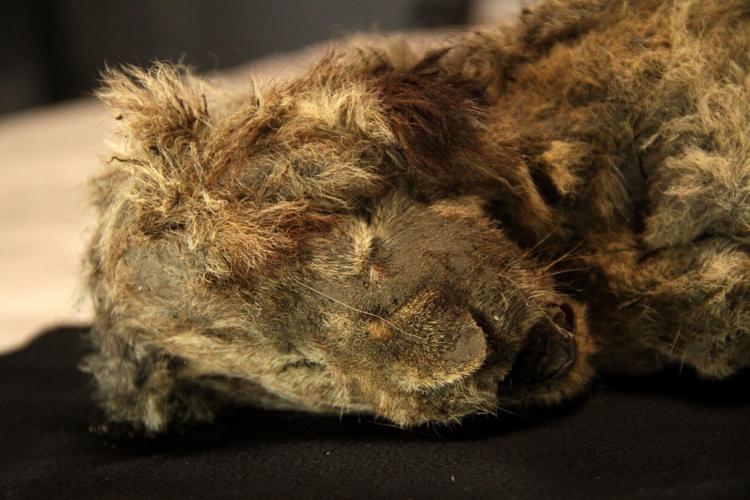
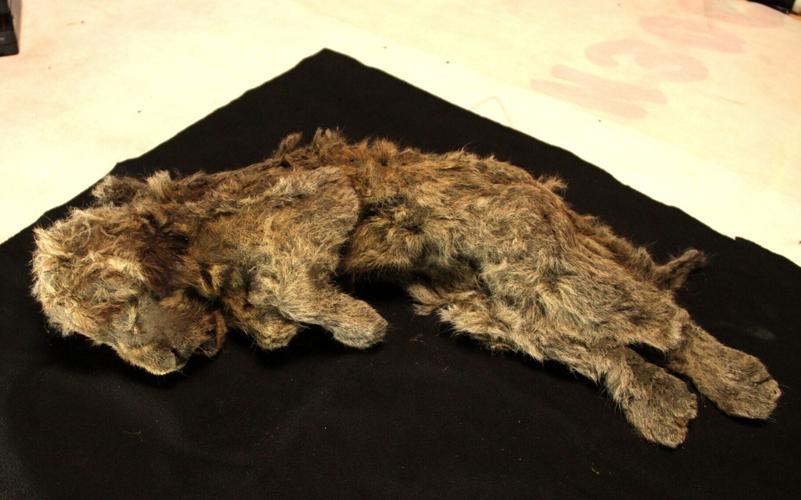
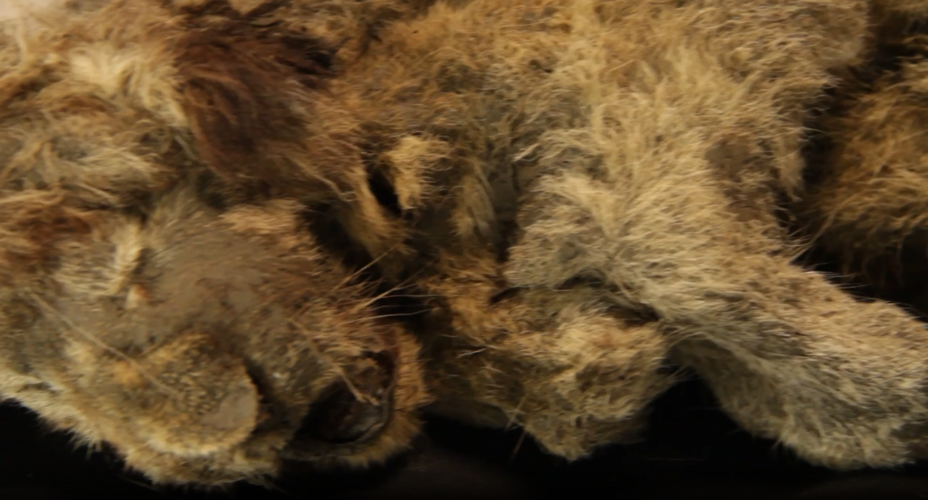

A frozen cave lion cub named Sparta, which has been radiocarbon dated to ca 32,000 years before present and genetically identified as a female. (Love Dalén via SWNS)
By Stephen Beech
An extinct species oflion once interbred with its modern cousins, suggests a new study.
Analysis of multiple genomes from the extinct cave lion has revealed that it represented a "highly distinct" evolutionary lineage, which separated from present-day lions more than a million years ago.
The findings, published in the journal Cell, also show that the cave lion had a history of interbreeding with modern lions that was tightly linked to past climatic changes.
Led by Swedish and British scientists, the research was conducted at the Centre for Palaeogenetics (CPG), which is a joint initiative by Stockholm University and the Swedish Museum of Natural History.
The research team analyzed 12 genomes from cave lions sampled across Eurasia and northernmost North America, spanning a period of over 100,000 years.
They were compared with 20 genomes from modern lions in Africa and southern Asia.
The cave lion DNA was extracted from teeth and bones, but also some soft-tissue specimens, including two "exceptionally well-preserved" cave lion cubs from Northern Siberia.
Study lead author David Stanton, now a lecturer at Cardiff University, said: "Cave lions have often been portrayed as just a larger, more rugged version of modern lions.
"But what we see in their genomes is something much more remarkable – a lineage that has been evolving independently for over a million years, accumulating its own unique biological features."
He said a comparison of the genomes shows that cave lions and modern lions formed "clearly distinct" groups, indicating long-term evolutionary separation.
While earlier estimates have suggested a relatively recent divergence, the new analyses support a much deeper split that may extend back well over 1.5 million years.

Sparta was found in 2018 in Belaya Gora, near the Indigirka River in northeastern Siberia, and her genome was sequenced as part of this study. (Love Dalén via SWNS)
The research team also identified genetic differences that likely contributed to the distinctive biology of cave lions.





The researchers found mutations unique to cave lions that are predicted to affect protein function, along with an excess of genetic changes in genes linked to brain function, vision, growth, and circulatory development.
The findings are consistent with evidence from fossils and cave art suggesting that cave lions differed from modern lions in size, behavior, and ecological adaptation.
But, despite the long period of separation, cave lions and modern lions didn't evolve in complete isolation.
The researchers identified multiple episodes of interbreeding between the two lineages across tens of thousands of years.
Although the genetic contribution from modern lions was relatively small, the researchers say the events were widespread and occurred at different points in time.
Stanton said that, strikingly, the timing of this gene flow appears to be "closely linked" to previous changes in global climate.
The research team found that the level of modern lion ancestry in cave lion genomes increased during periods when ice sheets were most extensive.
During those colder phases, cave lion populations likely expanded southward, bringing them into contact with modern lions in regions including Central and Southwest Asia.

The cave lion had a history of interbreeding with modern lions that was tightly linked to past climatic changes. (Love Dalén via SWNS)
Study senior author Love Dalén, research group leader at the Centre for Palaeogenetics in Stockholm, said: "Our results suggest that past climate change did more than reshape habitats.
"It actively brought species together, creating brief opportunities for interbreeding that would not have existed otherwise."
He says genetic evidence points to a recently extinct population of modern lions in Southwest Asia as the most likely source of the gene flow.
Dalén added: "These lions appear to have served as a contact zone between the two lineages during colder periods.
"At the same time, cave lion populations themselves were highly dynamic.
"The data reveal extensive genetic connectivity between cave lion populations across Eurasia, with ancestry spreading rapidly over large distances, within relatively short time spans."

(0) comments
Welcome to the discussion.
Log In
Keep it Clean. Please avoid obscene, vulgar, lewd, racist or sexually-oriented language.
PLEASE TURN OFF YOUR CAPS LOCK.
Don't Threaten. Threats of harming another person will not be tolerated.
Be Truthful. Don't knowingly lie about anyone or anything.
Be Nice. No racism, sexism or any sort of -ism that is degrading to another person.
Be Proactive. Use the 'Report' link on each comment to let us know of abusive posts.
Share with Us. We'd love to hear eyewitness accounts, the history behind an article.