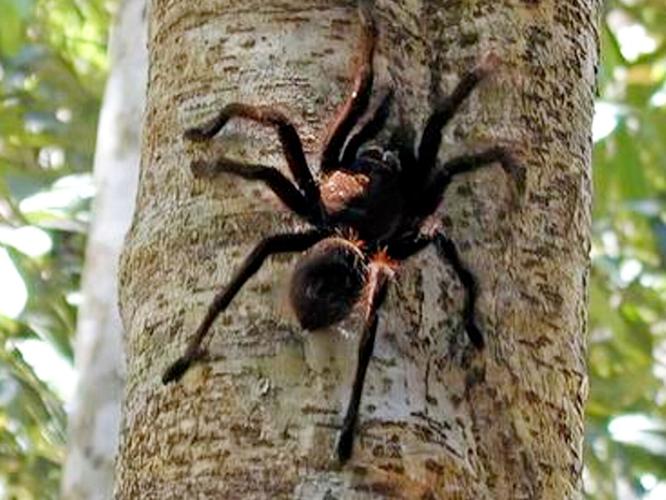
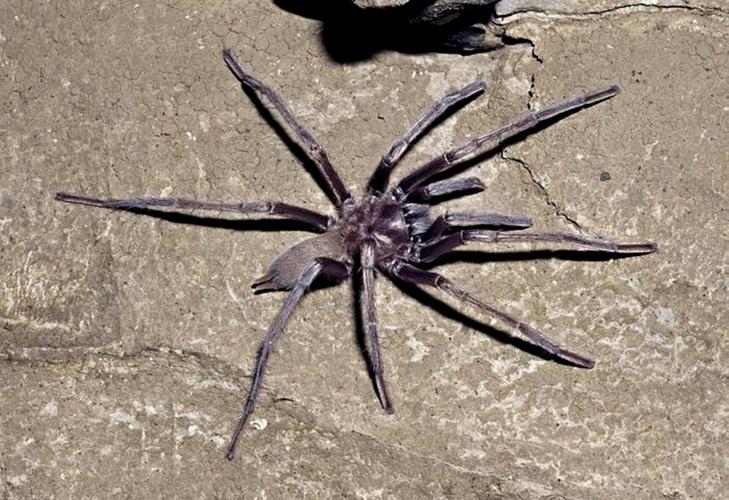
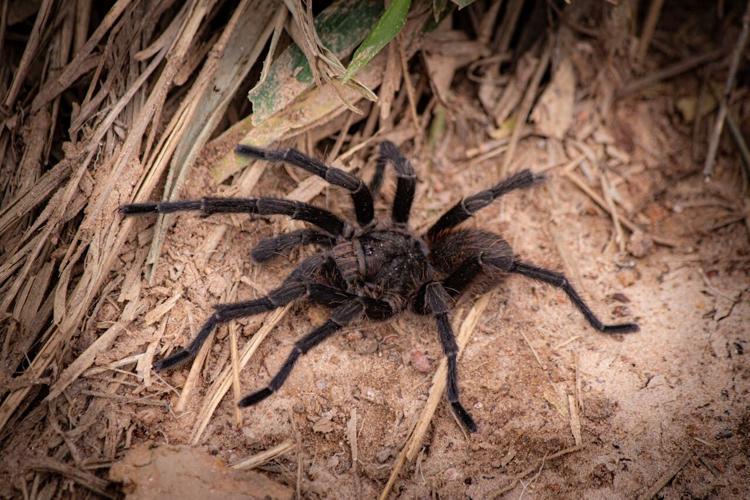
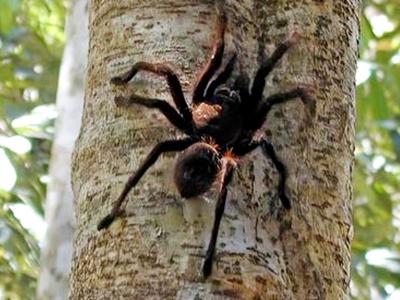

A blind cave-dwelling tarantula observed in Mexico. (Rick C. West via SWNS)
By Stephen Beech
Tarantulas use memory and learning skills to hunt for prey, suggests a new study.
Several cases of "spatial orientation" were recorded among the fearsome spiders living in both trees and in underground burrows.
The research team explained that spatial orientation refers to the ability of an animal to understand where it is in three-dimensional space and how to navigate purposefully within its environment.
They say their findings, published in the journal Ecology and Evolution, suggest that tarantulas may remember and reuse information to improve their chances of catching prey or to locate their retreats.
Study lead author Dr. Alireza Zamani and his colleagues studied spatial orientation in tarantulas in their natural habitats across North and South America.
Zamani said all the observed tarantula species showed behavior that may indicate learning.
Some tree-dwelling individuals were observed leaving their retreats every night and traveling to prey-rich locations around one to two meters away — such as areas near artificial lights that attracted flying insects.
After hunting, the spiders returned to the same retreats.
The research team also reported "unusual" climbing behavior in species that normally live in burrows.
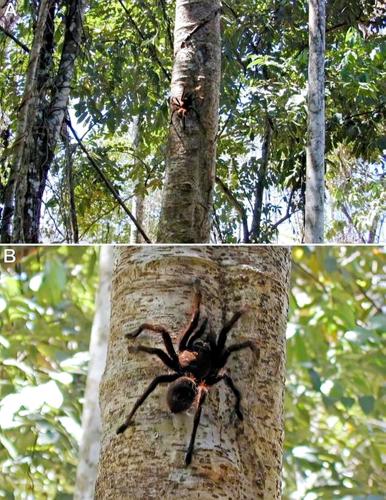
They described how the tarantulas appeared to adapt to foraging in tree canopies rather than on the ground during the dry season.

A female Goliath birdeater, a species that normally lives in burrows, foraging in tree canopies. (Rick C. West via SWNS)
The team said that, together, the observations suggest that tarantulas may remember and reuse information from previous experiences to improve their chances of catching prey.






And, in lowland floodplain areas, ground-dwelling tarantulas were seen temporarily moving into shrubs or trees during the rainy season, likely to avoid flooding.
Zamani said the observed behaviors differ from "ontogenetic shifts" — changes in an animal's habitat, diet, or behavior that occur at specific stages of development, usually when it grows from a juvenile to an adult.
Tarantulas were also observed responding to a disturbance by returning "quickly and directly" to their burrows without hesitation or signs of disorientation.
Zamani said what makes that one of the most important observations of the study is the fact that the blind cave-dwelling tarantula behaved similarly to the tarantulas with vision.
The researchers suggest that the behavior is likely supported by the spiders' ability to combine internal body signals related to movement, body position, and direction with environmental information, such as light, vibrations, and chemical cues.

(Photo by Lucas Pezeta via Pexels)
Zamani said: "Previous studies have shown that tarantulas can learn to avoid unpleasant stimuli, navigate complex mazes, and remember spatial locations over time.
"These abilities suggest that their nervous systems support more flexible behavior than traditionally assumed."
He noted that the cognitive interpretation remains preliminary.
Tarantulas are known to rely heavily on sensory information, particularly chemical and silk-based cues, which may also explain how they recognize retreats and choose foraging sites.
Zamani, from the University of Turku, Finland, says further experimental research will be needed to evaluate the relative roles of learning and sensory mechanisms.
He added: "Overall, studies on spider learning are still relatively recent, especially for tarantulas.
"Observations from the field, combined with controlled experiments, will be important for understanding how sensory cues, memory, and experience interact to help these spiders

(0) comments
Welcome to the discussion.
Log In
Keep it Clean. Please avoid obscene, vulgar, lewd, racist or sexually-oriented language.
PLEASE TURN OFF YOUR CAPS LOCK.
Don't Threaten. Threats of harming another person will not be tolerated.
Be Truthful. Don't knowingly lie about anyone or anything.
Be Nice. No racism, sexism or any sort of -ism that is degrading to another person.
Be Proactive. Use the 'Report' link on each comment to let us know of abusive posts.
Share with Us. We'd love to hear eyewitness accounts, the history behind an article.