For more than a century, Eastern European immigrants and their descendants have preserved pierogi-making traditions in American churches, restaurants, and homes, and the tradition has never needed a trend to sustain it. The food industry found ways to mass-produce them, as it does with everything, but the people making them from scratch kept going regardless. The handmade version they protected is exactly what the food world is now calling a trend.
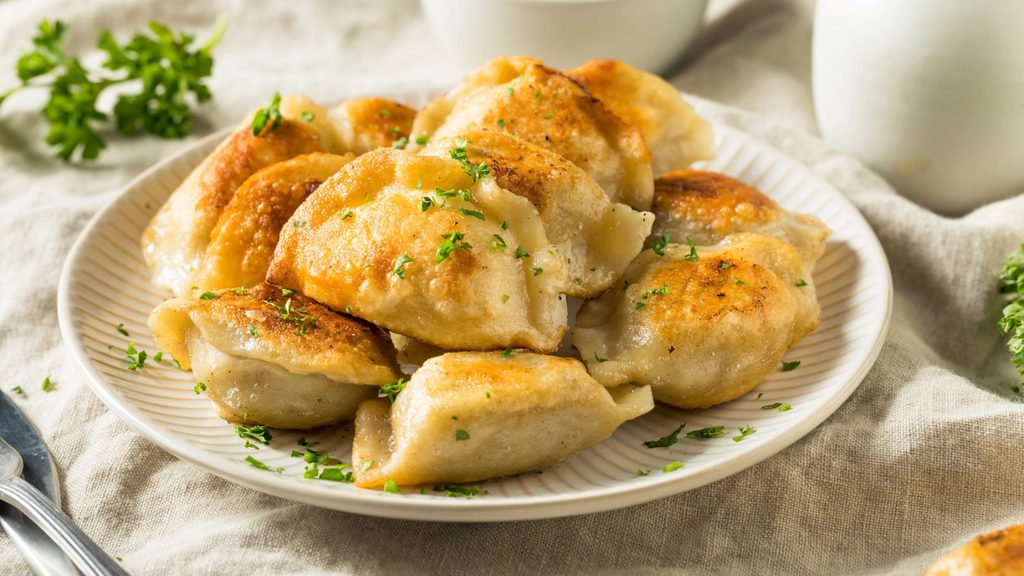
Our Lady of Perpetual Help Ukrainian Catholic Church in Wheeling traces its parish history to 1911, and its volunteers continue a long-running tradition of making and selling handmade pierogi. Ukrainian immigrants settled in South Wheeling in the late 1800s, bringing their dumplings with them and establishing the community from which the church’s food traditions grew. National Pierogi Day falls on Thursday, Oct. 8, but for this congregation, it is just another week of work.
How pierogi became an American institution
Eastern European immigrants carried pierogi into many of the industrial cities where they settled and found work. Pittsburgh took to them so deeply that the Pittsburgh Pirates have been staging a costumed pierogi race around PNC Park between innings since 1999. Runners in pierogi costumes, named Potato Pete, Cheese Chester, Sauerkraut Saul, Jalepeño Hannah, Oliver Onion, Bacon Burt and Pizza Penny, sprint roughly 280 yards while the crowd picks a favorite. In Pittsburgh, pierogi became so embedded in local culture that many residents treat them as much a regional staple as an ethnic food.
Mrs. T’s Pierogies uses the term “Pierogi Pocket” for a northeast and midwest corridor running through New York, New Jersey, Pennsylvania, Ohio, Indiana, Illinois and Michigan, with parts of the northern Midwest and southern New England, where the company says roughly two-thirds of US pierogi consumption is concentrated. Founded in Shenandoah, Pennsylvania on Oct. 8, 1952, Mrs. T’s says it now produces about 600 million pierogi a year. The date is commonly linked to Mrs. T’s founding as the reason Oct. 8 became National Pierogi Day. Classic fillings such as potato and cheese, served with sides like baked sauerkraut with apples and bacon, are a delicious way to celebrate this fun day.
The kitchen where nothing has changed
Back in Wheeling, what strikes visitors about the church kitchen is not the scale of the operation but its specificity. The volunteers use a dough-rolling machine and a specialized cutting tool sourced from a monastery in Canada. The assembly is still handwork: each pierogi is filled and sealed before going to the boiler. The Thursday public sales run most of the year, with a pause of about a month after Easter.
What the volunteers talk about, alongside the weather and their pets and the news from Ukraine, is what happens when they are gone. The congregation is smaller than it once was, and the next generation has grown up with a different relationship to the old traditions. Even if the recipe is recorded somewhere, the hands-on process may be harder to pass down than the ingredients list.
Pierozek keeps handmade pierogi on the menu in Brooklyn






In Greenpoint, Brooklyn, a neighborhood that has been called Little Poland for generations, a restaurant named Pierozek is making between 1,000 and 3,000 pierogi by hand every day. The owners credit a team of women who hand-assemble the pierogi, with nearly all of the core team working there from the beginning. Pierozek received its first Michelin Guide Bib Gourmand in 2021, a distinction recognizing good-quality cooking at good value.
Pierozek says almost 70% of its diners are trying pierogi for the first time. The restaurant marks National Pierogi Day every Oct. 8 with an eating contest, and the restaurant’s record is 88 pierogi, set by competitive eater Joel Hansen. Pierozek isn’t reinventing the dish so much as bringing a longstanding handmade tradition into a modern Brooklyn restaurant. Church kitchens and community groups across the region have been making pierogi by hand for generations.
Where this goes in 2026
The food world has caught up to what some already knew. For 2026, Yelp identified grandmacore, food and settings associated with home cooking and family nostalgia, as one of its dining trends. Comfort foods and global comfort foods ranked No. 2 and No. 7 respectively among the top 10 overall menu trends culinary professionals named for the year, reflecting diners’ appetite for nostalgia, comfort and emotional connection.
Pierogi have always been both; the difference is that the rest of the country is paying attention now.
The next batch depends on who learns to fold
Trend lists turn over every year, and grandmacore may not make the next one. For church kitchens like the one in Wheeling, the bigger question is whether the attention brings in new volunteers along with new customers. A recipe fits on a card. Sealing a pierogi by hand is learned at the table, next to someone who has done it for years, and fewer of those people are left to teach.
Mandy writes about food, home and the kind of everyday life that feels anything but ordinary. She has traveled extensively, and those experiences have shaped everything, from comforting meals to small lifestyle upgrades that make a big difference. You’ll find all her favorite recipes over at Hungry Cooks Kitchen.
The post The food world is calling it a trend, but pierogi makers have been at it for generations appeared first on Food Drink Life.
(0) comments
Welcome to the discussion.
Log In
Keep it Clean. Please avoid obscene, vulgar, lewd, racist or sexually-oriented language.
PLEASE TURN OFF YOUR CAPS LOCK.
Don't Threaten. Threats of harming another person will not be tolerated.
Be Truthful. Don't knowingly lie about anyone or anything.
Be Nice. No racism, sexism or any sort of -ism that is degrading to another person.
Be Proactive. Use the 'Report' link on each comment to let us know of abusive posts.
Share with Us. We'd love to hear eyewitness accounts, the history behind an article.