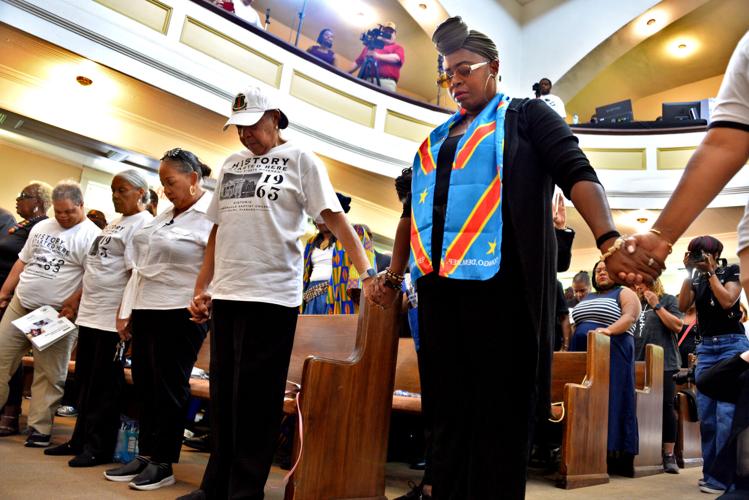
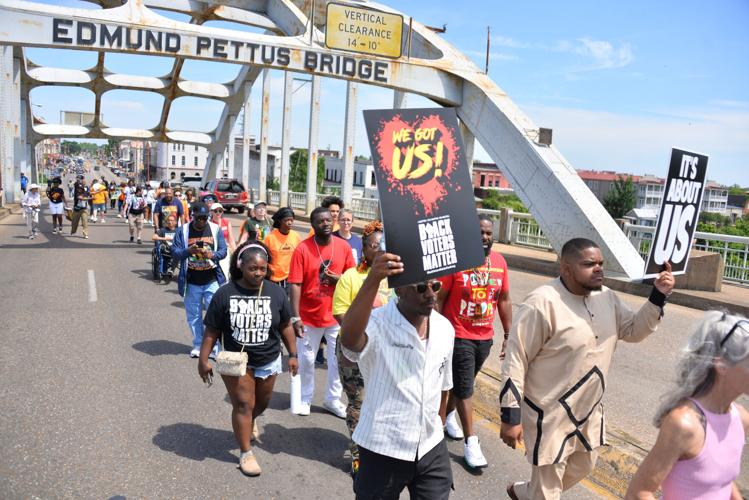
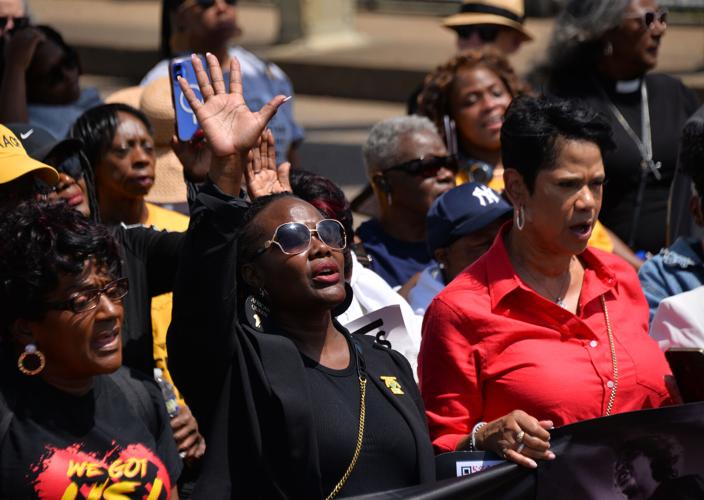
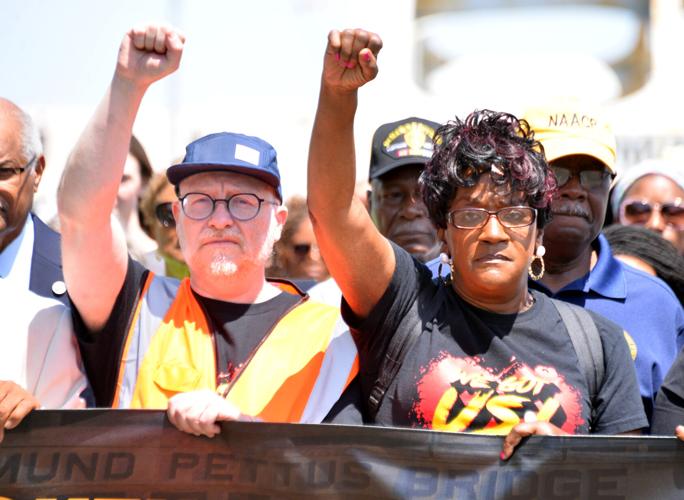
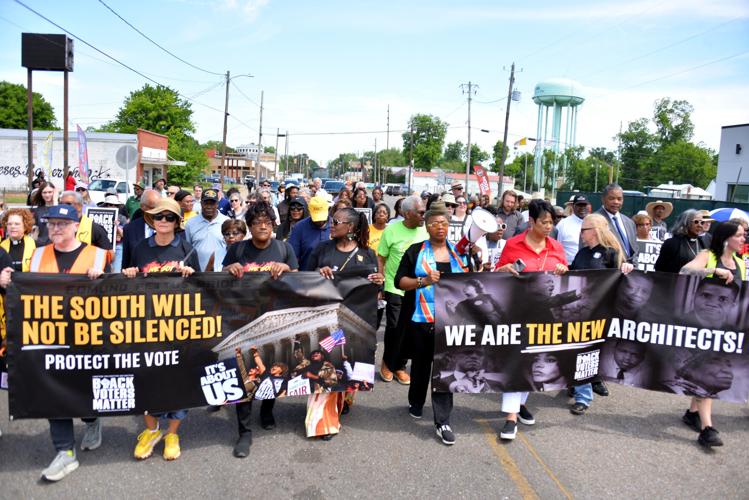
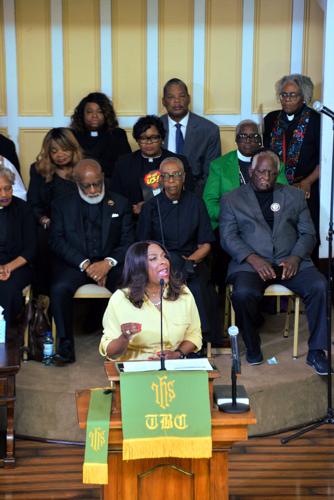
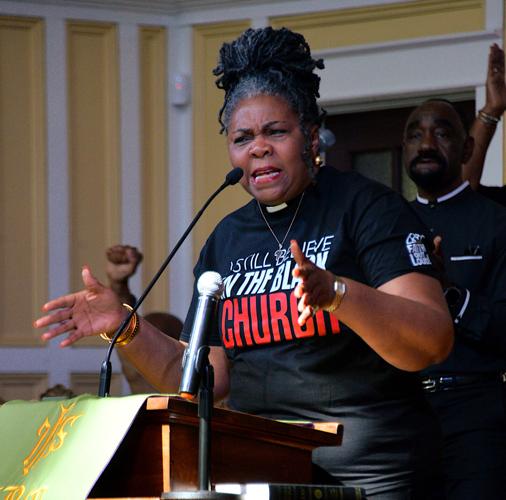

More than 1,000 people gathered in Selma on Saturday for the first leg of All Roads Lead to the South’s National Day of Action for Voting Rights protests that oppose a recent U.S. Supreme Court decision that organizers say weakens protections under the Voting Rights Act.
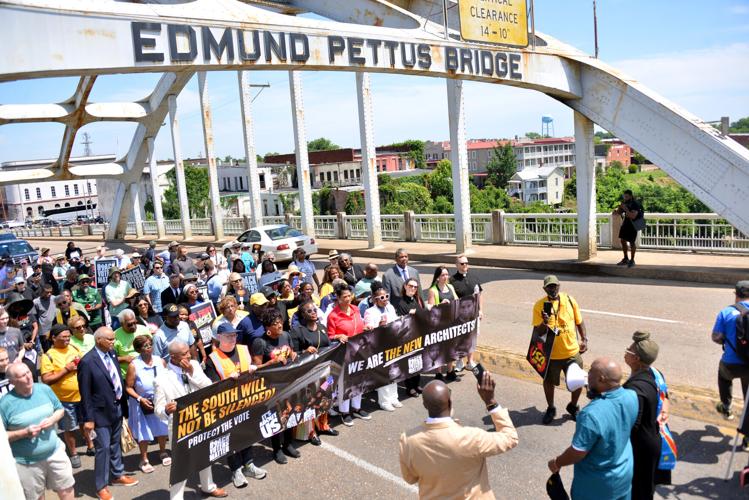
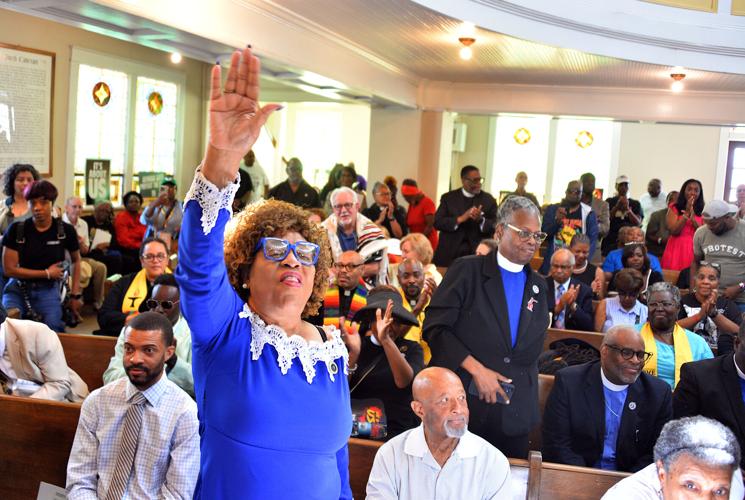
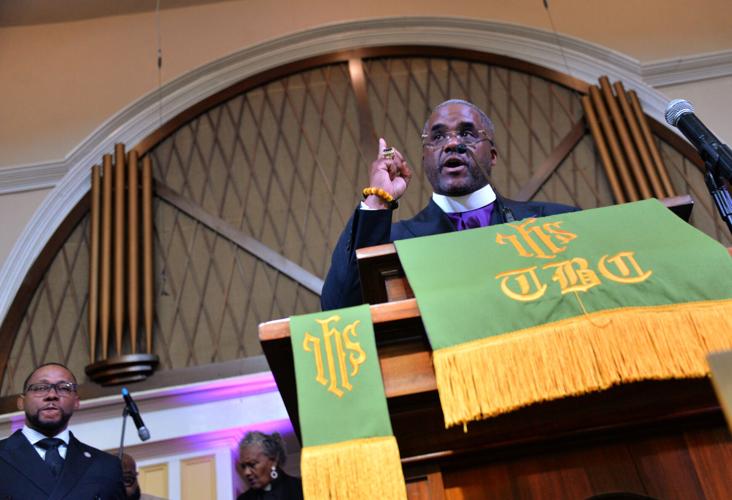
Selma’s pastor-led gathering began at the historic Tabernacle Baptist Church, where mass meetings were held before the 1965 Selma voting rights marches. Faith leaders from across the country led prayers, speeches and calls to action before demonstrators marched silently across the Edmund Pettus Bridge carrying signs reading “Black Voters Matter” and “What side of the bridge are you on?”
The protest was organized in response to the Supreme Court’s ruling in the Louisiana v. Callais case, which critics say weakens Section 2 of the Voting Rights Act by limiting challenges to electoral maps and voting laws viewed as racially discriminatory.
Speakers connected the court ruling to ongoing redistricting battles across the South, including in Alabama, where congressional district maps remain under dispute, especially districts held by Black Democrats.
U.S. Rep. Terri Sewell, whose District 7 seat is at risk, told the crowd the Black church has historically played a central role in civil rights movements and continues to lead on voting rights issues today.
“What we are seeing in the wake of the Supreme Court decision is a coordinated effort to erase our hard-fought progress and to silence the voices of Blacks and minorities,” Sewell said. “As someone who represents Alabama’s Civil Rights District, this fight is deeply personal for me.”
Sewell was joined by more than 20 members of Congress who participated in events in Selma and Montgomery throughout the day.
Pastors say the modern movement mirrors the faith-led organizing that fueled the original Selma campaign in 1965.
Rev. Traci Blackmon of St. Louis said worship and protest have long been connected in the fight for civil rights.
“The goal of people of faith is never just winning the battle — it’s winning the spirit and the soul,” Blackmon said from the church pulpit.
Rev. Leodis Strong, pastor of Brown Chapel AME Church in Selma, said churches were central to the original voting rights movement before legal victories were won in courtrooms.





“There was a legal component, but before there was a courthouse component, there was a church house component,” Strong said.
First-time Selma visitor and marcher Shosh Madick, a Rabbinic student living in New Orleans, said, “you could feel the power in the room.”
After the service, demonstrators crossed the bridge in silence to honor the foot soldiers who marched in Selma 61 years ago and were beaten by State Troopers on Bloody Sunday, an effort that helped lead to passage of the Voting Rights Act.
At the base of the bridge, Selma Mayor Johnny Moss III welcomed the crowd to the “sacred ground” of Selma where generations have had a voice thanks to the civil rights marches of the 1960s, adding Selma is “not just history, Selma is still a movement.”
Kathryn Belina, an equality captain and activist with Equality Florida, sobbed on the southside of the Edmund Pettus Bridge after the march, saying it was a privilege to have the opportunity to cross the bridge for equal voting rights like those in 1965. But she said the tears were also out of frustration over the Supreme Court’s reversal of the redistricted maps that required another rally.
“I never thought we’d be here again and that I would get the change to cross the bridge in this time for this reason,” Belina said.
Dianne Harris of Greensboro, who marched as 12-year-old in the 1960s, became emotional while crossing the bridge again Saturday.
“I was honored to be able to come back and cross the bridge again,” Harris said while resting on the side of the bridge and dabbing her wet cheeks with a tissue. “I was glad to be able to share this experience with so many people today.”
Charles Mauldin, a Selma foot soldier whose parents were among the first Black residents registered to vote in Dallas County after passage of the Voting Rights Act, said the Black community has one choice as voting rights are endangered. He had the crowd gathered at the southside of the bridge after the march say, “It’s our time. It’s our turn. If we don’t do our part, it’s our fault.”
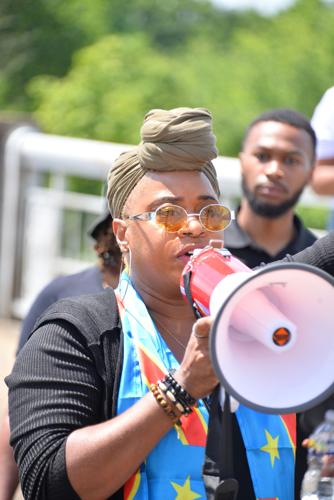
Black Voters Matters co-founder LaTosha Brown took the megaphone after Mauldin to end the Selma rally with a message to fight “hate with love.”
“Only love will carry us through,” she chanted with the crowd before boarding a bus and heading to Montgomery.
(0) comments
Welcome to the discussion.
Log In
Keep it Clean. Please avoid obscene, vulgar, lewd, racist or sexually-oriented language.
PLEASE TURN OFF YOUR CAPS LOCK.
Don't Threaten. Threats of harming another person will not be tolerated.
Be Truthful. Don't knowingly lie about anyone or anything.
Be Nice. No racism, sexism or any sort of -ism that is degrading to another person.
Be Proactive. Use the 'Report' link on each comment to let us know of abusive posts.
Share with Us. We'd love to hear eyewitness accounts, the history behind an article.