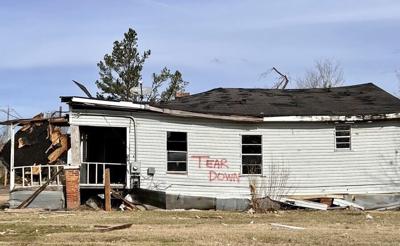

Selma city officials are working hard to get some of the money needed to rebuild the city after the January 2023 tornado.
Selma City Planning Director Danielle Wooten told the Selma City Council at their Feb. 13 meeting that the city has received $21.3 million in federal support in the last year and a half.
“I know the public says, ‘Where’s the $21 million? I don’t see it,’” Wooten said. But she said several projects are in the design and bid stages and should begin in the next few months.
Wooten took the Selma City Council through a 24-page report of the city’s efforts to help Selma recover from the tornado. The city’s disaster recovery planning has three main goals: Housing residents displaced by the tornado, repairing damaged infrastructure and revitalizing the city’s economy.
Housing, infrastructure and economic recovery are linked, and all three “will require a significant investment of time, money and resources,” the report states.
The loss of housing, especially affordable housing, “is a major concern in Selma,” the report says. “The tornado destroyed many affordable homes and rental units. This has made it difficult for low-income residents to find affordable housing.”
Over 40% of Selma residents live below the poverty line, so many residents were living in substandard and aging housing before the tornado tore a swath through the Queen City.
The lack of affordable housing has forced some residents to live with friends and families, but some have had to go to shelters. Demand for housing is expected to increase, which “could lead to higher housing costs,” making it even more difficult for residents to find affordable housing, the report says.
The recovery plan hopes to address housing issues through direct housing assistance and repair from FEMA as well as temporary housing and new affordable housing construction. The first of more than two dozen affordable modular homes was placed on its foundations in a neighborhood in Disaster Area No. 1 earlier this month.




FEMA has awarded Selma almost $8.3 million in tornado recovery, including debris removal, housing assistance and paying wages for public safety workers. More than 60 homes damaged beyond repair by the tornado will be torn down using $1 million in FEMA funds once the city gets clearance from the Alabama Department of Environmental Management, Wooten told the council.
The city has received $2 million from the U.S. Department of Housing and Urban Development to test up to 100 homes for lead contamination. About 85 homes can be rehabilitated with the funds.
The full extent of damage to the city’s infrastructure “is not yet known and it is likely that it will take several years for the city to fully recover,” according to the report. In addition to storm damage, the city’s infrastructure has deteriorated from “age, limited maintenance and economic constraints,” the report says.
“Damage assessments and priority sequencing has been completed to identify projects and measures to prioritize repair and reconstruction efforts based on the severity of damage and need, criticality to community function and resource availability while enhancing resilience against future disasters,” the report says.
Fifty-nine blocks in downtown Selma and Disaster Area 1, which is basically the center of the city, will be resurfaced soon with a $2 million grant from the Delta Regional Authority. The city has applied for a $29 million grant from the U.S. Department of Transportation that would resurface streets city-wide.
“Put your hands together,” Wooten joked as she folded her hands in prayer.
The city has identified economic development corridors along Highland Avenue, Citizens Parkway, Broad Street and Dallas Avenue. The goals are to attract new businesses, help existing businesses expand, improve the downtown streetscape and promote the downtown area.
“The challenges include the need for systematic revitalization, balancing historic preservation with modern infrastructure, financing and funding, engaging public private partnerships effectively and ensuring the integration of the community’s vision into the development process,” the report says.


(0) comments
Welcome to the discussion.
Log In
Keep it Clean. Please avoid obscene, vulgar, lewd, racist or sexually-oriented language.
PLEASE TURN OFF YOUR CAPS LOCK.
Don't Threaten. Threats of harming another person will not be tolerated.
Be Truthful. Don't knowingly lie about anyone or anything.
Be Nice. No racism, sexism or any sort of -ism that is degrading to another person.
Be Proactive. Use the 'Report' link on each comment to let us know of abusive posts.
Share with Us. We'd love to hear eyewitness accounts, the history behind an article.