

This is the second a three-part series looking at state intervention in local school districts. Read Part 1 here.
SELMA — Mason’s grandfather had recently taught him the family recipe for fried green tomatoes. And Mason wanted to show his classmates in the Better Basics program at Brantley Elementary School how to make them, using green tomatoes in the class’ garden.
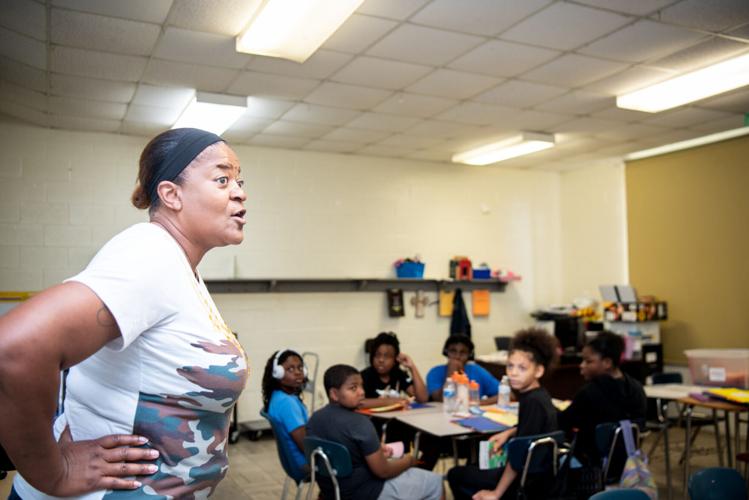
“They did the batter, cut the tomatoes. We have safety kids’ knives, potato peelers, and they cut their tomatoes,” their teacher, Towanda Friday, said. “Mason showed them how to season it, and they season it all up. And so they watched us cook the tomatoes for them.”
Friday teaches fifth grade at Brantley Elementary in the Dallas County School system, and the Better Basics program in the summer. It was a grant program through a Birmingham organization that serves central Alabama to “advance children’s literacy” and also incorporates music.
Mason’s plans aligned with Friday’s, who along with reading and math teaches her students how to take care of a garden. She said in a recent school visit that they had tomatoes, squash, sunflowers, watermelon and red peppers. She teaches them how to make everyday lunches, and to stay away from the microwave.
“They’re not only going to do cooking and the garden. They’re bringing in instruments to play in a band,” she said. “They’re trying to help build Brantley up.”
Friday teaches in a system that is in the early stages of supervision by the state. Alabama State Superintendent Eric Mackey intervened in the system in March, his third intervention, saying that the system did not follow proper procurement processes in dealing with more than $12.1 million in federal funds.
Alice Jackson, the system’s director of federal programs, said intervention is helping on the financial side. Part of why the system had so many federal dollars left, she said, was due to not having a streamlined system to process those funds.
“I’m very optimistic that with the transition of Mr. Sampson and the company of Dr. Boyd, that we’ll be able to get the system where it needs to be in a timely manner,” Jackson said of the system’s former superintendent, Anthony Sampson, and the state official in charge of the intervention, Daniel Boyd.
Why the state stepped in
Mackey intervened in Dallas County because of financial and board governance concerns, according to the show cause letter sent to the local board on Feb. 21.
“This behavior erodes public trust in individual members and the Board as a whole. It also suggests that the Board is dysfunctional and ineffective in properly stewarding the funds awarded to the system for its students,” Mackey wrote in the letter. “Consequently, losing faith in the Board’s ability to govern could lead to a decline in engagement and support, making it more difficult for the DCSS to receive additional federal monies in the future.”
Mackey said in a June interview that the Dallas intervention is different from the Sumter County and Bessemer City interventions.

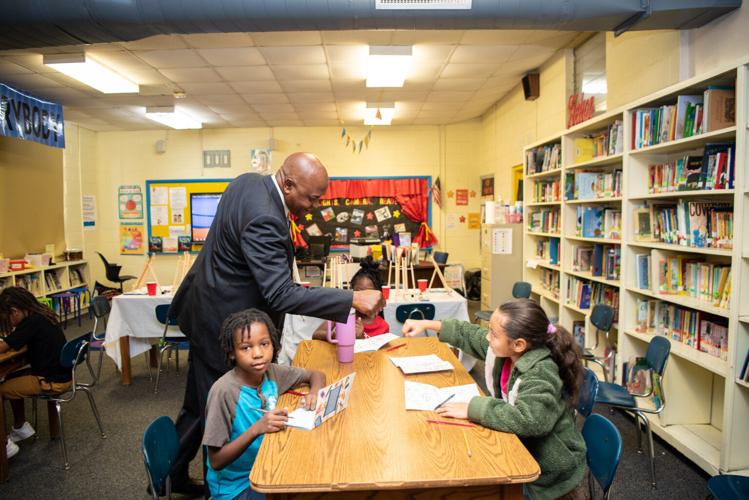
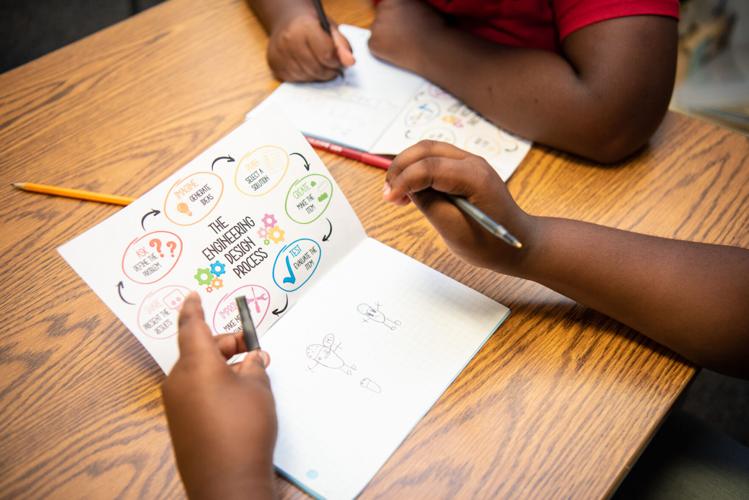
Students at Brantley Elementary School take part in a STEM activity during a visit from Dallas County Schools Superintendent Anthony Sampson on Monday, June 30, 2025. (Andi Rice for The Alabama Reflector)
“It was not necessarily that the board couldn’t get together and get it done, but they just didn’t have it,” he said. “They literally don’t have the money and don’t have the capacity to handle the situation that was before them.”
One reason for that is a shrinking population base. Dallas County’s population shrunk 12% between 2010 and 2020. Public school enrollment has fallen even faster: Dallas County Schools had just over 3,300 students in the 2014-15 school year; it fell to 2,262 in the 2023-24 school year, a 32% decrease. Boyd said that the population decline is directly related to the intervention and the school closures.
“Our schools are a microcosm of the greater community,” Boyd said. “As our greater community gets smaller, the population of schools will decline.”
The district is already being reshaped by intervention. In an effort to get one month’s worth of expenses in reserve, two of the district’s 11 schools will close. Boyd, the state-appointed chief administrative officer for the Dallas and Bessemer interventions, said the system had 20% of a month’s expenses in reserve. He said in a phone interview Tuesday that a month’s expenses for the system is about $2.8 million.
“I feel that perhaps in 18 months or so, we’ll have that state minimum of one month reserve, maybe even before 18 months, which will be huge,” Boyd said. “It’s been years since the district had this one month reserve.”
The Dallas County Board of Education unanimously approved the closures of J.E. Terry Elementary School in Plantersville and Bruce K. Craig Elementary School in Selma on June 4. Like the district, Both schools had seen enrollment fall. J.E. Terry, which had 123 students in the 2014-15 school year, had 81 in the 2023-24 school year, according to the Alabama State Board of Education. Bruce K. Craig, which had 218 students enrolled in 2014-15, had 148 in 2023-24.
Boyd said the teachers at those schools were offered positions at other schools in the district and the students will consolidate to Valley Grande Elementary School, in Valley Grande. Both closed schools are about 12.5 miles from Valley Grande, in opposite directions.

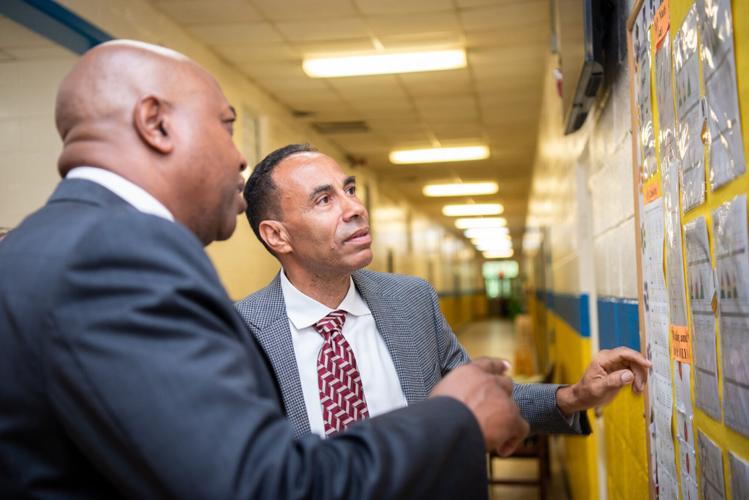
Dallas County Superintendent Anthony Sampson, left, confers with Dr. Daniel Boyd as they review student performance data at Brantley Elementary School in Selma, Ala., on June 30, 2025. The meeting is part of ongoing efforts to improve academic outcomes in Dallas County Schools. (Andi Rice for The Alabama Reflector)





“We don’t feel that it will make a lengthy trip for the students. Our transportation supervisor and transportation staff are working closely together to make sure that we’ve streamlined the routes as much as possible,” he said.
Boyd did not rule out the possibility of further closures, but said he feels confident the two closures will help get the system’s finances back in line.
“Even though you have a plan in place, it’s not until school starts and you see how the routes run that you’re able to make additional modifications to improve efficiency,” Boyd said.
Academics
Academic achievement was not a reason for the state’s intervention, and former Dallas County Superintendent Anthony Sampson took pride in the kids’ achievements.
“I’m really proud that kids know where they stand academically on their own, not based on what somebody else is saying,” he said on June 30, his last day as superintendent. .
Sampson, who had served as superintendent since 2022, chose not to renew his contract in November so he could be closer to his family in Baldwin County.
“The last 100 days have been very busy, very fulfilling, and it just never ends. There’s always highs and there’s always lows,” Sampson said.
Former DCS Superintendent Hattie Shelton has stepped in as an interim superintendent while Boyd searches for a permanent superintendent. She said in a phone interview Thursday that she will support the students and teachers to her best ability.
“I’m probably going to be praying very hard for things to turn around for us and turn around quickly,” Shelton said.
‘A lot of motivation’

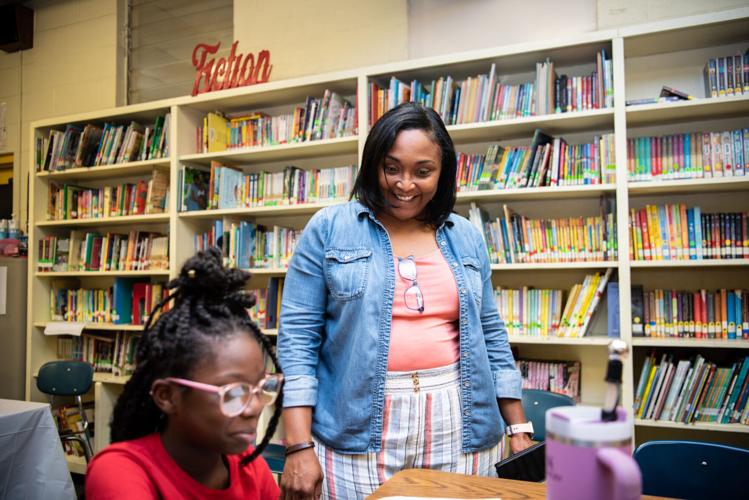
Brantley Elementary Principal Adrienne Lee speaks with students during a visit by Dallas County Superintendent Anthony Sampson on June 30, 2025, (Andi Rice for Alabama Reflector)
Brantley Elementary Principal Adrienne Lee values transparency in academics, and making the usually stressful tests fun for her students.
“We do a lot of motivation here. We’re very unorthodox,” Lee said. “We’re doing a lot of music, we’re doing a lot of activities to push and motivate you.”
The school got a 56 on the 2022-2023 state report card, a result that surprised Lee. She started posting graphs depicting the school’s performance on recent state tests on Brantley Elementary’s colorful hallways.
“Instead of us taking that 56 and saying that’s who we are, we said, ‘That’s exactly who we started from,’” she said. “And we started to build ourselves.”
The school’s score increased to a 67 for the 2023-2024 report card.
“That motivation does a lot, and we motivate our kids a lot,” she said. “We’re playing music, we’re getting in the hallway, we’re dancing.”
Although recent test score data is not available at the school and district level, the fifth and sixth graders in Friday’s class knew how they did on the state test. Of the six students in her class on June 30, the average proficiency score was 2.6 out of 4 for math and 2.8 out of 4 for English Language Arts. Students are scored from level one to level four, where levels three and four are considered proficient. Statewide, 68% of fifth graders are proficient in ELA, and 40% of fifth graders are proficient in math.
“When I tell you they go hard, they work really hard, and they listen to everything that I taught them or told them to do. They implemented it no matter what, no matter how much homework I give them to do, they actually did it,” Friday said. “I’m really proud of them, because they put their best forward at all times.”
Updated at 9:50 a.m. to correct the identity of the person in the lead photo. It is Anthony Sampson, not Daniel Boyd.
This story is from alabamareflector.com.

(0) comments
Welcome to the discussion.
Log In
Keep it Clean. Please avoid obscene, vulgar, lewd, racist or sexually-oriented language.
PLEASE TURN OFF YOUR CAPS LOCK.
Don't Threaten. Threats of harming another person will not be tolerated.
Be Truthful. Don't knowingly lie about anyone or anything.
Be Nice. No racism, sexism or any sort of -ism that is degrading to another person.
Be Proactive. Use the 'Report' link on each comment to let us know of abusive posts.
Share with Us. We'd love to hear eyewitness accounts, the history behind an article.