





(Photo by cottonbro studio via Pexels)
Half of Americans say they’re more disconnected than ever — but in a good way, according to new research.
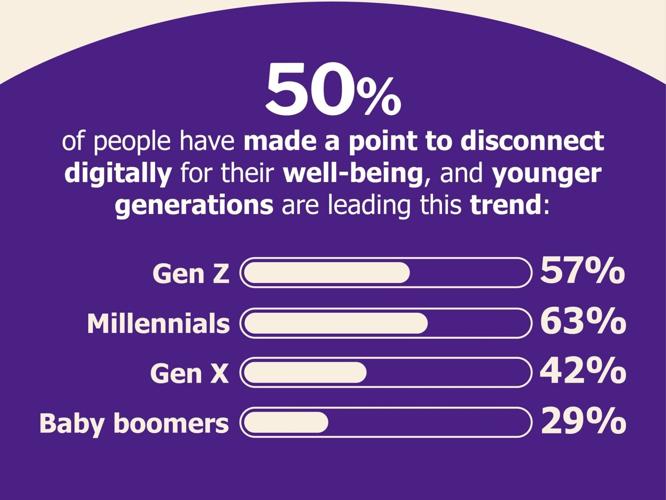
In the survey of 2,000 Americans, 50% said they’ve made a point to disconnect digitally and spend less time on screens for their well-being.
And young Americans are trailblazing this trend, with more Gen Z (63%) and millennials (57%) getting offline than Gen X (42%) and baby boomers (29%).

(Talker Research)
The study was conducted by Talker Research on behalf of ThriftBooks and revealed that Gen Z (54%) and millennials (43%) are also more likely than Gen X (33%) and baby boomers (22%) to have a designated screen-free time in their day.
Uncovering the “why” behind this trend, respondents said that being digitally disconnected makes them feel more productive (42%), present for their loved ones (33%) and aware of the goings-on in their daily lives (36%).
And when they notice they’re spending too much time on screens, people reported they feel overwhelmed (25%), anxious (22%), irritable (18%) and unsatisfied with their lives (19%). They also reported that, on average, 70% of the time they spend online leads to feelings of disconnection and loneliness rather than authentic connection.
Looking at how these feelings influence daily habits and decisions, more than eight in 10 Americans (84%) said they’ve incorporated analogue lifestyle choices in their day-to-day, which emphasize non-digital tools in favor of slower, more tangible ways of living.

(Photo by cottonbro studio via Pexels)
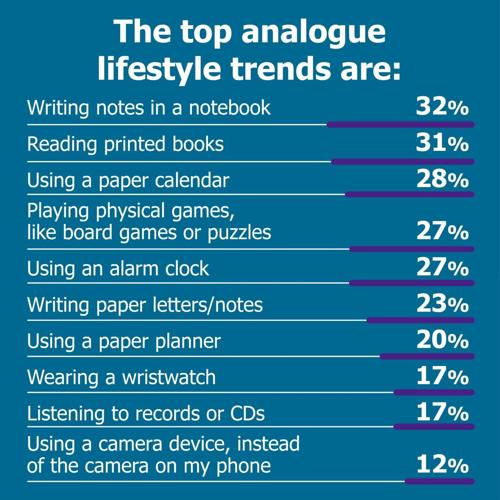
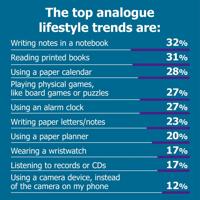
According to the findings, the top 10 analogue trends and habits were writing notes in a notebook (32%), reading printed books (31%), using paper calendars (28%), playing physical games, like board games or puzzles (27%) and using alarm clocks (27%).
Along with those, respondents said they write paper letters (23%), use physical planners (20%), wear wristwatches (17%), listen to records or CDs (17%) and use camera devices, instead of phone cameras (12%).
“The study findings indicate that people are more aware than ever of the value of offline time,” said Barbara Hagen. “What’s even more interesting and positive to see is that people are replacing this time with healthy habits and activities, like reading.”
In the survey, more than three-quarters (77%) said that the older they grow, the more they realize the importance of spending time in the “real world” as opposed to the online world.






For many (66%), this looks like incorporating slow living (e.g., a slower, more mindful approach to life that prioritizes intention and quality over speed) in the new year, with Gen Z (71%) and millennials (70%) once again leading the charge to slow down.
When respondents want to slow down and seek a break from the online world, they said they turn to reading (32%), quality time with friends and family (51%), hands-on hobbies (31%) and time outdoors (41%) as alternatives.

(Talker Research)
Zooming in to how reading benefits mental health, compared to time spent online, Americans said that picking up a book makes them feel relaxed (46%), mentally stimulated (32%) and grounded (27%).
And in line with the trend of digital disconnection, the data found that reading will be more popular than ever in 2026, with 70% of people reporting they plan to read more in the new year.
Twenty-nine percent think they’ll consume equal amounts of fiction and nonfiction in 2026, 24% anticipate they’ll read more non-fiction books and 22% think that fiction will be their top category.
Also concurrent with the rest of the study findings that analogue tools and habits are on the rise, half of those polled (49%) want to read more physical books in the new year.
“Reading books, especially printed ones, is an excellent way to slow down, ground yourself and really immerse yourself in an activity that gives back to you,” continued Hagen. “Not only is it mentally stimulating, but it’s a great way to relax, calm down and get a break from our busy lives.”

Luan Fonseca
TOP 10 ANALOGUE LIFESTYLE TRENDS
- Writing notes in a notebook (32%)
- Reading printed books (31%)
- Using a paper calendar (28%)
- Playing physical games, like board games or puzzles (27%)
- Using an alarm clock (27%)
- Writing paper letters/notes (23%)
- Using a paper planner (20%)
- Wearing a wristwatch (17%)
- Listening to records or CDs (17%)
- Using a camera device, instead of the camera on my phone (12%)
Research methodology:
Talker Research surveyed 2,000 general population Americans who have access to the internet; the survey was commissioned by ThriftBooks and administered and conducted online by Talker Research between Dec. 2 and Dec. 5, 2025. A link to the questionnaire can be found here.
To view the complete methodology as part of AAPOR’s Transparency Initiative, please visit the Talker Research Process and Methodology page.



(0) comments
Welcome to the discussion.
Log In
Keep it Clean. Please avoid obscene, vulgar, lewd, racist or sexually-oriented language.
PLEASE TURN OFF YOUR CAPS LOCK.
Don't Threaten. Threats of harming another person will not be tolerated.
Be Truthful. Don't knowingly lie about anyone or anything.
Be Nice. No racism, sexism or any sort of -ism that is degrading to another person.
Be Proactive. Use the 'Report' link on each comment to let us know of abusive posts.
Share with Us. We'd love to hear eyewitness accounts, the history behind an article.