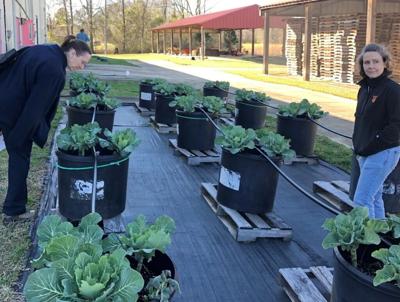
A research, education, and extension center in Dallas County is helping small farmers learn how to market and preserve their fruits and vegetables.
Tuskegee University’s Black Belt Marketing and Innovation Center on Highway 80 in Dallas County is a local processing facility that provides the equipment and training farmers need to get their crops to market.
Consumers prefer local food, but even locally grown fruits and vegetables must be preserved. Processing helps preserve fruits and vegetables so they can be enjoyed year-round. Small- and medium-scale farmers such as those you might see at your local farmers market face unique challenges when it comes to processing their produce.
That’s where the BBMIC comes in. The BBMIC has undergone extensive transformation in recent years to become a produce research facility, aggregation center and processing incubator for the Dallas County region.
The 18,000-square-foot center is one of only a few facilities in the state that provides the equipment and training necessary to increase economic opportunities for small farmers while making more fresh produce available to Black Belt families.
This support is important because slightly more than half of the farms in Dallas County report revenues of less than $10,000 per year. Additionally, about a quarter of the farmers have been farming for less than 10 years. A critical step toward developing a healthy regional food system is supporting Black Belt farmers through education and training that will help them access markets and, in turn, develop more financially viable farms.
The BBMIC is fully equipped with an inline washing conveyor, sorting tables, grading tables, pea shellers, greens spinner and vacuum packaging equipment. The slicing machine could slice 2,000-4,000 pounds of produce per hour. The pea shellers used to separate peas from their pods similarly boast an impressive speed of two bushels of peas in 15 minutes.
Farmers stored or processed 37,662 pounds of produce at the BBMIC in 2024. This includes collard greens, mustard greens, corn, watermelons, summer squash, kale, peas, peppers, turnip greens and okra.






The most critical need fulfilled by the BBMIC for farmers may be its cold storage capacity. Cold storage is vital for extending the shelf life of saleable product and reducing waste.
Although the BBMIC also has an ice machine, farmers still struggle to reduce their product’s “field heat” at the farm, which reduces shelf life. The Center provides plastic containers that are more effective at cooling the product than boxes.
Local farmer organizations sometimes use the Center’s refrigerated truck to transport produce from farms to the facility and to take goods from the Center to markets in Selma and Linden. Food is distributed to wholesalers, direct home delivery to the elderly, two food banks, three farmers markets and one church.
The BBMIC prioritizes education and research to benefit small-scale, underserved farmers in the Black Belt. Farmers, community members and interns who engage in processing fruits and vegetables receive training on manufacturing practices and food safety and hygiene.
The BBMIC also serves as an event space for gatherings such as the second annual Black Belt Food Systems Alliance Meeting held in December, where farmers had an opportunity to connect with available resources for scaling up their farms and discuss their vision for a strong Black Belt food system that is financially viable for producers.
To learn more about Tuskegee University’s programs supporting Black Belt farmers and food producers, including their mini-grants up to $5,000, visit Tuskegee’s Carver Integrative Sustainability Center website. The work of the BBMIC is made possible by public and private support, including funding from several USDA sources, The Heart of Alabama Food Bank, and the W.K. Kellogg Foundation.
Kaitlin Fischer is a rural sociologist and postdoctoral fellow in decision-making and team science at Auburn University. She can be reached at kmf0101@auburn.edu. Kristin Woods is a sustainable food systems resource specialist for Tuskegee University Cooperative Extension, with a focus on diverse farming systems. Her email address is kwoods2@tuskegee.edu. Wendiam Sawadgo is an assistant professor & Alabama Cooperative Extension System economist at Auburn University. His email address is wendiam@auburn.edu
(0) comments
Welcome to the discussion.
Log In
Keep it Clean. Please avoid obscene, vulgar, lewd, racist or sexually-oriented language.
PLEASE TURN OFF YOUR CAPS LOCK.
Don't Threaten. Threats of harming another person will not be tolerated.
Be Truthful. Don't knowingly lie about anyone or anything.
Be Nice. No racism, sexism or any sort of -ism that is degrading to another person.
Be Proactive. Use the 'Report' link on each comment to let us know of abusive posts.
Share with Us. We'd love to hear eyewitness accounts, the history behind an article.