The hot dog has been America’s most reliable summer food for over a century, and this summer it turns out to be one of its most interesting. The regional debates are real, the culinary ambition in the category is genuine and National Hot Dog Month this July has more substance behind the celebration than the name usually suggests.
Americans have been eating hot dogs by the billions every summer for as long as anyone can remember, and the numbers behind National Hot Dog Month are genuinely striking. What is different right now is not the volume but the conversation happening around it, as cities stake serious cultural identity on their own version of the frank, chefs build real restaurant concepts around it and a growing industry bets that Americans are ready to pay more for a better one.
America eats 7 billion hot dogs this summer
Americans typically consume 7 billion hot dogs between Memorial Day and Labor Day, roughly 818 every second throughout the summer. July alone accounts for 10% of annual retail hot dog sales, and on the Fourth of July, Americans put away an estimated 150 million hot dogs in a single day.
Industry analysts value the U.S. hot dog and sausage production sector at $26.4 billion in 2026, with producers focused on premiumization and niche products best positioned in the category going forward. For a food that started as a street cart staple, those are serious numbers.
Chicago draws the line on its dog
No city has codified its hot dog with more conviction than Chicago. The Chicago dog is a specific, non-negotiable assembly: an all-beef Vienna Beef frank on a steamed poppy seed bun, topped with yellow mustard, chopped white onion, tomato wedges, a dill pickle spear, sport peppers and a dash of celery salt.
The rule every Chicagoan will state without being asked is the one about ketchup: there is none, and there will not be any. This is not a preference but a point of civic identity, one the city has maintained through generations of hot dog stands, drive-throughs and sports venues, and its strict orthodoxy has since become a calling card well beyond Illinois, with restaurants across the country building credibility by replicating it exactly rather than riffing on it.
New York keeps it simple on purpose
The New York-style dog operates from a completely different philosophy. An all-beef frank, steamed or boiled, lands in a soft bun with yellow mustard and a choice of sauerkraut or onion sauce, served fast from a cart in the middle of whatever else is happening. The New York dog is defined by economy of ingredients and speed of execution, built for a city that has been eating lunch on the move since push-cart vendors worked the Lower East Side in the 1890s. It is a format so stripped down that it has nothing to apologize for and nothing left to cut.






Tucson’s Sonoran dog rewrites the recipe entirely
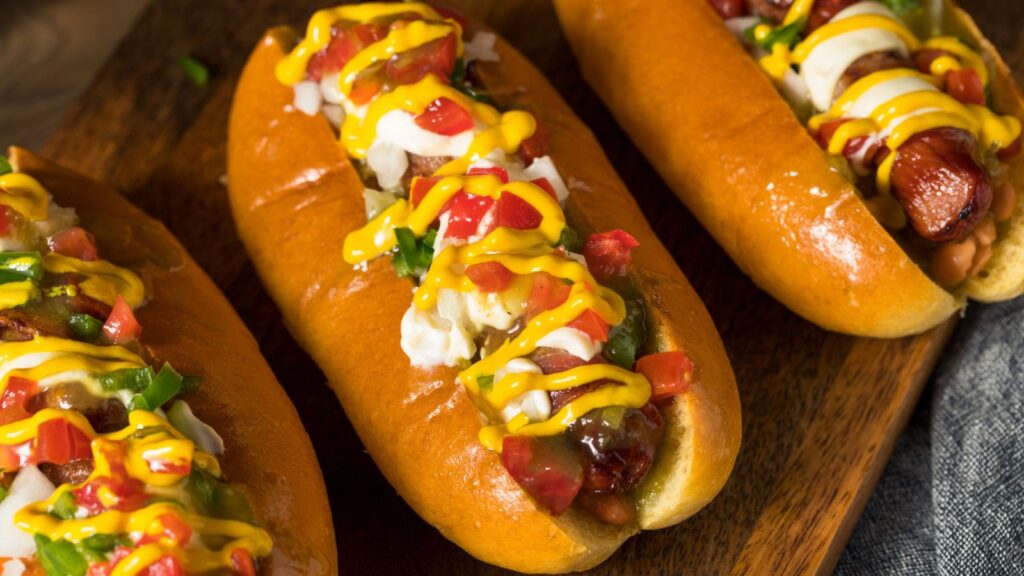
The most food-forward regional hot dog story in America right now belongs to Tucson. The modern Sonoran dog is generally traced to Hermosillo, the capital of the Mexican state of Sonora, traveling north across the border into Arizona, where it took hold in restaurants and street carts and never let go. The build is a study in controlled indulgence: a bacon-wrapped, all-beef frank nestled in a soft bolillo-style bun, loaded with pinto beans, chopped tomato and onion, yellow mustard, mayonnaise and jalapeno salsa.
In February 2026, Visit Tucson launched the official Sonoran Dog Trail, a self-guided web app connecting locals and visitors to stops across the city. El Guero Canelo, recipient of a James Beard America’s Classics Award, is one of the trail’s best-known stops. The trail’s launch reinforces Tucson’s standing as a UNESCO City of Gastronomy.
Chefs take the frank seriously
One example of the premiumization industry analysts describe is Lefty’s West End Tavern in Greenville, South Carolina. The concept is built around the idea that the hot dog can carry serious culinary ambition: one signature frank and a second that changes monthly to feature a different major league ballpark hot dog.
In May 2026, the monthly feature was a Sonoran dog inspired by the Arizona Diamondbacks, confirmed on the restaurant’s own social media. In a food scene as competitive as Greenville’s, a rotating monthly concept is a serious commitment, one that reflects a broader conviction that the frank deserves to be treated as a vehicle for culinary storytelling, not just a vehicle for mustard.
The category’s next chapter is already being written
What is happening to the hot dog in the summer of 2026 is not a departure from what the food has always been. The street cart dog and the upscale restaurant frank are expressions of the same thing. It’s a food so deeply embedded in American life that it can absorb ambition without losing the plot.
An industry worth billions, a trail celebrating Tucson’s UNESCO City of Gastronomy status and a monthly rotating concept in the South Carolina Upstate all point toward the same conclusion: the hot dog is not waiting around to be rediscovered; it has been here all along, feeding people well, on their own terms, wherever they happen to be standing.
Jennifer Allen is a retired professional chef and long-time writer. Her work appears in dozens of publications, including MSN, Yahoo, The Washington Post and The Seattle Times. These days, she’s busy in the kitchen developing recipes and traveling the world, and you can find all her best creations at Cook What You Love.
The post 7 billion hot dogs later, America is finally starting to take the frank seriously appeared first on Food Drink Life.

(0) comments
Welcome to the discussion.
Log In
Keep it Clean. Please avoid obscene, vulgar, lewd, racist or sexually-oriented language.
PLEASE TURN OFF YOUR CAPS LOCK.
Don't Threaten. Threats of harming another person will not be tolerated.
Be Truthful. Don't knowingly lie about anyone or anything.
Be Nice. No racism, sexism or any sort of -ism that is degrading to another person.
Be Proactive. Use the 'Report' link on each comment to let us know of abusive posts.
Share with Us. We'd love to hear eyewitness accounts, the history behind an article.