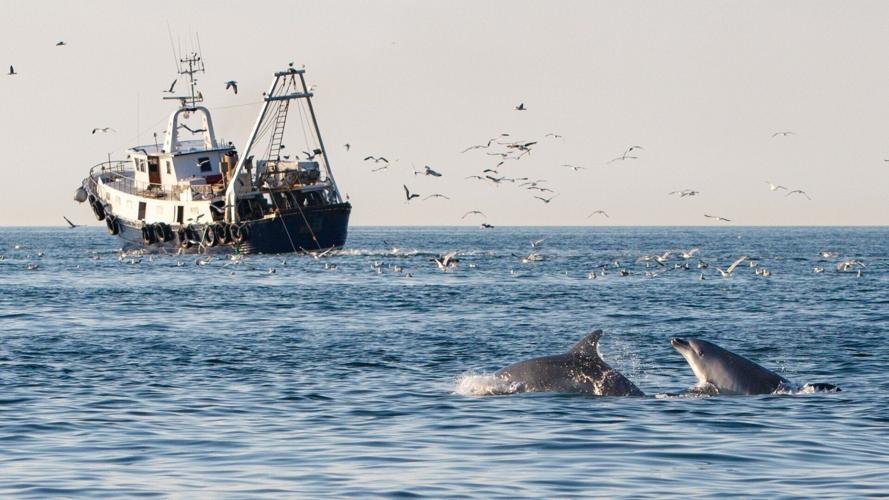
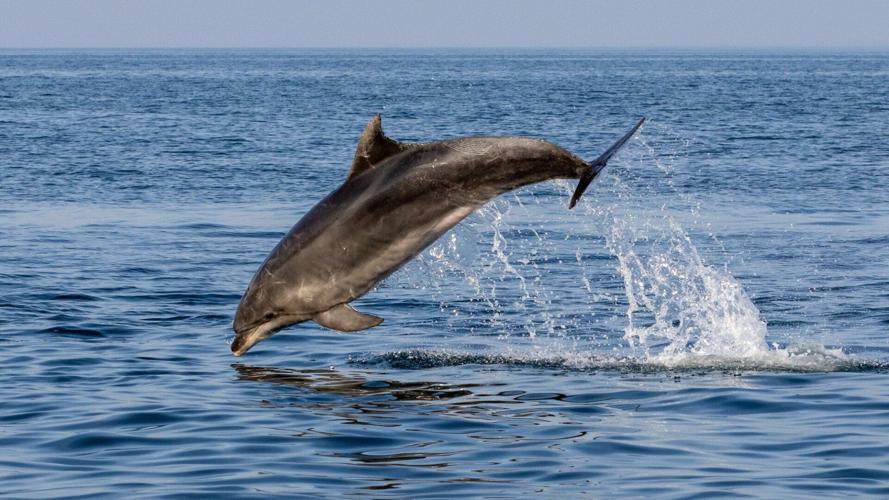
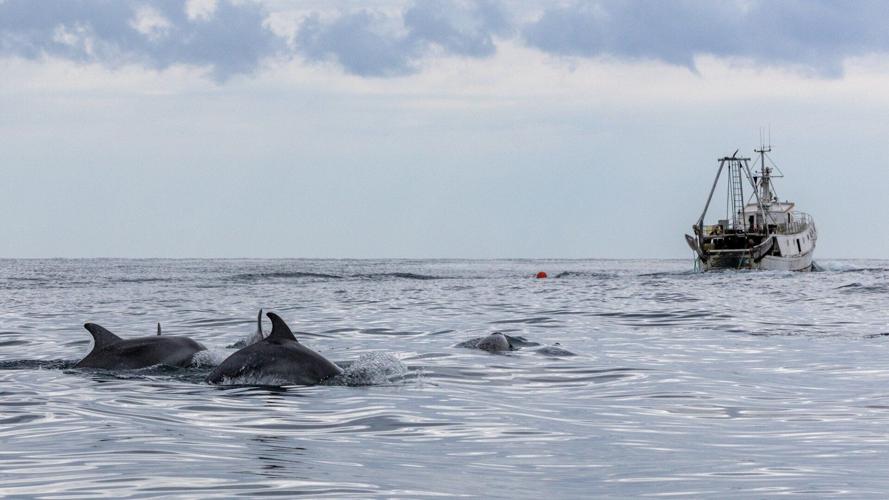

Two bottlenose dolphins follow a midwater trawler in the waters of Veneto, Italy. (Dolphin Biology and Conservation via SWNS)
By Stephen Beech
Dolphins are becoming increasingly reliant on fishing trawlers for food, suggests new research.
Three out of four bottom trawlers in the Adriatic Sea are followed by bottlenose dolphins scavenging in their wake, reveals the study.
Conservationists say their findings suggest there isn't enough prey for the dolphins to hunt elsewhere.
The Adriatic seabed has been plowed by bottom trawlers for decades, resulting in ecosystem damage.
Many apex predators are no longer present there, with only the bottlenose dolphins left.
Researchers say the frequency of their presence around fishing boats - up to 76% of the trawlers inspected by scientists off Marche, Italy, were followed by dolphins - suggests that they may be struggling to hunt normally.
Study lead author Giovanni Bearzi said: "Long-term, consistent, and deliberate association with trawlers suggests a high degree of reliance on that fishery.
"While dolphins would still need to forage independently when trawling does not occur, on days of trawling they forage predominantly near trawl nets."
Bearzi, president of Dolphin Biology and Conservation, Italy, says fish populations of the Mediterranean in general, and the Adriatic Sea in particular, are "severely overexploited."

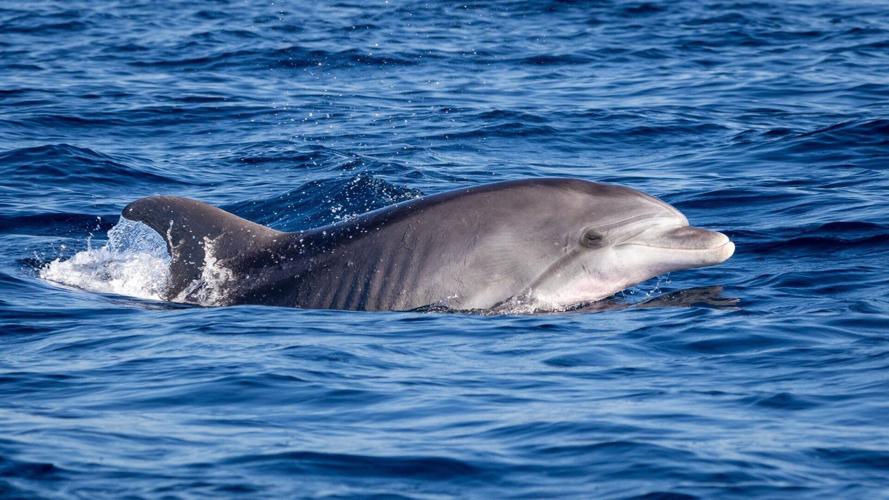
Bottlenose dolphin in the Adriatic Sea. (
He said: "Although we know dolphins can forage around trawlers, eating discarded fish or even sneaking into the moving net to snatch a meal, it's not clear how reliant they are on the trawlers for food or what impact this could be having on their behavior and health."
To understand how bottlenose dolphins respond to trawlers, scientists monitored trawlers offshore from Veneto and Marche in Italy.
Between 2018 and 2024 they surveyed in Veneto, and in 2025 they surveyed in Marche, carrying out a total of 859 inspections of trawlers over 148 days.
During this process, the researchers photographed the dolphins to identify individual animals.
They then analyzed the data, looking for differences in dolphin behavior between the two regions and across different types of trawler.
Their findings, published in the journal Frontiers in Mammal Science, showed that 76% of trawlers in the Marche area and 26% of trawlers in the Veneto area were followed by dolphins.
The researchers couldn't account for the "striking" difference, but it's unlikely to be caused by sampling bias, as they inspected more than 100 trawlers in Marche.
On average, dolphins followed 41% of otter trawlers and 35% of midwater trawlers but only 1.5% of beam trawlers.







Bottlenose dolphin in the Adriatic Sea.
The researchers say the difference may be because the nets used by beam trawlers in the area are harder for dolphins to access and don't target suitable prey.
Study co-author Silvia Bonizzoni, of Dolphin Biology and Conservation, said: "We estimated that the bottlenose dolphin populations of Veneto and Marche, combined, exceed 1,000 individuals.
"Between 86% and 90% of the dolphins, depending on region, were photographed one or more times while they were following trawlers.
"The evidence suggests that the majority of a relatively large community of dolphins regularly forage behind trawlers."
Bearzi says dolphins have always followed fishing boats, but such normal "opportunistic2 behaviour seems to have increased in intensity over time.
A previous study in the Adriatic in the 1990s found that only 10% of trawlers were followed by dolphins.
Bearzi said many animals whose prey are depleted start pursuing food near humans, such as polar bears scavenging in rubbish dumps.
He says trawlers could represent a simple source of nourishment in an impoverished ecosystem.
Study senior author Randall Reeves said: "It is known that bottlenose dolphins are occasionally injured or killed by trawl gear, and that foraging behind trawlers can affect dolphins' diet, social organization, and communication.

A group of bottlenose dolphins follow a bottom otter trawler in the waters of Marche, Italy. (
"Dolphins may also suffer hearing damage that results from chronic exposure to the noise of trawlers. It is risky behavior."
Reeves, chairman of the committee of scientific advisors at the U.S. Marine Mammal Commission, added: "Finding sufficient prey away from trawlers in an overfished sea may be too difficult.
"It appears that for these animals, taking the risks is better than going hungry."
The research team emphasized that bottlenose dolphins are resilient.
If trawling were reduced or even banned to give the ecosystem a chance to rebuild, they believe dolphins would adapt and thrive as they used to before the age of trawling.
Other species that long ago declined or disappeared in the region could also make a comeback, once the environment is protected from trawling.
Bearzi said: "We advocate conservation action to protect a rich diversity of species.
"As trawlers have been causing profound damage to Adriatic ecosystems, their continued use is inadvisable, not only to protect dolphins but also to conserve marine biodiversity more generally."

(0) comments
Welcome to the discussion.
Log In
Keep it Clean. Please avoid obscene, vulgar, lewd, racist or sexually-oriented language.
PLEASE TURN OFF YOUR CAPS LOCK.
Don't Threaten. Threats of harming another person will not be tolerated.
Be Truthful. Don't knowingly lie about anyone or anything.
Be Nice. No racism, sexism or any sort of -ism that is degrading to another person.
Be Proactive. Use the 'Report' link on each comment to let us know of abusive posts.
Share with Us. We'd love to hear eyewitness accounts, the history behind an article.