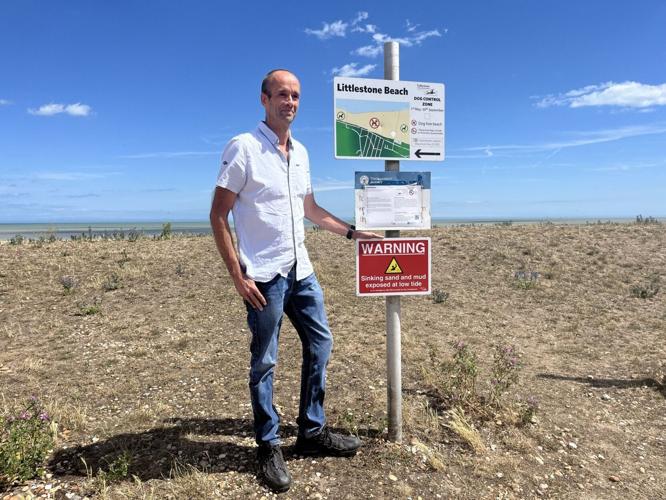
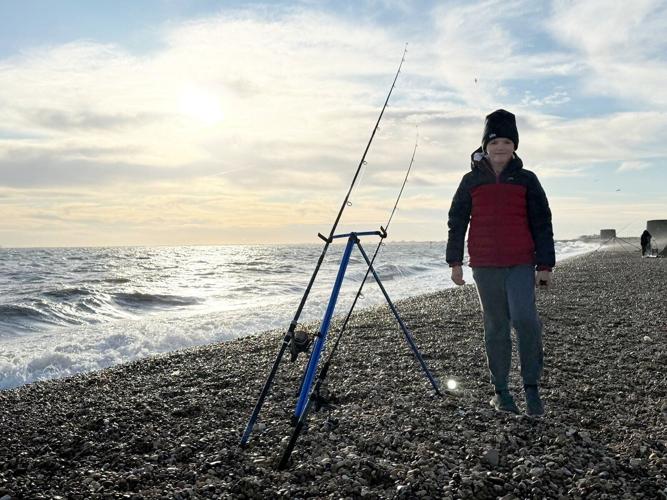
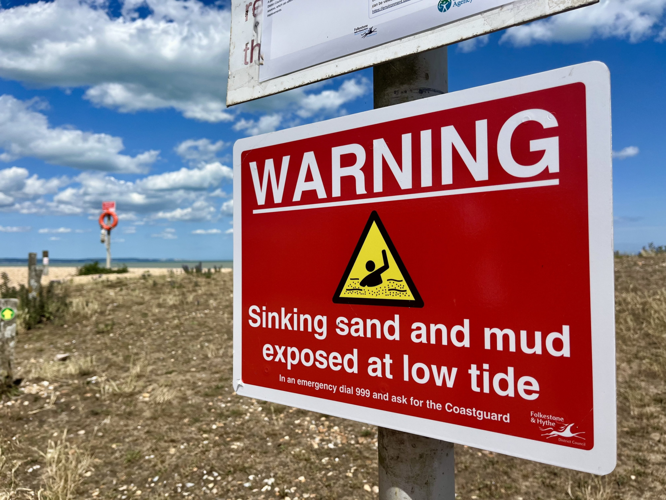

James, 47, and his son, Oliver, 11, were digging for bait on Saturday, May 2, at St Mary's Bay in Kent when they suddenly became trapped in soft mud up to their chests. (Folkestone and Hythe District Co via SWNS)
By Jack Fifield
A dad and his 11-year-old son nearly died after sinking chest-deep in mud on the beach as the tide came in.
Keen anglers James, 47, and his son Oliver, 11, were digging for bait on Saturday, May 2, at St. Mary’s Bay in Kent when they suddenly became trapped in soft mud up to their chests as the tide came in beneath.
The former science teacher thought he might die during the ordeal as attempts to shout and call for help from people on the shore only elicited friendly waves — as beachgoers didn’t realize the danger they were in.
James said, “That dark thought went through my mind, I was just thinking at one point 'I’m going to have to hold him up to swim in.'”
“That’s why it’s vitally important that all parents teach their children how to swim.”
The quick-thinking dad used his bait pump — which is about a meter long — as a probe to feel for solid ground underneath the mud to make the journey 120 meters to the shore.
Luckily, he had previously worked in the Australian rain forest as part of his final project to qualify as a zoologist, and remembered training to kick his legs and move in circles in order to get through mangrove swamps.
James added, “I didn’t see the point in calling the emergency services — we make a decision when we’re in this position.”
“I didn’t think anyone would’ve got to us in time, it would’ve been two minutes to make the call, and we just had to get moving.”

James' son Oliver. (James via SWNS)
James said each step was like "weightlifting" as he picked his son up to prevent him from sinking and move him forward.
He said, “I don’t know how I did it physically, it’s adrenaline and cortisol, normally I wouldn’t be fit enough to pull that off.”
“When we got to the beach, I had the tide lapping at the back of my neck, that’s how close it was. It was freezing, it was so cold under there.”
James said when they finally got back to the shore a couple having lunch on the seawall even commented that it looked like they were "having great fun."






He said, “I took a deep breath — I couldn’t cope with it, I was just done, I was cooked. The adrenaline was wearing off, I dropped on the beach.”
“I literally had to pick Oliver up and throw him onto the beach. For myself, I dragged myself up onto the beach, onto the shingle.”
Now, new signs have been installed to warn beachgoers of the danger caused by the mud, as a direct result of the incident.
In a statement, Folkestone and Hythe District Council said, “Following concerns raised by a resident about increasing awareness of the potential dangers of soft mud and sand around some of our favorite coastal spots, 25 additional signs have been installed to help keep visitors informed and safe.
“Mudflats are exposed when the tide goes out and covered by water when the tide comes back in.

“In some areas, this can create a risk of people becoming stuck in soft, quicksand-like ground that can trap feet and make movement difficult.
“Working alongside the Environment Agency, the RNLI and local councilors, beach safety remains a top priority.
“If you're visiting the area this summer, please take care where you step and follow the safety guidance in place at these locations.
“In an emergency, dial 999 and ask for the Coast Guard.”
An RNLI spokesperson said, “We understand that any incident on or near the water can be very frightening and we are glad that James and Oliver were able to make their way to safety.
“If anyone finds themselves, or sees anyone else, in trouble in the sea, we advise calling 999 or 112 immediately and asking for the Coast Guard so that the appropriate service can be dispatched without delay.
“HM Coast Guard coordinates all maritime search and rescue in the UK, and will deploy the most appropriate rescue team(s) for the emergency at hand — whether that is RNLI crews, the fire and rescue service or coastguard rescue officers trained in mud rescue.
“Kent Fire and Rescue Service have statutory responsibility for rescues from mud and unstable surfaces in the county.
“We have not had any calls to incidents involving mud in this area over the past five years, so this would not meet the operational requirement for a hovercraft as they are deployed at strategic locations along the coast.
“We do, however, review the allocation of search and rescue assets regularly to take into account changing use of the water.”

(0) comments
Welcome to the discussion.
Log In
Keep it Clean. Please avoid obscene, vulgar, lewd, racist or sexually-oriented language.
PLEASE TURN OFF YOUR CAPS LOCK.
Don't Threaten. Threats of harming another person will not be tolerated.
Be Truthful. Don't knowingly lie about anyone or anything.
Be Nice. No racism, sexism or any sort of -ism that is degrading to another person.
Be Proactive. Use the 'Report' link on each comment to let us know of abusive posts.
Share with Us. We'd love to hear eyewitness accounts, the history behind an article.