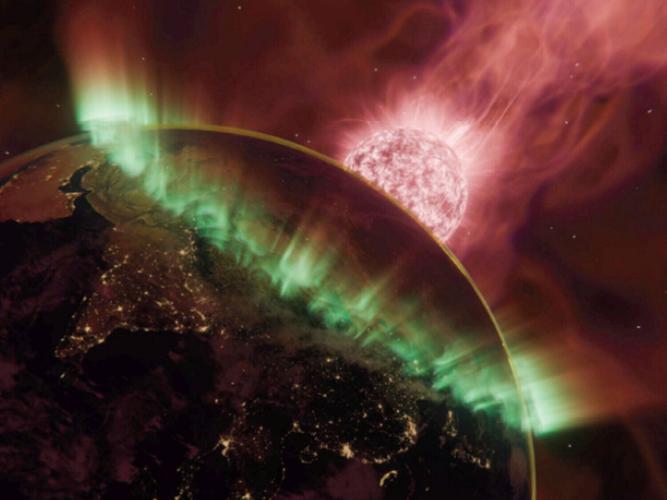
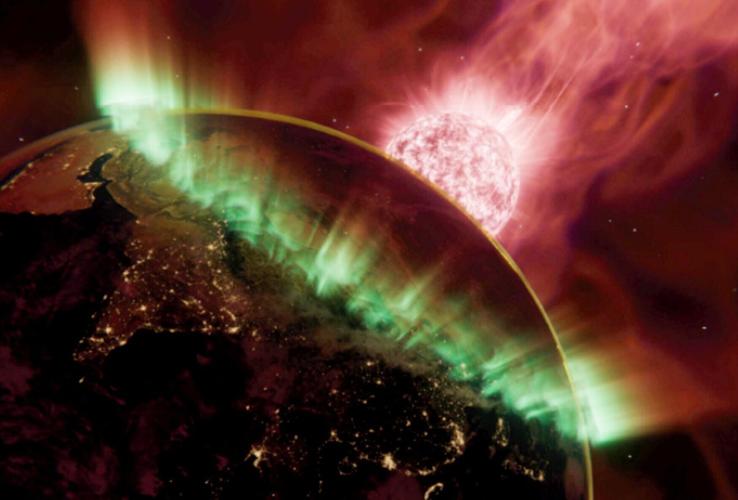
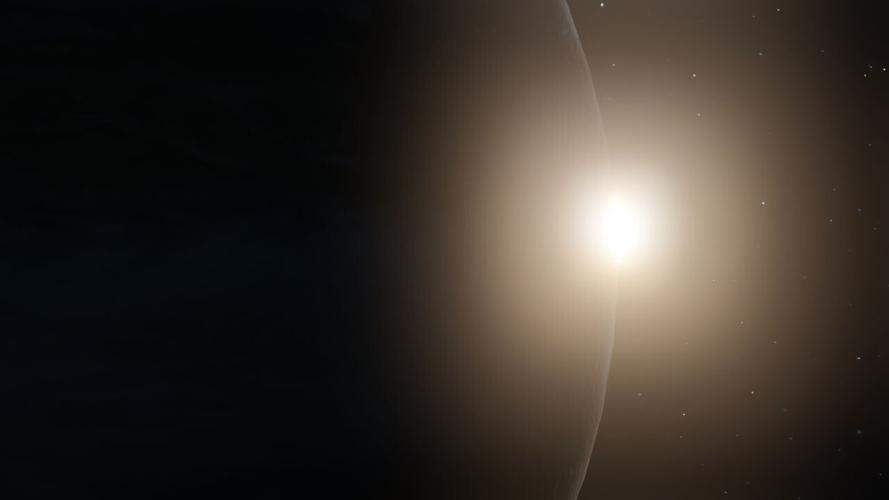

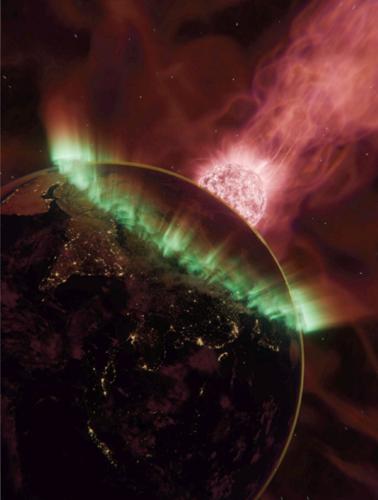
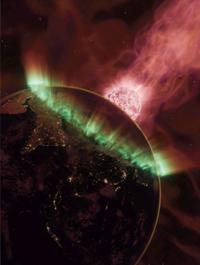
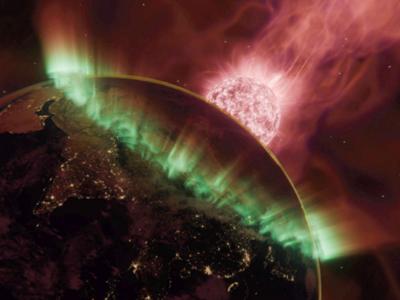

Illustration of solar wind streaming from a fuming sun drives auroras bright enough to be seen far from the poles, a dazzling signature of an extreme geomagnetic storm. (Nithin Sivadas / NASA / GSFC via SWNS)
By Stephen Beech
Risks of potentially devastating solar storms may be underestimated, warns a new study.
And the effects of extreme space weather on life on Earth may be larger than previously thought, say scientists.
It is already known that solar storms can disrupt satellite operations, GPS navigation and high-frequency radio transmissions, as well as trigger vivid auroral displays visible far beyond polar regions.
Extreme geomagnetic storms are temporary disturbances in the plasma and magnetic field around the Earth.
They can also trigger extensive power outages, and even increase how much radiation astronauts and pilots are exposed to.

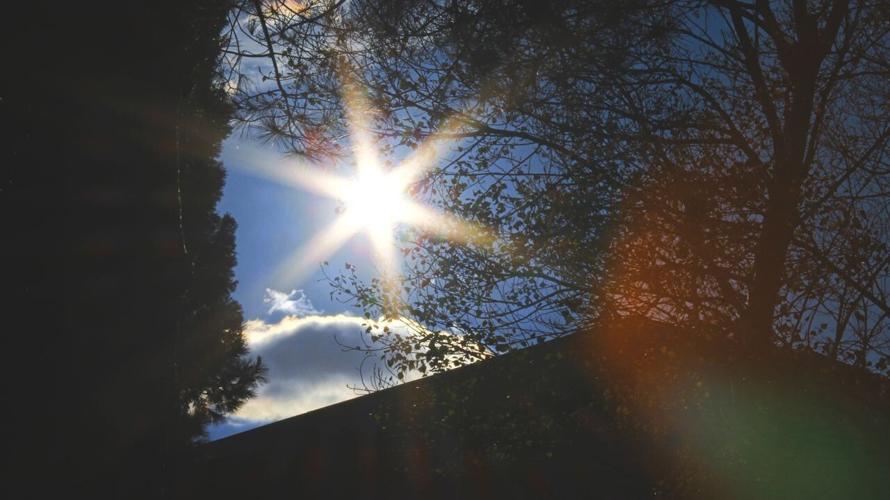
(Photo by Zelch Csaba via Pexels)
For decades, scientists have thought that there is an upper limit to how Earth responds to solar storms.
Electric currents in the Earth's upper atmosphere are widely understood to reach an upper limit with increasing solar wind strength.
But new research suggests the upper limit is an "illusion" resulting from uncertainty in the measurement of the solar wind strength.
The findings, published in the journal Nature, mean solar storms could have "far worse" effects on our technology than previously thought.
The study was led by Nithin Sivadas, of NASA, and co-authored by Maria Walach, from Lancaster University in the U.K.

(Photo by Giona Mason via Pexels)
Walach said: "Our planet's magnetic field does a really great job of protecting us against many space weather effects and so they often just show up as glitches or beautiful aurora.
"There are however extreme cases, where satellites unexpectedly fall back to Earth, or we lose communication and GPS signals."






She explained that the solar wind is a never-ending stream of hot gases flowing from the sun, which can strengthen during solar eruptions.
Observations have suggested that, as the solar wind strengthens, electric currents in the Earth's upper atmosphere — which can affect satellites, communications and navigation signals — increase to a certain point but then, on average, level off.
The team says this apparent limit is merely an effect of uncertainties in solar wind measurements.

Extreme geomagnetic storms are temporary disturbances in the plasma and magnetic field around the Earth. (Nithin Sivadas / NASA / GSFC via SWNS)
They claim the issue is that most solar wind measurements of extreme events are taken by spacecraft at Lagrange point one, which is a million miles closer to the sun than the Earth.
Hence the solar wind that strikes the Earth is likely weaker due to a regression to the mean effect.
Averaging observations from many events makes it look like strong solar winds do not produce equally strong currents because on average weaker solar winds arrive at Earth.
The team found evidence from more than a million solar wind measurements taken by Earth-orbiting NASA spacecraft, very close to our planet.
Analysis of the observations showed a direct relationship between the strength of the solar wind and the currents in the upper atmosphere, suggesting there is no upper limit but rather Earth's response will continue to increase along with the solar wind strength, and impacts to technology can increase as well.

(Photo by Erkan Utu via Pexels)
Walach said: "If there is no upper limit to our planet's response to the solar wind, modeling for extreme cases needs to take this into account and we should be vigilant of space weather effects.
"Fortunately, these very extreme cases are rare, but this also means we have limited data to work with and only time will tell what happens at the very extreme one-in-a-thousand-year kind of event."
Lead author Sivadas added: "We usually assume the truth may be around its measurement.
"But probability theory says it leans one way.
"That's why space weather risks appear underestimated."

(0) comments
Welcome to the discussion.
Log In
Keep it Clean. Please avoid obscene, vulgar, lewd, racist or sexually-oriented language.
PLEASE TURN OFF YOUR CAPS LOCK.
Don't Threaten. Threats of harming another person will not be tolerated.
Be Truthful. Don't knowingly lie about anyone or anything.
Be Nice. No racism, sexism or any sort of -ism that is degrading to another person.
Be Proactive. Use the 'Report' link on each comment to let us know of abusive posts.
Share with Us. We'd love to hear eyewitness accounts, the history behind an article.