

(Photo by Esperanza Doronila via Unsplash)
Nine in 10 Americans are eating ultra-processed foods without realizing it, according to new research.
A survey of 2,000 general population Americans explored how respondents think, feel and make decisions about ultra-processed foods, and just how far off their perception is from reality.
Respondents estimate their diet consists of only 16% ultra-processed foods; however, the CDC data show ultra-processed foods make more than half of the average American's diet, currently estimated at 53% — meaning most people are underestimating their own exposure by more than three times.
Conducted by Talker Research for Amy's Kitchen, the survey found that the blind spot runs deep: while most Americans consume ultra-processed foods at least once a week, just 9% can correctly identify which foods are actually considered ultra-processed.
Many commonly purchased diet staples like sliced bread (42%), breakfast cereal (35%), and deli meat (33%) and crackers (33%) often fall into the “ultra-processed” category without respondents realizing it.
Meanwhile, perceived “safe” choices like plant-based milks (50%), protein bars (45%) and granola bars (45%) often undergo heavy processing.
On the other hand, respondents mistook whole foods like pasteurized milk (50%) and rolled oats (40%) for being processed, and mildly processed options like kombucha (16%) or canned beans or vegetables (11%) were wrongly flagged as ultra-processed.
More than a third believe any level of processing automatically makes a food "bad" (37%), mistaking all jarred (54%), canned (49%) or frozen (45%) foods as being just as unhealthy as cookies or chips.
Half of respondents say they are not confident they know the difference between "processed" and "ultra-processed" at all, and 44% say they usually feel overwhelmed by the amount of conflicting information about what foods they should or shouldn't eat.

(Talker Research)
“Consumers shouldn’t have to be experts in food processing to understand what they’re eating or the potential long-term impact of their choices,” said Paul Schiefer, CEO of Amy’s Kitchen. “With ultra-processed foods so prevalent in our food system, greater transparency around ingredients and how food is made is essential. Tools like the Non-UPF Verified seal help make it easier for people to make informed choices for themselves and their families.”
That confusion carries a substantial cost, and the real number is even higher than people think.






The average American estimates that they spend $52 on “real” foods in a given week, and another $40 on ultra-processed foods, adding up to an estimated $128,149 over their lifetime.
But the cost at the checkout is only part of the picture. Health economist Lindsay Allen, PhD, examined the broader financial toll associated with a diet high in ultra-processed foods, accounting for healthcare spending, lost productivity, and other long-term factors. Her analysis found those hidden costs can add up to more than $350,000 over a lifetime — on top of what consumers spend buying the food itself.
"Especially in this economy, people tend to think about the sticker price of food, not the downstream cost of eating it," said Allen. “People typically only see the price on the receipt, and don't consider the invisible costs associated with eating a high ultra-processed foods diet over time, including a shorter life expectancy, which carries a sizable economic cost of its own. That gap between what people expect to pay and what they're actually paying is exactly why these data matter."
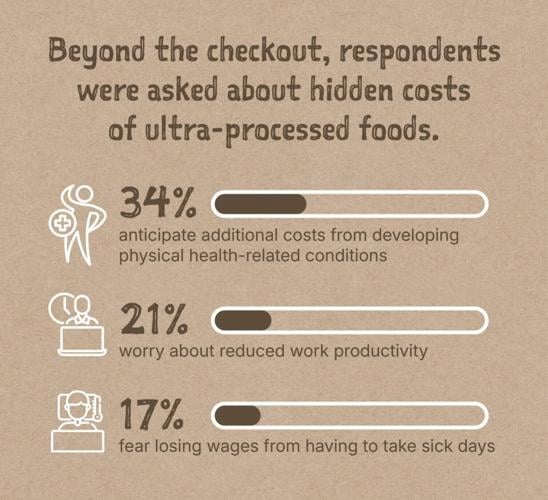
Respondents’ instincts on where the financial cost comes from were split: 34% anticipate additional costs from developing physical health-related conditions, 21% worry about reduced work productivity and 17% fear losing wages from having to take sick days.
On average, those surveyed make three purchases a week driven by a whim or craving, and another three driven by cost over what they’d consider the healthier option.
Even so, staying within budget (31%) and buying foods their household will actually eat (23%) top the list of priorities when grocery shopping.
That balance isn’t always easy to strike — 21% feel like they're choosing between health and cost, and 20% struggle to find options they actually want to eat.
Still, 41% often feel torn about purchasing ultra-processed foods in the first place.
While 71% of respondents think about the amount of ultra-processed foods in their diet, 61% believe that ultra-processed foods are so common that they don't think they could avoid them if they tried.
However, the data suggest people are open to change: 42% said that if they knew purchasing ultra-processed foods would end up costing them more long-term, they’d cut down on buying them.
Sixty-nine percent said they'd be willing to spend more on higher-quality groceries — nearly $1,200 more a year — if it meant reducing their long-term health risk.
Respondents placed the most responsibility for preventing these long-term costs on food manufacturers (28%) — more than on retailers, government or themselves.
Research methodology:
Talker Research surveyed 2,000 general population Americans who have access to the internet; the survey was commissioned by Amy’s Kitchen and administered and conducted online by Talker Research between Sept. 3 and Sept. 8, 2026. A link to the questionnaire can be found here.
To view the complete methodology as part of AAPOR’s Transparency Initiative, please visit the Talker Research Process and Methodology page.
(0) comments
Welcome to the discussion.
Log In
Keep it Clean. Please avoid obscene, vulgar, lewd, racist or sexually-oriented language.
PLEASE TURN OFF YOUR CAPS LOCK.
Don't Threaten. Threats of harming another person will not be tolerated.
Be Truthful. Don't knowingly lie about anyone or anything.
Be Nice. No racism, sexism or any sort of -ism that is degrading to another person.
Be Proactive. Use the 'Report' link on each comment to let us know of abusive posts.
Share with Us. We'd love to hear eyewitness accounts, the history behind an article.