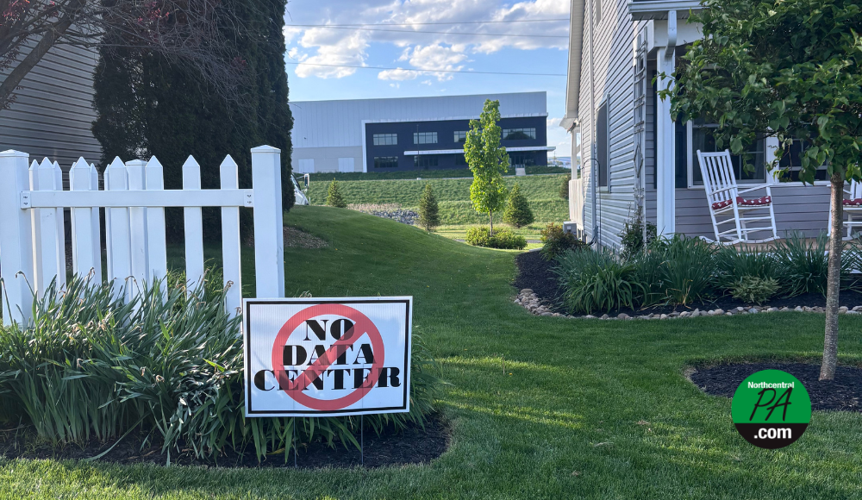
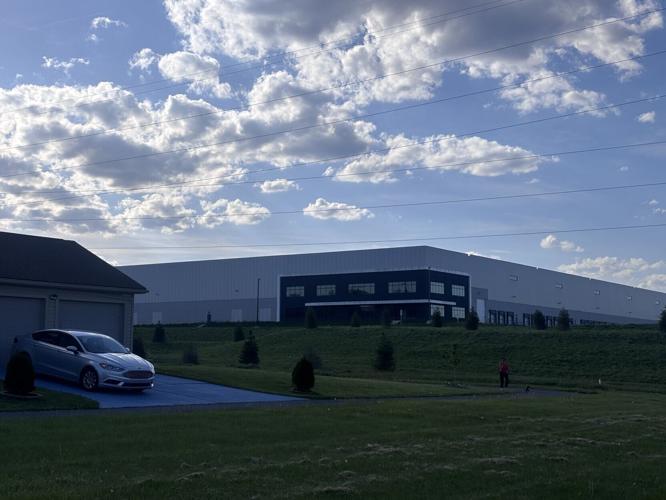
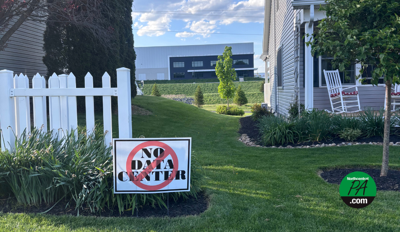
Allenwood, Pa. — Residents filed back to their homes after Monday's Gregg Township meeting in Union County. Behind their houses, a gray monolith dominated the horizon: a new 478,400-square-foot building.
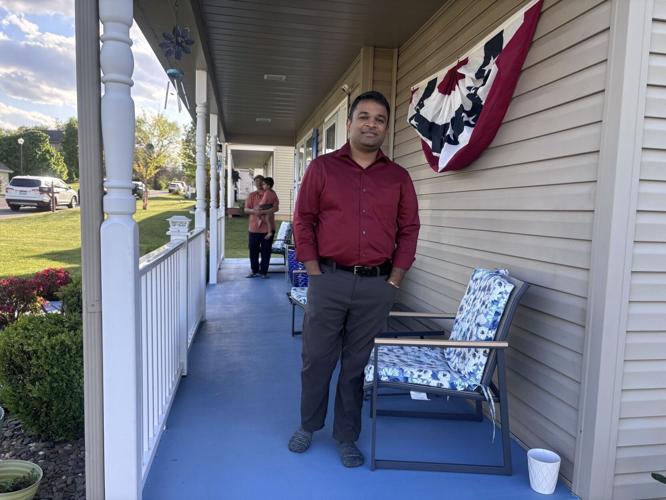
"Once that comes in, it's going to destroy everything," Dilshan Gamaralalage said standing on his porch, gesturing toward the site of one of PNK Group's proposed data centers. This one, on the south side of Great Stream Commons, is less than 200 yards away from his home.

Dilshan Gamaralalage with his family on their front porch after the township meeting.
Gamaralalage says he moved from New York to Gregg Township two years ago, looking to settle down and lead a more peaceful life with his family in rural Pennsylvania.
His job as a director of operations in the fast food industry demands "24/7" attention. He had hoped his home to be a secure place he could get away from it all, and spend quiet time with his family. In two short years, the newcomer's future has changed drastically, totally out of his control.

Gamaralalage's garage eclipsing the data center's proposed home.
He left New York for a reason, he said. Now, the newcomer is ready to join his neighbors — many whom have lived there for decades — in a cause to preserve the perks of rural living.
Showing up, speaking out
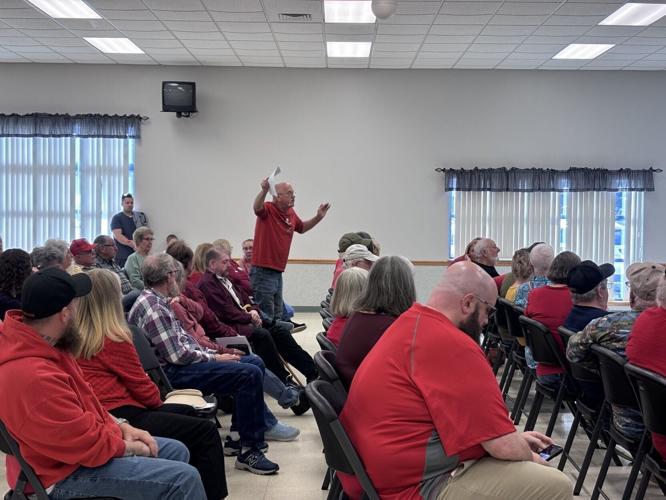
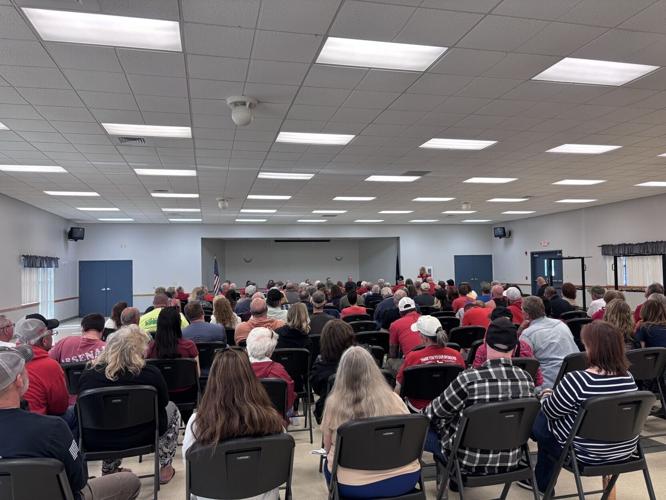
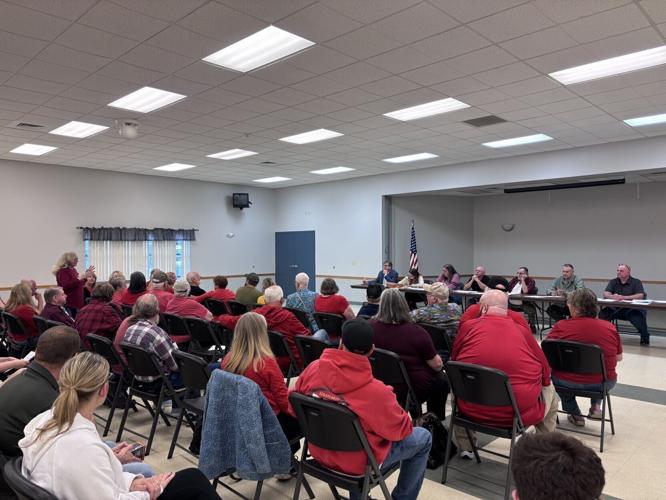
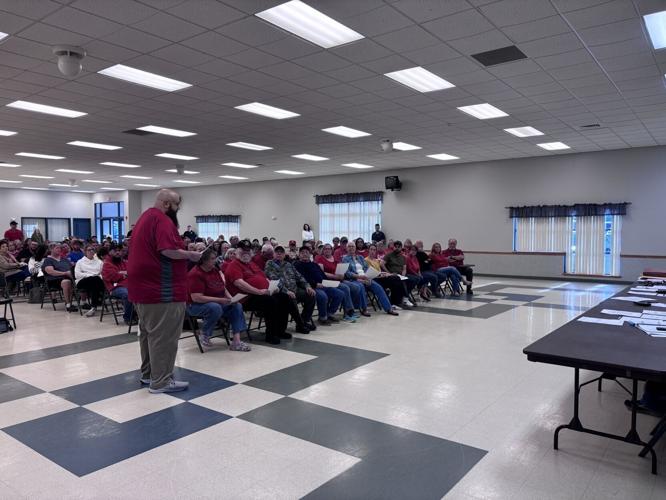
Gamaralalage was one of over 100 residents who packed the Warrior Run Area Social Hall for a supervisors' public meeting Monday evening. They gathered to voice concerns about the proposed data center development at Great Stream Commons, the commercial and industrial park along Route 15.

Lisa Hollenbach counted 109 people who came to the meeting.
PNK Group had offered the text for a zoning ordinance allowing their data center to be built as they see fit. Gregg Township residents wanted supervisors to hear their wants and needs before agreeing to anything the developer put forth.
PNK has committed to constructing five buildings on the property it purchased. Four could potentially become data centers. Two have been completed, with the next three expected be constructed in the next three years. One of their buildings is leased to ModCorr, a Texas-based company that manufactures modular prisons.
The meeting drew a large crowd, and from it, powerful responses from neighbors who worry the data center would bring a plethora of unnecessary burdens to the slower part of Union County: constant noise, electromagnetic radiation, declining property values, and an enormous demand on local water and energy resources.
Taking inspiration from Montour County meeting-goers who pushed back against Talen Energy's proposed data center, a majority of the crowd wore red to make their stance clear: stop the data center's installation, or at least, pump the brakes.

Red shirts became a trademark for anti-data center citizens during the "Say No!" movement in Montour County, where activists pushed back against Talen Energy's development encroaching on Montour Preserve.
A public hearing on proposed zoning amendments related to the development is scheduled for June 1 at 6 p.m. at the Warrior Run Area Social Hall at 188 White Deer Ave., Allenwood.
A regular supervisors' meeting will take place in the same place at 4:30 p.m. that day. Thanks to clarification at the Monday meeting, it was learned that written comments from residents will be accepted ahead of the June 1 hearing and entered into the record.
This hearing will feel more like a court proceeding than a township meeting, supervisors explained. A stenographer will be present, recording every word of testimony brought by the public.
'The wrong project in the wrong place'
Speaker after speaker rose to challenge the development on Monday. One resident put it bluntly: "This is the wrong project in the wrong place," he said, raising questions about wastewater disposal and the effect on home values. He said he is not opposed to development broadly, but called for it to be done responsibly.

Matthew DeWire, a teacher at Williamsport Area High School, has lived in Gregg Township for 19 years.
Matthew DeWire, who lives on the same street as Gamaralalage, said during his allotted three minutes for public comment that the developer had already neglected to mow the property, which he said he had done on his own land at least three or four times already this season. This wasn't a sign of a good neighbor, he said.
"Families will watch their investments erode," DeWire said. "Homeowners are being asked to absorb real financial loss." He said he would support higher "costs — that's code for taxes" if it meant offsetting lost future revenue. His closer drew applause: "Once the damage is done, it cannot be undone."
Kate McCarty, a resident of Alvira Place, said she feared the noise would affect not only her human neighbors, but also animals in the area. A nearby zoo, Clyde Peeling's Reptiland, hosts animals that she suspects could react poorly to the low rumblings, too, pointing out that the project would fundamentally disrupt life as they know it, and not just at home.

A mechanical engineer, Rebecca DeWire, spouse to Matthew, offered an explanation as to why noise from a data center is especially difficult to control and contain. The constant low-frequency hum that these large machine-filled facilities produce, she said, behaves differently than higher-pitched sounds.
"High frequency is like light. It can be shut out or blocked," she said. "But low frequency is like water. It flows around barriers." That kind of noise, she added, travels through shrubs and walls and can "build up" inside homes, becoming most resonant and noticeable at night when the surrounding area is otherwise quiet.
Dr. Henry G. Yavorek, who works at the nearby Eye Center of Central PA in Great Stream Commons said the issue was not hypothetical for him. When the buildings in the commercial park were being built, he said, vibration from the construction affected the microscopes used during surgery.
"I'm concerned about the constant vibration that a data center would make," he said, adding that it could compromise patient safety and potentially force the surgery center to relocate.
Resident Andy Frontz noted that a data center can consume more electricity than 2,000 homes, far higher than the entire combined use of Allenwood's village. He also brought up how the Amazon Web Services data center complex in Salem Township recently requested to increase their water usage to 270,000 gallons per day.






Alvira Court resident Sue Williams urged the township to create clear zoning standards before any approvals. She referenced Luzerne County as a model. There, setback requirements keep data centers at least 1,000 feet from residential areas. "Be proactive now," she said.
Township working on ordinance, attorney hired as special counsel
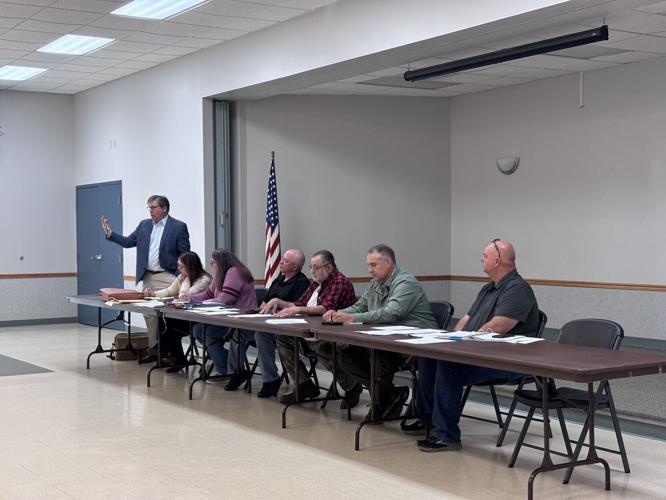
The township's newly-hired attorney, Richard Shoch, told attendees that zoning amendments are being drafted. While PNK has submitted its own proposed ordinance language, the township is not required to adopt it. He confirmed the June 1 public hearing date, and said the decision could be delayed if needed.

Richard Schoch, the township's hired attorney — not the solicitor, Jenna Neidig — stands flanking the supervisors.
Gregg Township hired Shoch, a Sunbury-based attorney with more than 20 years of municipal law experience, who said he is currently helping multiple municipalities navigate similar situations, adding that data center proposals are increasingly common. Township Supervisor Solicitor Jenna Neidig's expertise is in family and real estate law, and the township needed extra legal support in this uncharted territory.
He pointed to a similar past situation in Point Township, where a proposed data center ultimately failed after the developer determined it could not comply with height restrictions in the local ordinance.
Still, Shoch said that every situation is different. Great Stream Commons is an established commercial park with existing activity, unlike the completely undeveloped industrial land involved in Point Township.
Shoch said his immediate focus is on attending the planning commission's upcoming work session and regular meeting, reviewing the developer's proposed ordinance language, and working to draft protective provisions the township feels are missing. He acknowledged the legal reality that constrains what a municipality can do outright.
"If it's a lawful use, we have to provide some place in the municipality for them to do this," he said. However, he added that he and officials alike are working out what parameters and safeguards to attach that would make the move-in more bearable for residents.
He also noted that several issues raised at Monday's meeting, including noise and other effects on neighboring properties, had already been raised independently by members of the planning commission.
Township Supervisor Michael Keiser said after the meeting, "We're going to do our best on the board" to abide by residents' wishes and the law. The other two supervisors declined to comment.
Community organizing in spite of odds
Gamaralalage said he has been working to raise awareness through a Facebook group called Gregg Township Community and has been in contact with the Standard Journal to help publicize both Monday's meeting and the June 1 hearing. He is also working to bring professors from Bucknell University, one of whom is his cousin, to lend technical expertise to the opposition's case.
He expressed frustration, however, with a rule limiting public comment at the zoning hearing to Gregg Township residents. The township has a population of roughly 3,800, he noted, but close to 2,500 of those residents are incarcerated at the federal prison located within township limits, leaving a small and largely elderly group of 1,300 to make its voice heard.
"Our fight is not just for us, but for everybody around here," he said. Most of his neighbors, between himself and the social hall, are senior citizens on fixed incomes in a 55-and-older community. Any increase in utility costs or property taxes, he said, could be enough to displace some of them.
He said he understands that the community is up against a large, well-funded developer with resources and legal support.
"My favorite story is David and Goliath," he said. "I believe in it. That's the outcome we're expecting."
He paused. The birds chirped. His son played in the yard. He had no slingshot.
"I don't know if we can beat them," he said. "At least we're trying."
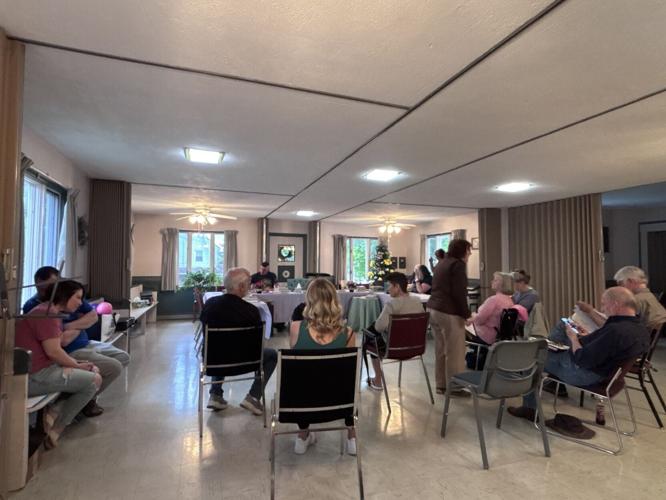
Meeting in the church to prepare for June 1
Preparing for the next meeting set for June 1, the township's residents kept their momentum and met the following evening, May 5, in the Washington Presbyterian Church. It was still decorated for Easter. The readerboard out front read, "Blessed are the peacemakers."

Neighbors gathered in a nearby church to talk strategy.
DeWire led discussions, beginning with reflections on the prior day's meeting. Both DeWire and Lisa Hollenbach, another advocate in the neighborhood, said they walked away feeling "cautiously optimistic" for the first time since the news of the data center hit.
Hollenbach made a quick point that Warrior Run Fire Department Chief Doug Funk had dispelled a rumor that the volunteer company had been "bought" by PNK. The claim circulated after PNK reportedly offered to buy them a truck in light of likely increased need if and when the data center's operations were to be in full swing — Funk said "no" to the offer. "Do good work!" Hollenbach said as she left the meeting.
For the bulk of the meeting, attendees traded strategies on how to best get their points across to supervisors, be equipped to combat potential false claims from PNK, and gain momentum within their small community before the June 1 hearing comes. Gamaralalage was excited to share he had been in talks with radio station 94KX to arrange for an advertisement to run for the ordinance hearing. Much of their concerns centered around how to hold the data center's operators accountable if and when they violate any regulations that may be established in the ordinance to be written in a few weeks. They promised to one another that they would focus more on the electric needs that the center would call for at the next meetings.
Attendees scoffed at the idea of fines being billed to operators when more violations came, calling it "peanuts." Instead, they determined the best idea should be defined thresholds for violations by the center that would trigger shutdowns, and "hit them where it hurts."
The small gathering held strong for two hours, with conclusions drawn by Sue Wajda, an Allenwood resident, and Sam Burleigh co-founder of Concerned Citizens of Montour County. His group had fought and won a battle like this recently, and he came with plenty of advice for those in the nearby county.


"We cannot fight them monetarily," Wajda said.
But, Burleigh said, "You can out-voice, out-pressure them. Your town, your rules."

(0) comments
Welcome to the discussion.
Log In
Keep it Clean. Please avoid obscene, vulgar, lewd, racist or sexually-oriented language.
PLEASE TURN OFF YOUR CAPS LOCK.
Don't Threaten. Threats of harming another person will not be tolerated.
Be Truthful. Don't knowingly lie about anyone or anything.
Be Nice. No racism, sexism or any sort of -ism that is degrading to another person.
Be Proactive. Use the 'Report' link on each comment to let us know of abusive posts.
Share with Us. We'd love to hear eyewitness accounts, the history behind an article.