


Allenwood, Pa. — Farmers in Union and Lycoming counties are formally organizing to protest a data center's proposed "personal extension cord" being constructed across their properties.
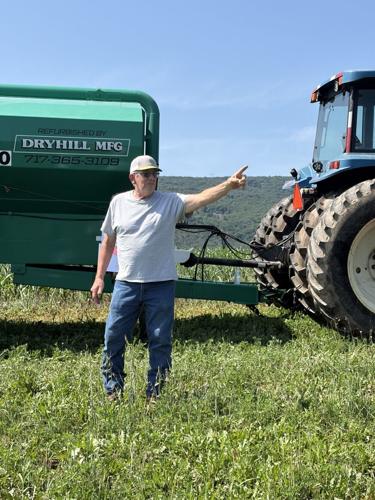
Standing on a 93-acre farm his grandparents bought 100 years ago, Terry Snoddy pointed across the White Deer Valley toward the ridge where PPL Electric Utilities wants to run a new high-voltage transmission line — and toward the two existing rights-of-way he says the utility could use instead.
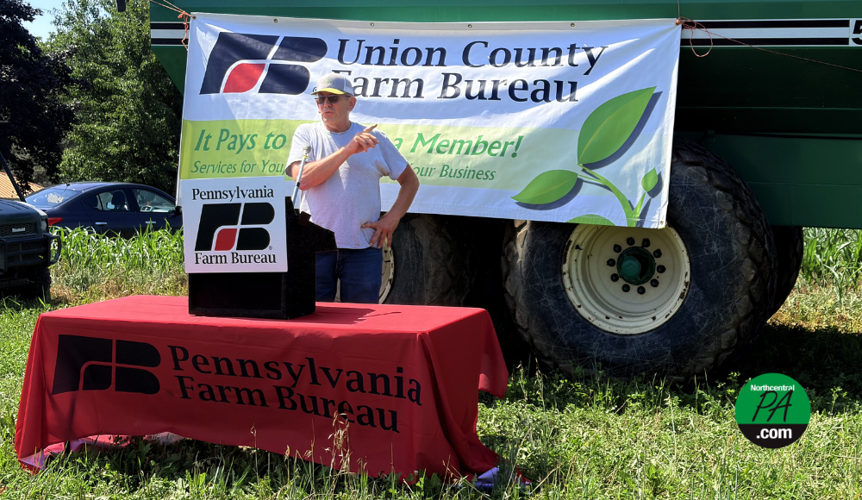
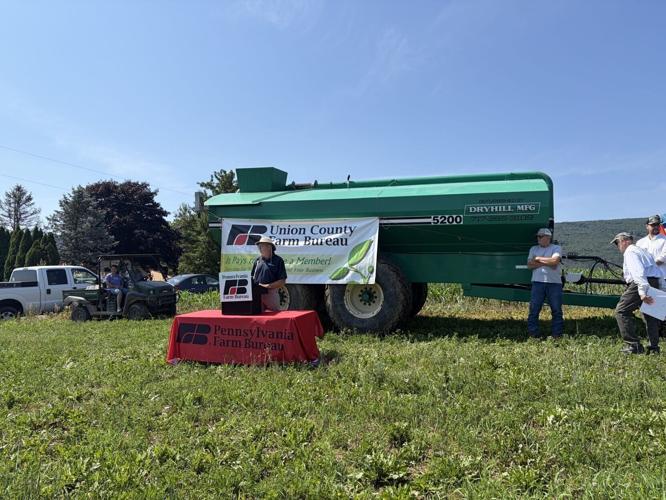
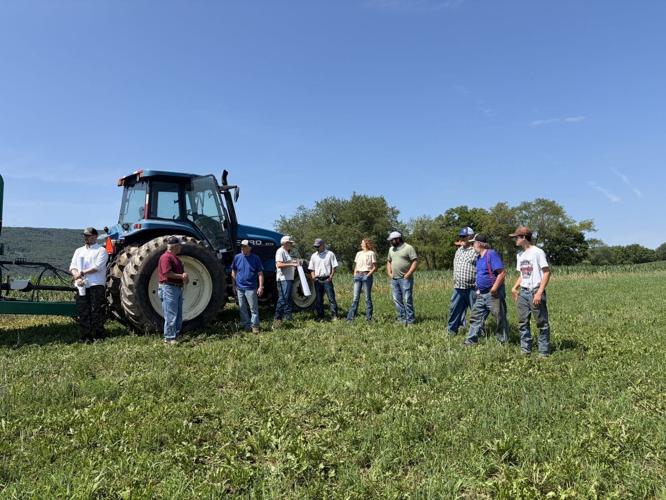
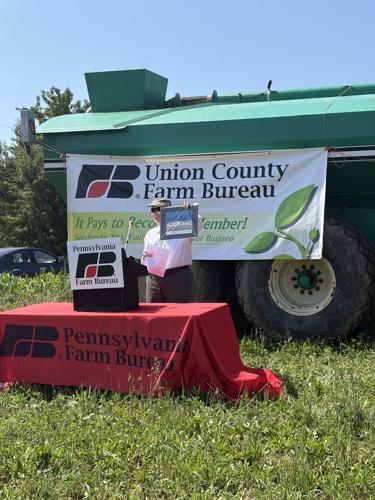
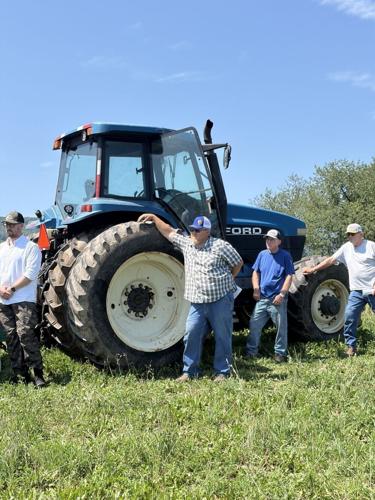
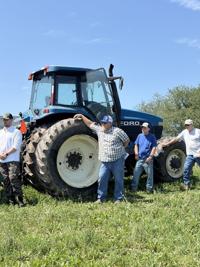
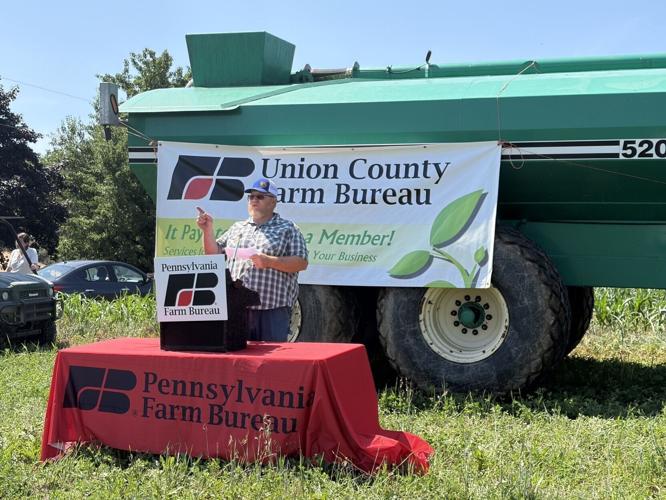
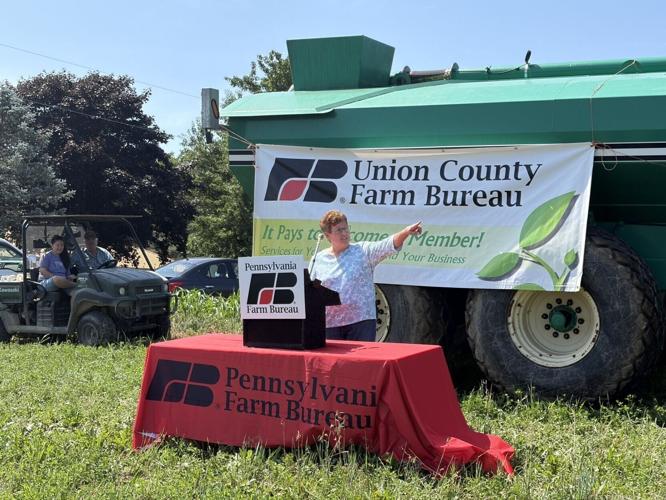
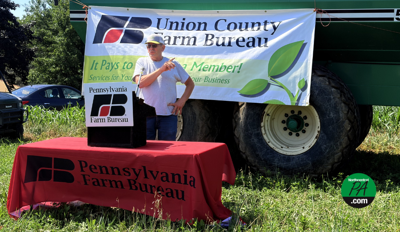
Snoddy was one of six farmers who spoke Monday at a Pennsylvania Farm Bureau press conference on Snoddy's farm, renewing opposition to PPL's proposed 230,000-volt transmission corridor through Gregg and Washington townships. The line would serve a data center complex planned by PNK Group at Great Stream Commons in Allenwood, Union County.

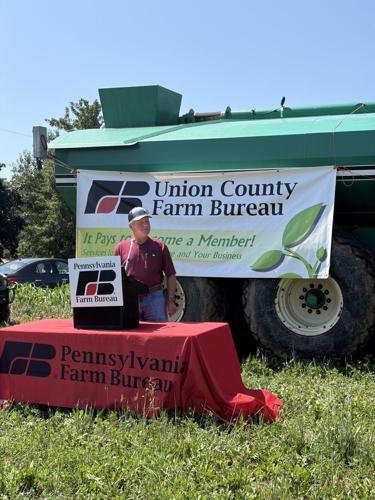
Andy Bater, District 6 Director for the Pennsylvania Farm Bureau, representing Centre, Clinton, and Lycoming counties.
The farmers were joined by Andy Bater, a member of the Pennsylvania Farm Bureau's state board of directors, who used the event to push a separate piece of legislation: an eminent domain reform bill that would require utilities and other condemning authorities to more fully compensate landowners when private property is taken for public use.
"We should not have land taken away from us without due proper work on that," Bater said. "And if it does need to be utilized for the public good, we need to make sure that the process fully compensates farmers for that land, because it has not in the past."
Bater said the bill passed the Pennsylvania Senate unanimously and has advanced through the House, where it is awaiting a floor vote. He asked attendees to contact their state legislators in support. He also said the bill, as currently written, does not address a separate loophole affecting preserved farmland: land enrolled in the state's agricultural preservation program — which restricts what owners themselves can do with the land — is not protected from utility transmission line easements.

"The challenge we have with preserved farmland is that if a utility decides that it needs to run a power line across a farm, that preserved farmland designation does not hold," Bater said. "There needs to be more teeth in the preserved farmland laws in this particular instance."
An 'extension cord,' not a public line, farmers say
Snoddy told attendees that PPL has presented five proposed route segments for the roughly nine-mile corridor, and said the utility has not acknowledged two additional existing rights-of-way — roughly four miles long, he said — that already run partway toward Allenwood along the base of Bald Eagle Ridge, largely across state game lands and federal prison property rather than private farmland.
"If they don't use what they already have and don't go across public ground, it makes a mockery of common sense and logic," Snoddy said.

Snoddy points in the distance toward the game lands where Alvira once existed.
Snoddy said his farm and two neighboring farms — including the Hiller farm — are all enrolled in the state's farmland preservation program, and estimated that preserved farmland exposed to the proposed routes totals roughly 600 acres in Gregg Township alone, a figure he said could exceed 1,000 acres once preserved land in Washington Township, Lycoming County, is included.
Snoddy said the line's impact would go beyond the towers themselves: a 150-foot right-of-way and field access lane would take roughly five acres out of production on his farm, he said, along with soil compaction from construction equipment and a permanent right for PPL to access the property at will. He also noted that deed restrictions tied to farmland preservation already bar him from developing a commercial solar facility on the same land PPL is seeking to cross.

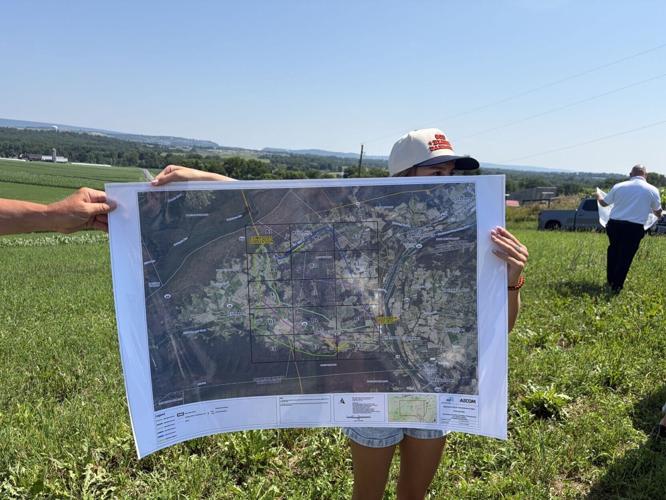
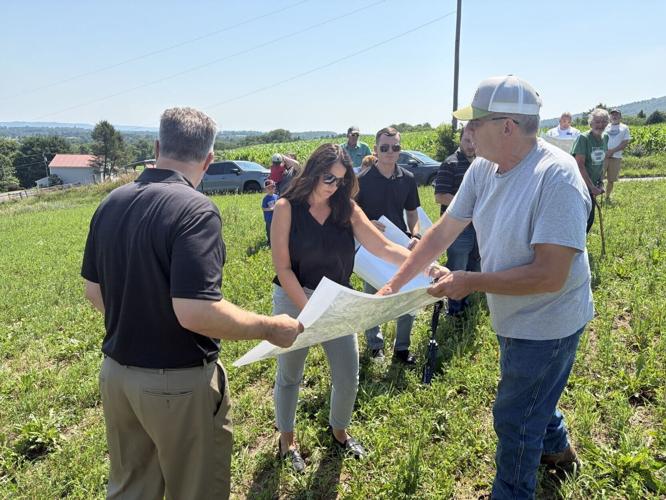
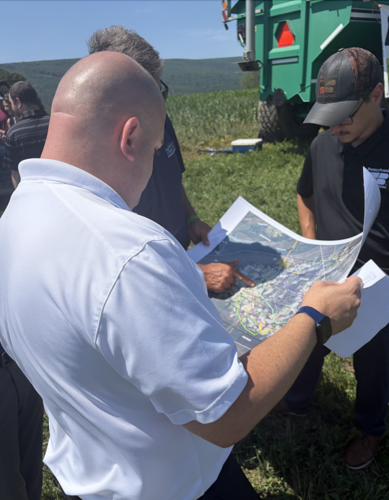
Brynn Fisher of Allenwood holds up a map the segmented land and different proposed routes of the transmission line.
Snoddy said he has a copy of an email from PNK Group, and said the company, along with a PPL representative, acknowledged at a June 3 open house in Montgomery that the line is intended to serve a single customer rather than the broader electric grid. "This is a single-purpose line," Snoddy said, characterizing the correspondence. "It is their personal extension cord. It is not for the public use."

Snoddy pulled a map from a tractor of the meeting, depicting the segments of land where the transmission line may run through.
Snoddy also referenced the history of the surrounding land: roughly 8,000 acres in the valley were taken from private landowners during World War II — a reference to the former village of Alvira, which was seized by eminent domain for a wartime TNT plant.
"For almost 85 years the White Deer Valley has borne the brunt of 'for the public good,'" Snoddy said, arguing the current proposal serves a single private company rather than the public.
The Russian connection
Snoddy and other speakers repeatedly referred to PNK Group as a Russian company, some saying that foreign entities should not benefit off the backs of Americans and their private land.
PNK Group was founded in Saint Petersburg, Russia, in 2004 by Andrey Sharkov, and the Russian entity remains headquartered in Moscow.

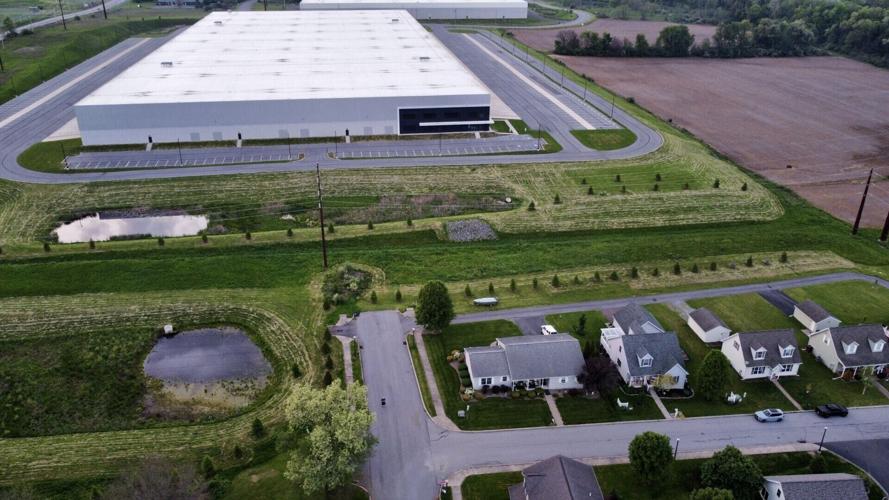
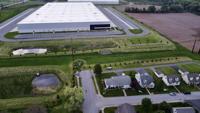
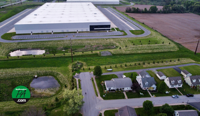
An aerial view of the site of PNK's proposed data center in Gregg Township, Union County.
In 2023, according to a sworn deposition Sharkov gave in an unrelated Georgia case, he formally separated the U.S. and European operations from the Russian company.
An attorney for PNK Group's U.S. arm has said the American company is neither owned nor controlled by the Russian entity, and PNK Group has stated that no current owner, investor, or backer of the company is based in Russia or holds Russian citizenship.
Sharkov, in the same deposition, said he is no longer a Russian citizen but continues to split his time among the U.S., Monaco, and Moscow.

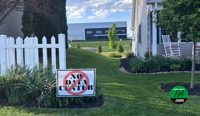
PNK Group has committed to constructing five buildings on the property it purchased. Four could potentially become data centers. Two have been completed, with the next three expected be constructed in the next three years. One of their buildings, neighboring The Eye Center, is leased to ModCorr, a Texas-based company that manufactures modular prisons.
Farmers describe damage, unmet promises from prior PPL projects
Several speakers said existing PPL infrastructure on their land has already caused problems the utility failed to address.

Farmer Todd Hiller of Hiller Lane speaks his views.
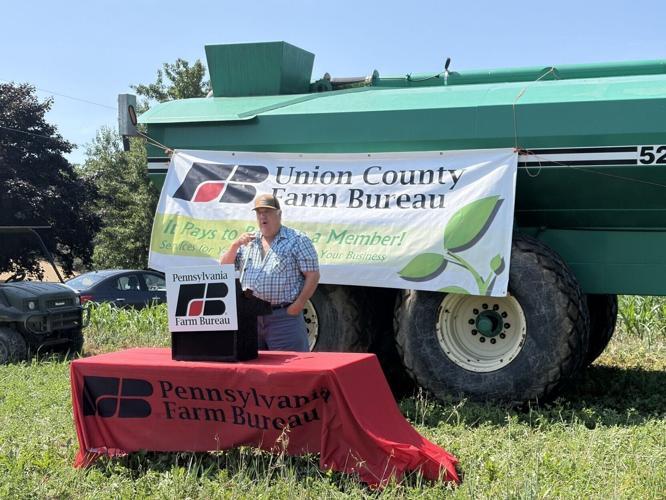
Todd Hiller, who farms in multiple counties, including Northumberland County, said a PPL contractor building a separate transmission line on his Northumberland County farm destroyed roughly five acres of corn during construction in late February and early March, and that construction debris, cut poles, and old foundations remained on the property months later, uncleared. He said the damage prevented him from planting roughly five more acres this year.

Dimarco, vice president of the Pennsylvania Board of Game Commissioners, recounts his experience with PPL's lines through his property.






Like Snoddy, Hiller questioned why PPL would build a new corridor across private farmland rather than use an existing right-of-way across public land nearby.
Allen Dimarco, who said he has dealt with PPL for 52 years, said two existing transmission lines already cross his farm near the event site, combining for roughly 200 feet of right-of-way, and that a separate farm he owns in Washingtonville is also crossed by a power line. He said PPL has not returned his calls seeking updates during past construction, and that he continues to pay property taxes on land the utility uses for its lines while having little control over how it's used.
Dimarco said aerial applicators — airplanes, helicopters, and drones — generally will not spray within 150 feet of transmission lines, which he said would further limit crop treatments on portions of his farm if a new line is added.
Family farms, memorials in the path

Susan Sellard, with her daughter, Susan, seated in the background, speaks of how she wishes to preserve her family's farm for future generations to enjoy.
Janet Sellard, whose family has farmed land in the area for roughly 70 years and enrolled it in the state's farmland preservation program, said she has written to state and federal legislators opposing the project and has heard back from two, including state Rep. Joe Hamm. She also thanked Lycoming County Commissioner Mark Mussina for being at the Monday meeting.

Snoddy shows Commissioner Mark Mussina the map's orientation in relation to his farm.
Sellard said she intends to continue writing letters and offered to share a list of legislator contact information with attendees. Sellard said the proposed route would pass near memorials on her property honoring her father-in-law and, eventually, her father.

Brad Sunaday shows a photo of his farm's famed Lovehill in the winter time.
She said she and her husband, who adopted two children from Kazakhstan, are not opposed to data centers generally but believe the project should not proceed on preserved farmland for the benefit of a single company.
Brad Sunaday, who farms what he calls Lovehill Farm — named for a hillside cross his son placed on the property around 2012 — said two of PPL's proposed routes would run directly over the hillside.
Sunaday said his family has retained a former Pennsylvania Public Utility Commission chief deputy counsel, who has advised them that two of the proposed routes could legally be built across nearby federal prison property and state game lands instead of private farmland. The identity of this legal counsel was not disclosed at the press conference.
A township supervisor caught in the middle
Brett Taylor, a Washington Township supervisor and member of the Lycoming County Planning Commission who farms roughly 1,000 acres in the area with a farming consortium, said nearly all of his farmed land falls within the proposed corridor.

Taylor reads a statement from PNK's website.
Taylor, who was previously quoted on the same concerns, reiterated that a fatal helicopter crash involving power lines several years ago has made aerial applicators unwilling to fly near high-voltage lines, and estimated the resulting loss of fungicide and foliar fertilizer applications could cost his operation $60,000 to $70,000 annually — a recurring loss, he said, not a one-time construction impact.
Taylor said that at a recent meeting with PPL, a company representative denied that an existing wooden-pole line in the area was scheduled to be removed, despite what Taylor said was prior township notice of planned removal. Taylor said landowners along that line received notices days later stating PPL would begin removing it in August.
Taylor also said he learned that the informational meeting where these exchanges occurred was funded by a data center company based in Austin, Texas, rather than by PPL itself.

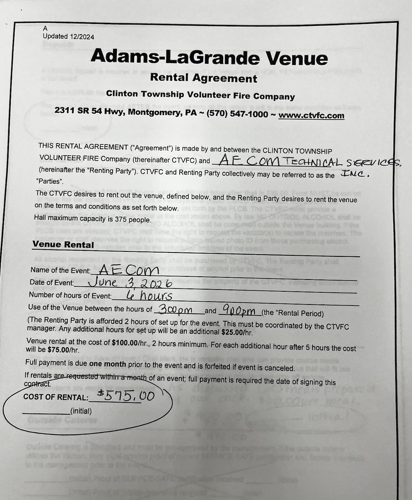
After the meeting, Taylor forwarded a copy of the check that the Clinton Township Volunteer Fire Company, where the info session was held, received from AECom Technical Services for renting the space. AECom has seen recent success from their investments in hyperscale data centers.

Brett Taylor listens to the other farmers' accounts.
Taylor argued that PPL is acting as a contractor for the data center project and is the only entity in the arrangement with eminent domain authority — which he said is why the utility was brought in.
Taylor said the situation has created governance conflicts across multiple local boards: he and fellow Washington Township Supervisor George Ulrich, both of whose farms lie in the proposed corridor, must recuse themselves from related township votes, and solicitors and planning commission volunteers across Washington and Gregg townships and Lycoming and Union counties have similarly had to step back due to potential conflicts of interest. He noted that transmission lines are not subject to local zoning or regulation under Pennsylvania's Municipalities Planning Code, leaving route decisions to the Public Utility Commission.
State Rep. Joe Hamm: 'I'm pro common sense'
State Rep. Joe Hamm attended the press conference and noted the property is not in his legislative district, but said he agreed to get involved after Sellard reached out asking to talk.

State Rep. Joe Hamm views one of the maps for the proposed transmission line's potential routes.
Hamm said he met with several of the farmers the Wednesday before the press conference and plans to keep helping where he can, including potentially facilitating conversations with PPL about alternate routing.
"I'm not pro data center. I'm not anti data center. I'm pro common sense," Hamm said, arguing that data centers belong in industrial parks rather than "in the middle of a farm field" or next to homes.
Hamm said he supports data centers coming to Pennsylvania only if they bring their own power supply rather than drawing on a state grid he said is already facing projected blackouts and brownouts, and only if developers — not ratepayers — cover the cost of any infrastructure the projects require. He also called for data centers to be responsible stewards of the state's water supply.
On the transmission line specifically, Hamm echoed the farmers' account that the project has been described by its developers as benefiting only the data center rather than the broader electric grid. He said affected farmers stand to lose significant annual income from land taken out of production, with no compensation offered by PPL or the data center developer beyond, in his characterization, being told to "live with it."
Congressional candidate weighs in
Congressional candidate Rachel Wallace attended the press conference and provided a statement afterward, saying local residents — not utilities or the data center industry — should have the deciding voice in the project.
"Our farmers should not be shouldering the costs for data centers," Wallace said in the statement. "This is why local control is so important, so residents — not Big Tech, big corporations, or big government — have a say here. I'm grateful to all the farmers who spoke out this morning and I'm proud to stand with them."
Bater closed the event by reiterating the Farm Bureau's two asks: passage of the pending eminent domain reform bill, and future legislative attention to the preserved-farmland loophole for utility easements.

(0) comments
Welcome to the discussion.
Log In
Keep it Clean. Please avoid obscene, vulgar, lewd, racist or sexually-oriented language.
PLEASE TURN OFF YOUR CAPS LOCK.
Don't Threaten. Threats of harming another person will not be tolerated.
Be Truthful. Don't knowingly lie about anyone or anything.
Be Nice. No racism, sexism or any sort of -ism that is degrading to another person.
Be Proactive. Use the 'Report' link on each comment to let us know of abusive posts.
Share with Us. We'd love to hear eyewitness accounts, the history behind an article.