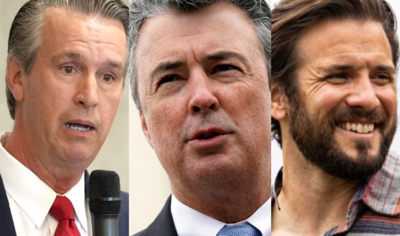

WASHINGTON — As candidates for Alabama’s open U.S. Senate seat race to the May 19 primary finish line, the Republican frontrunners to replace Sen. Tommy Tuberville are working to make themselves stand out in what’s expected to be a close battle.
Six Republicans are vying for the GOP nomination to work alongside Sen. Katie Britt in Washington. Alabama Daily News could not reach GOP candidates Seth Burton, Dale Shelton Deas Jr. or Rodney Walker.
Former Navy Seal Jared Hudson, Attorney General Steve Marshall and Rep. Barry Moore are sharing their perspectives on key issues in the race, including the affordability crisis, the Iran war and Congress’ role in the federal government.
Cost-of-living crisis
Inflation and the high cost of living are the top issues for likely Republican primary voters. Here’s what the Senate hopefuls laid out as their plans to address that.
Jared Hudson
Former Navy SEAL Jared Hudson said the approach to tackling inflation is multi-pronged: confronting health care costs, unleashing American energy, encouraging deregulation and boosting the workforce through education initiatives.
The anti-human trafficking nonprofit CEO blamed subsidizing health care through the Affordable Care Act, or Obamacare, for making coverage unaffordable. Instead, Hudson wants to see executive orders, such as the Most-Favored Nations drug pricing policy, fully implemented. It directs the White House to negotiate deals with pharmaceutical companies to lower prices to align with what other countries pay for the same drugs.
“That’s impacted me personally, with some medical issues that I had from the military that I deal with now, that’s impacted the cost of a certain medication that I need, and it’s lowered it to the same cost that you would pay in Canada or Europe or anywhere else,” Hudson said.
On energy, he emphasized the importance of critical infrastructure projects, such as liquid natural gas systems and investments in the development of nuclear microreactors.
“Making sure that we pull the red tape of government away, or the finger of government off of these businesses so that they can invest (and) they can do all of the work that’s needed,” Hudson said.
The Republican candidate also said the education piece is the final step, ensuring states can focus on educating students “for the good-paying jobs that currently exist, the good-paying jobs of tomorrow, and then also making sure that we educate the workforce that we already have in place.”
Steve Marshall
One part of addressing the accountability crisis is combating “uncontrolled federal spending,” Marshall said.
“When we are $39 trillion in federal (debt), we have to rein in federal spending to be able to allow for us to deal with many of the other issues,” he told ADN.
The attorney said energy policy is “extremely important,” so natural resources can be used “effectively.” He argues that policies that focus on American energy stand in contrast to the Biden Administration’s attacks on the “natural and abundant resources we have in our country that have allowed us for years and years to produce cheap and affordable energy.”
Marshall also highlighted the need to combat soaring housing costs through deregulation.
“We need to make sure that we’re removing the (regulatory) impact of the government (to) allow the market to be able to work effectively, so that we can drive down prices and allow folks to live out that American dream, particularly in being able to own their own home.”
Barry Moore
Moore said tackling “government waste” and getting a handle on fraud will help lower inflation.
“We want to see interest rates come down. We want to see young families be able to afford a house for the first time,” he added.
The congressman also touted the tax breaks included in the Republican-led tax and spending law passed last year.
“I think the Big, Beautiful Bill did some wonderful things. It cut taxes for working-class families,” Moore told ADN. “But if we can get the spending (and) the fraud under control in Washington, D.C., (that will help.)”
Iran war
As the United States’ war against Iran has surpassed 75 days, Congress has rejected numerous Democrat-led attempts to halt the war and get congressional approval for further military action. The Republican candidates said that President Donald Trump is not outside of his authority to take action in Iran right now. A ceasefire has been in place for more than a month.
Hudson
Hudson said the authority to declare war rests with Congress. But argues that lawmakers don’t need to do that now regarding the conflict with Iran because it’s not a “Trump war and an Israel war” but a conflict that’s been “going on for 50 years.”






“We’re not doing any major military actions (now),” Hudson told ADN. “So at this point in time, just blocking the straits, we’ve got to make sure that we keep the strait open for coalition escorts.”
The U.S. focus needs to be on destroying immediate threats, Hudson added.
“Avoid those broad strikes,” the candidate said. “That’s going to be a way that the president can continue to do what he’s doing without probably overstepping that line and getting his feet held to the fire by Congress, and I think that that’s what they’re doing right now.”
Marshall
“I agree with Sen. (Katie) Britt and Sen. (Tommy) Tuberville that (the) president has Article II authority to be able to engage as he’s done, and that there’s no need at this point to be able to come back to Congress for that approval,” he told ADN succinctly.
Both Britt and Tuberville have voted down Democrat-led Iran war powers resolutions aimed at curbing the president’s military operations.
Moore
Moore said he sees the military action in Iran not as a war, but as a conflict.
“I think that right now there seems to be very little military activity since we’ve got strait secured (and) negotiations are ongoing,” he told ADN.
The Senate hopeful added that he trusts Trump’s judgment and that the United States is in a “good spot” when it comes to handling the Middle Eastern nation.
“He took care of Venezuela and Maduro, and he’s done an incredible job. He’s probably the best on foreign policy and diplomacy I’ve ever seen,” Moore said, praising Trump’s handling of foreign nations.
Has Congress ceded too much power to the presidency?
Hudson
The political newcomer said Congress has ceded too much authority to the executive branch. That’s been the case under multiple administrations, not just under Trump, Hudson added.
“The job of a legislative branch… is to make sure that we codify, let’s say, those good executive orders that a president might push during their term, so they don’t end as soon as they leave office, and do away with those bad ones that they push that negatively impact the American people, for us, the people of Alabama,” Hudson told ADN.
He also pointed out that Trump will have just two years left in office after the midterms, so he argued the next senator from Alabama needs to be someone who will “stand on (their) own two feet”, regardless of which administration is in power.
“The only way that you can do that is to take back the authority that was outlined in the beginning by our forefathers,” Hudson said.
Marshall
Marshall said the issue lies more with Congress’ inability to advance legislation rather than ceding authority to the presidency.
“I think my mission in going to the Senate is to truly move the needle in being able to get legislation passed and allow for us to take on the issues of the day,” Marshall told ADN.
He argued that presidents shouldn’t have to rely on executive orders to accomplish their agenda, especially when Republicans control the House, Senate and the White House.
“I think that in many respects is Congress’s fault that the executive branch has done what it’s done because they have not been able to be successful in getting policy positions that are important to the person sitting in the White House accomplished.”
Moore
For Moore, he doesn’t think Congress has ceded too much power. Instead, he thinks the filibuster in the Senate has derailed the Republican agenda.
“We’re not really ceding our power to the executive branch. In many ways, I think we’re ceding it to… senators in the Senate, and they’re Democrats who do not want to do with the will of the American people,” Moore said, referring to the legislative practice that requires 60 votes to end debate in the upper chamber.
The eventual Republican nominee will face one of four Democrats vying for the open Senate seat. The Democratic candidates are Dakarai Larriett, Kyle Sweetser, Everett Wess and Mark Wheeler.

(0) comments
Welcome to the discussion.
Log In
Keep it Clean. Please avoid obscene, vulgar, lewd, racist or sexually-oriented language.
PLEASE TURN OFF YOUR CAPS LOCK.
Don't Threaten. Threats of harming another person will not be tolerated.
Be Truthful. Don't knowingly lie about anyone or anything.
Be Nice. No racism, sexism or any sort of -ism that is degrading to another person.
Be Proactive. Use the 'Report' link on each comment to let us know of abusive posts.
Share with Us. We'd love to hear eyewitness accounts, the history behind an article.