







(Photo by Vitaly Gariev via Unsplash)
Half of Americans are looking to flip their approach to wellness on its head in 2026, according to new research.
A survey of 2,000 U.S. adults, split evenly by generation, looked at whether Americans are taking a simplified approach or leaning more toward “healthmaxxing” — and how this might be changing in 2026.
The research explored how Americans are navigating today's rapidly evolving wellness landscape — revealing a notable shift.
While Americans have more access than ever to health information, products and innovations—such as AI-powered health tools and tech-driven wearables—many are becoming more selective about which trends they embrace.
Among the 51% of Americans looking to change their wellness routines this year, 44% said they are simplifying their approach by focusing on baseline habits such as quality sleep, regular movement, and foundational nutrition—double the amount of respondents (21%) who are pursuing more advanced optimization strategies.
Conducted by Talker Research on behalf of The Vitamin Shoppe for its annual 2026 Health & Wellness Trend Report, the survey revealed this shift is especially pronounced among younger adults.
Gen Z is more than twice as likely as boomers to change their wellness approach this year (65% vs. 31%). And nearly half of Gen Zers (47%) who are changing their routines are prioritizing simpler habits, compared with one-third of baby boomers (33%).
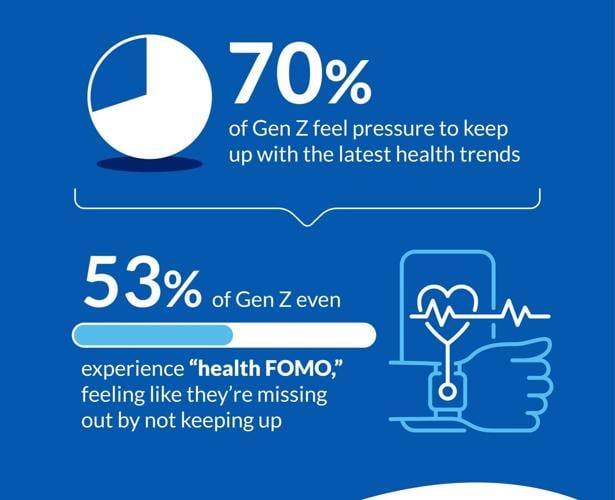
This shift towards simplification isn't necessarily due to younger generations losing interest in wellness. In fact, of all generations, Gen Z is most likely to feel pressure to keep up with the latest health and wellness trends (70%), compared to millennials (60%), Gen X (48%) and boomers (32%).
More than half (54%) of the youngest generation also frequently experiences “health FOMO,” or the feeling that they’re falling behind in their health goals due to not keeping up with the latest trends and tools, more than any other generation.

(Talker Research)






Despite the information overload, half of those polled feel empowered by the ever-increasing amount of health and wellness information, products and technology available today. On the other hand, one-third feel overwhelmed and fatigued by it all.
Notably, men are more likely to feel empowered (59%) than women (46%).
While many respondents are looking to return to core health habits, a majority of Americans also use supplements to support their routines. The survey found 56% of respondents currently take at least one dietary supplement to support their nutritional health and performance.
These priorities are already shaping related purchasing behavior, as outlined in The Vitamin Shoppe’s 2026 Trend Report. The retailer’s data shows increased fiber supplement sales this year, in correlation with TikTok’s popular “fibermaxxing” trend.
Seven in 10 (69%) of survey respondents also said they are actively trying to increase their fiber intake through food, supplements or both.
“Fiber is having a moment because people are realizing that better health doesn't always require a complicated solution,” said Dr. Sarah Jamison, a member of The Vitamin Shoppe Wellness Council. “It's one of the few nutrients that supports multiple aspects of wellness simultaneously, making it a simple, high-impact habit for people looking to improve their overall health.”

(Photo by Kampus Production via Pexels)
Respondents are also paying closer attention to what's inside supplement formulas: More than one-third (37%) said ingredients now matter more than the brand name, while 40% weigh both equally.
Nearly two-thirds (64%) place greater trust in trademarked ingredients than generic alternatives, and almost half (47%) have decided against purchasing a supplement because they felt the label or formula lacked sufficient transparency.
“This year's study reflects the contrasting dynamics of today's consumer, who is increasingly informed and discerning. Innovation still matters, but credibility has become the ultimate differentiator,” said Sharon Leite, CEO of The Vitamin Shoppe. “Consumers are gravitating toward products that combine scientific validation, transparent sourcing, trusted ingredients and seamless integration into everyday life.”
Research methodology:
Talker Research surveyed 2,000 Americans 18+, split evenly by generation (500 Gen Z, 500 millennials, 500 Gen X and 500 baby boomers) who have access to the internet; the survey was commissioned by The Vitamin Shoppe and administered and conducted online by Talker Research between May 26 and June 1. A link to the questionnaire can be found here.
To view the complete methodology as part of AAPOR’s Transparency Initiative, please visit the Talker Research Process and Methodology page.

(0) comments
Welcome to the discussion.
Log In
Keep it Clean. Please avoid obscene, vulgar, lewd, racist or sexually-oriented language.
PLEASE TURN OFF YOUR CAPS LOCK.
Don't Threaten. Threats of harming another person will not be tolerated.
Be Truthful. Don't knowingly lie about anyone or anything.
Be Nice. No racism, sexism or any sort of -ism that is degrading to another person.
Be Proactive. Use the 'Report' link on each comment to let us know of abusive posts.
Share with Us. We'd love to hear eyewitness accounts, the history behind an article.