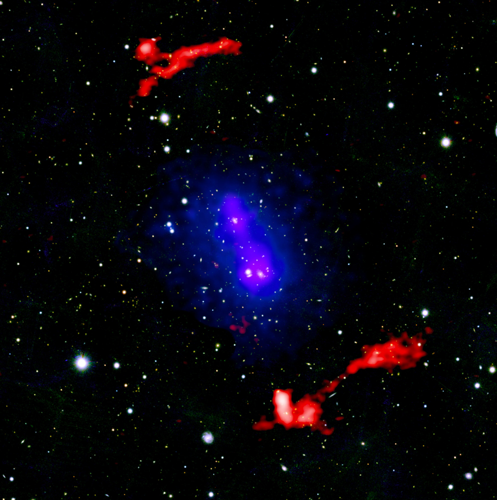
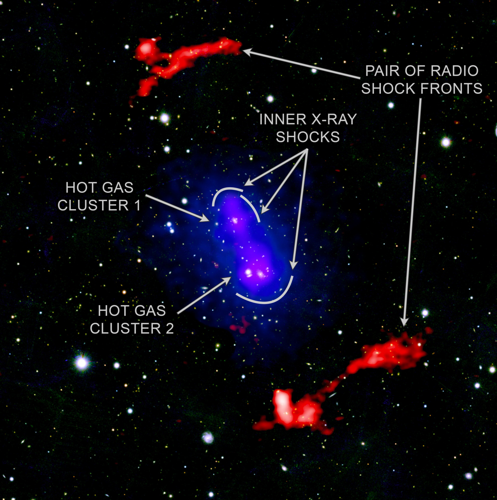

The two galaxy clusters known as PSZ2 G181. (NASA/CXC/CfA/PanSTARRS et al. via SWNS)
By Dean Murray
Space scientists have captured a rare cosmic event: two galaxy clusters have collided and are poised to smash into each other again.
Galaxy clusters are some of the largest structures in the universe, containing hundreds or thousands of individual galaxies, massive amounts of superheated gas, and invisible dark matter.
New observations from NASA’s Chandra X-ray Observatory and other telescopes show that the two galaxy clusters involved in the collision, collectively known as PSZ2 G181 and about 2.8 billion light-years from Earth, collided about a billion years ago.






The event caused structures that researchers say are probably shock fronts — similar to those created by jets that have broken the sound barrier.

(NASA/CXC/CfA/PanSTARRS et al. via SWNS)
Since the collision, the clusters have continued traveling outwards and are currently separated by about 11 million light-years, the largest separation of these kinds of structures that astronomers have ever seen.
NASA explains: "Now, data from NASA’s Chandra and ESA’s XMM-Newton is providing evidence that PSZ2 G181 is poised for another collision. Having a first pass at ramming each other, the two clusters have slowed down and begun heading back toward a second crash."
A paper describing these results appears in a recent issue of The Astrophysical Journal (ApJ) and is led by Andra Stroe from the Center for Astrophysics | Harvard & Smithsonian (CfA) and collaborators. It is part of a series of three papers in ApJ.

(0) comments
Welcome to the discussion.
Log In
Keep it Clean. Please avoid obscene, vulgar, lewd, racist or sexually-oriented language.
PLEASE TURN OFF YOUR CAPS LOCK.
Don't Threaten. Threats of harming another person will not be tolerated.
Be Truthful. Don't knowingly lie about anyone or anything.
Be Nice. No racism, sexism or any sort of -ism that is degrading to another person.
Be Proactive. Use the 'Report' link on each comment to let us know of abusive posts.
Share with Us. We'd love to hear eyewitness accounts, the history behind an article.